
- 著者
- KUBO Tomoko
- 出版者
- The Association of Japanese Geographers
- 雑誌
- Geographical review of Japan series B (ISSN:18834396)
- 巻号頁・発行日
- vol.84, no.1, pp.27-28, 2011 (Released:2011-12-03)
- 参考文献数
- 1

- 著者
- SUGIMOTO Koun
- 出版者
- The Association of Japanese Geographers
- 雑誌
- Geographical review of Japan series B (ISSN:18834396)
- 巻号頁・発行日
- vol.84, no.1, pp.29, 2011 (Released:2011-12-03)
- 著者
- Matteo GISMONDI
- 出版者
- The Association of Japanese Geographers
- 雑誌
- Geographical review of Japan series B (ISSN:18834396)
- 巻号頁・発行日
- vol.83, no.2, pp.79-88, 2011-03-30 (Released:2011-05-26)
- 参考文献数
- 32
- 被引用文献数
- 1 1
Italy is a major tourist attraction for Europeans and the rest of the world's population because of its natural and cultural beauty. The high influx of tourists after the 1950s provoked an uncontrollable urbanization in Italy, which primarily occurred in coastal areas. The region of Liguria, which is located in Northwest Italy, suffered heavily during this period, and the progressive degradation of the landscape has been a topic of discussion in Liguria and the European community for the past few decades. This study employed Geographical Information Systems (GIS) to identify the areas visible from roads that are frequently used by tourists. Visibility analysis has been proposed as a method to help focus rehabilitation processes on the most visible areas. The lack of conservation demonstrates the progressive abandonment of rural areas and suggests that forest fires are degrading the quality of the landscape. Historical and typical cultivation areas, however, have been suggested as targets for initiation of the rehabilitation process. A balance is required between the development of the tourist infrastructure and the preservation of the local identity to allow for economic development while maintaining the natural and historical heritage of the region.

- 著者
- Eranga Hemanthi Ranaweera RANAWEERAGE
- 出版者
- The Association of Japanese Geographers
- 雑誌
- Geographical review of Japan series B (ISSN:18834396)
- 巻号頁・発行日
- vol.83, no.1, pp.77-78, 2010-09-30 (Released:2010-10-10)
- 著者
- LIU Yungang TAN Yuwen NAKAZAWA Takashi
- 出版者
- The Association of Japanese Geographers
- 雑誌
- Geographical review of Japan series B (ISSN:18834396)
- 巻号頁・発行日
- vol.84, no.1, pp.1-15, 2011 (Released:2011-12-03)
- 参考文献数
- 37
- 被引用文献数
- 3 5
In this paper, we describe and analyze the characteristics of the daily activities and living spaces of Japanese expatriates in Guangzhou, China. Our findings are based on data we generated through a survey questionnaire and interviews. As a result of Japanese transnational companies' intense direct investment in China and the personnel rotation systems within the internal labor market, many Japanese citizens have been relocated to Guangzhou. Japanese expatriates in Guangzhou are mainly managers or technical transferees, middle aged, male, and highly educated. On average, most stay in China for several years, and display the characteristics typical of a sojourner. In contemporary Guangzhou, eight Japanese “agglomeration spots” have been created. Japanese expatriates tend to concentrate in specific apartment complexes or residential lots within these agglomerations. They enjoy high-quality ambiance and spacious rooms with various services. The chief criteria employed when selecting their homes include the quality of the property, convenience in terms of traffic, onsite services and amenities, a beautiful environment, and being located within Japanese communities. The everyday lives of Japanese migrants unfold within a limited territory and these expatriates are relatively isolated from the host society. They shop, dine, and receive various services mainly at familiar Japanese-oriented facilities. They tend to live in their own Japanese-style small communities, without interacting with the host society. The abovementioned findings seem to have much in common with the situation of Japanese expatriates in other cities: residential areas are segregated from local citizens, and the self-sufficient living spaces built for them add to their isolation.
- 著者
- TRUONG Quang Hoang
- 出版者
- The Association of Japanese Geographers
- 雑誌
- Geographical review of Japan series B (ISSN:18834396)
- 巻号頁・発行日
- vol.83, no.2, pp.89-102, 2011-03-30 (Released:2011-05-26)
- 参考文献数
- 16
In Vietnam, a legal framework for Community Forest Management (CFM) development has been established since 2003. Although the government has paid increasing attention to development, CFM has yet to show notable signs of progress in this area. This paper aims to understand problems and challenges to CFM development. A field survey was conducted through different methods in which information was cross-checked for credibility. In August of 2009, an interview using visual tools was applied to informants with low education and considerable language barriers for reliable information. The results of this study showed that current laws and regulations of the time had been insufficient in supporting CFM development. These interviews indicate that during the process of implementing forest and forestland allocation policy, there was little effort to build people's awareness of the project or to properly develop the skills of those designated to work in a managerial capacity, and overall participation was limited due to the poor approach employed by policy implementers. Outside actors have less support and poor collaboration with the village community, leading to many villagers with poor knowledge of the laws, regulations and policy. Village regulation was less effective, and many households lost a chance to benefit from community forest. The CFM system did not function well and serious conflicts happened. Moreover, it was found that people's lack of arable land put a large pressure on CFM. The village failed to cover certain costs for the CFM operation as expected. Errors in defining forest boundary will make it difficult to stop severe disputes in the allocated forest. Failure to realize forestry production causes a decrease in people's interest and motivation to CFM.
- 著者
- IIZUKA Ryo
- 出版者
- The Association of Japanese Geographers
- 雑誌
- Geographical review of Japan series B (ISSN:18834396)
- 巻号頁・発行日
- vol.83, no.2, pp.105-106, 2011-03-30 (Released:2011-05-26)

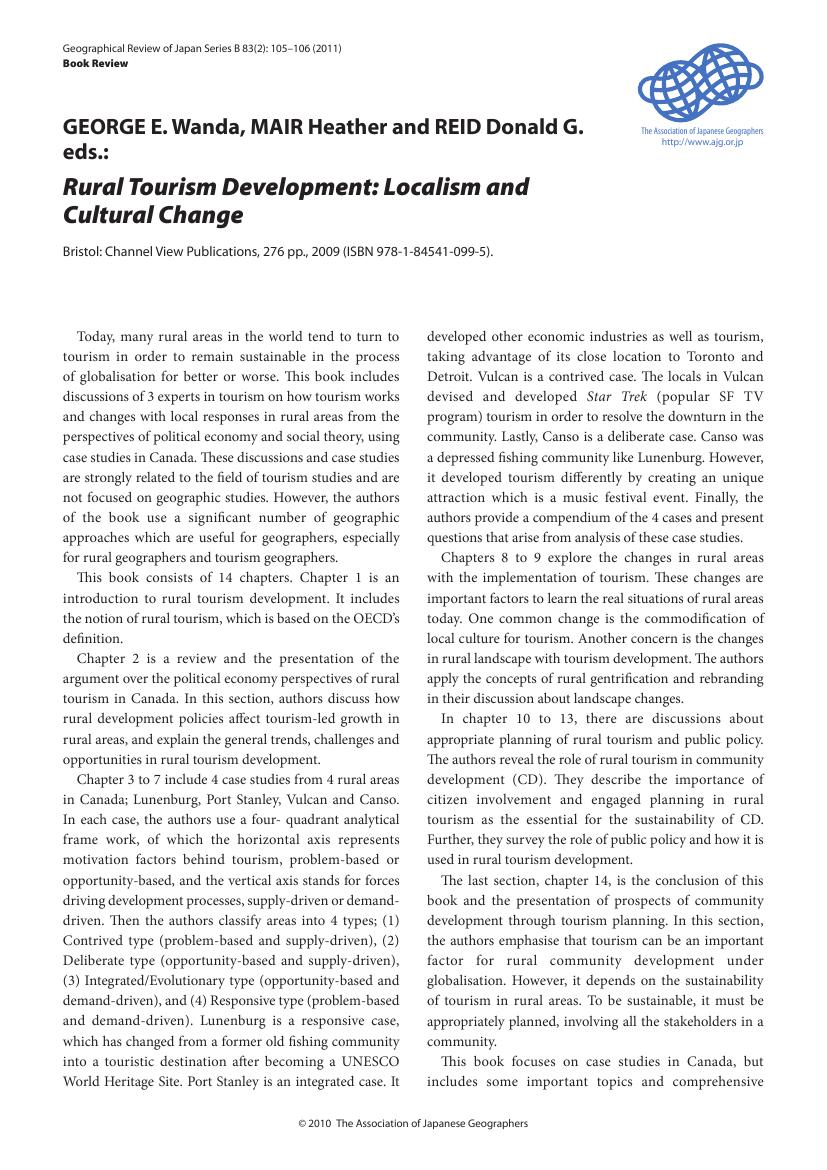
- 著者
- UOI Natsuko
- 出版者
- The Association of Japanese Geographers
- 雑誌
- Geographical review of Japan series B (ISSN:18834396)
- 巻号頁・発行日
- vol.83, no.2, pp.103-104, 2011-03-30 (Released:2011-05-26)
- 著者
- ISHIKAWA Yoshitaka
- 出版者
- The Association of Japanese Geographers
- 雑誌
- Geographical review of Japan series B (ISSN:18834396)
- 巻号頁・発行日
- vol.83, no.1, pp.1-14, 2010-09-30 (Released:2010-10-10)
- 参考文献数
- 55
- 被引用文献数
- 1 2
This paper explores the roles of matchmaking agencies (MAs) in international marriages in contemporary Japan by identifying them from such sources as Yahoo Japan's website, telephone directory, and a website of international marriage agencies. With the selected agencies, in-depth interview surveys were conducted, and the following findings were obtained. Many MAs started matchmaking services due to their own personal experiences with international marriage. For Japanese men, the main motivation for international marriage is the difficulty of finding Japanese women to marry. Regarding the spatial distribution of Japanese clients, there is an obvious distance-decay tendency: the shorter the distance from a particular MA office, the more clients. MAs provide various kinds of advice about preparing documents to help foreign wives of Japanese clients acquire spouse visas. Although many MAs are conscientious, they are wary of unscrupulous agencies. Furthermore, based on interviews with immigration officials, at least one-third of all international marriages registered in Japan are agency-based marriages. These results suggest that the significance of MAs needs to be favorably evaluated in the context of Japan's current population, which started to decline in 2005. Foreign brides as new residents might obtain permanent residence status in Japan and should be supported by national and local governments.
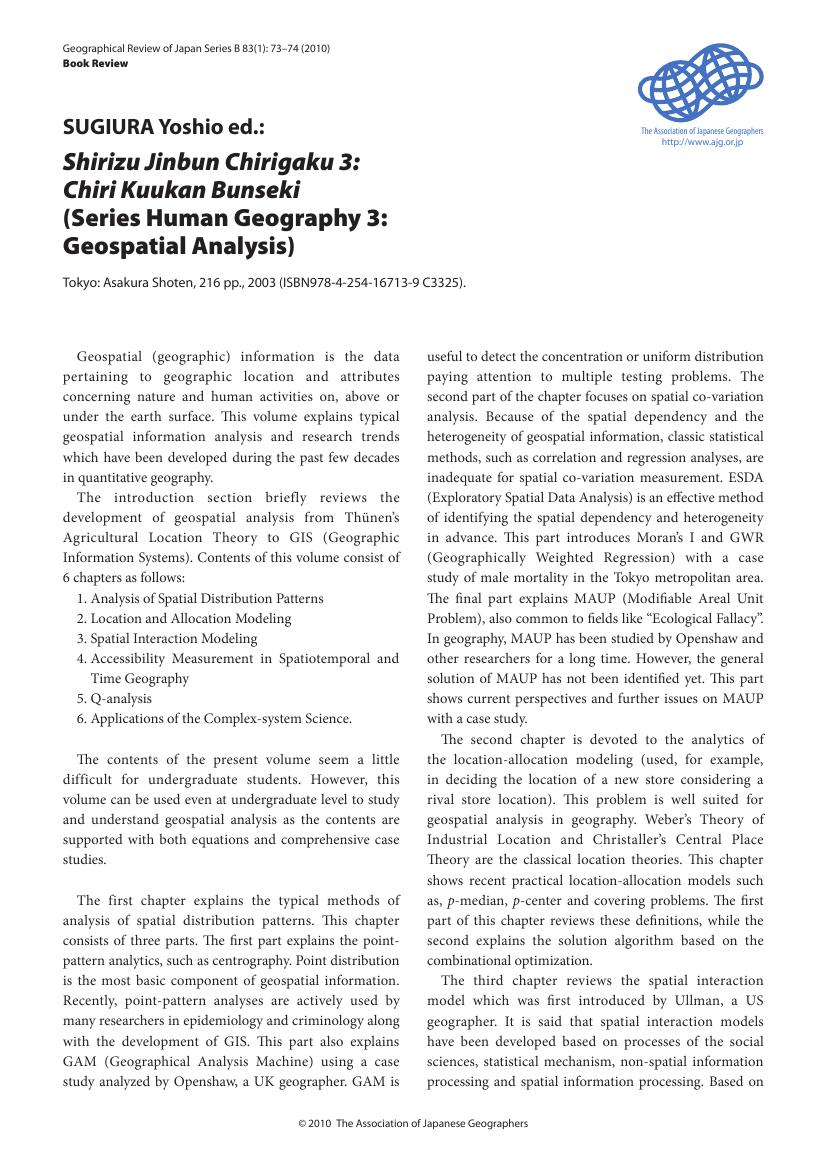
- 著者
- SAITO Hitoshi
- 出版者
- The Association of Japanese Geographers
- 雑誌
- Geographical review of Japan series B (ISSN:18834396)
- 巻号頁・発行日
- vol.83, no.1, pp.73-74, 2010-09-30 (Released:2010-10-10)

- 著者
- HAYASHI Takuya
- 出版者
- The Association of Japanese Geographers
- 雑誌
- Geographical review of Japan series B (ISSN:18834396)
- 巻号頁・発行日
- vol.83, no.1, pp.75-76, 2010-09-30 (Released:2010-10-10)
- 参考文献数
- 5
- 著者
- PARK Sookyung
- 出版者
- The Association of Japanese Geographers
- 雑誌
- Geographical review of Japan series B (ISSN:18834396)
- 巻号頁・発行日
- vol.83, no.1, pp.32-46, 2010-09-30 (Released:2010-10-10)
- 参考文献数
- 32
- 被引用文献数
- 1 2
Assessments of telemedicine from a geographical perspective have generated a variety of opinions with regard to its distribution and optimal spatial organization. Such discussions are associated with the fundamental question of health care, in other words, the balance between equity and efficiency in health care services. Accordingly, these discussions are concerned with the extent to how telemedicine can complement insufficient medical services (equity) and how telemedicine plays a role in making a profit for patients or medical institutions (efficiency). Within such contexts, it is stipulated that telemedicine in Korea and Japan aims to promote regional health care and has emerged on basis for each diagnostic area controlled at a tertiary-care level. In spite of its significance and the rise of informatization in health care, few have attempted to address telemedicine in geography. Therefore, this paper presents arguments on the geographical characteristics related to two aspects of telemedicine—distribution and network—in Korea and Japan and explores each telemedicine operation through two cases. For the most part, the medical institutions involved with telemedicine in Korea are distributed in Kyunggi (the central part of Korea as the metropolitan area). As for Japanese telemedicine, the medical institutions supplying and receiving telemedicine are mainly located in the northern and southern parts of Japan, but not in metropolitan areas. Regarding telemedicine networks, the nationwide medical institutions receiving telemedicine are considerably involved with the medical institutions providing telemedicine in Kyunggi. Contrary to the Korean case, the Japanese telemedicine networks are based in each diagnostic area and are controlled at a tertiary care level. Moreover, some of the outlying Japanese telemedicine networks lack strong referral relationships with metropolitan areas, unlike those in Korea. Therefore, it is not an oversimplification to say that the geographic characteristics of telemedicine in Korea and Japan can be summarized as “centralized” and “decentralized,” respectively. The differences in their traditional health care systems and development processes and the distinctions regarding how telemedicine is used as well as the knowledge of patients and medical workers all have a significant effect on such geographical characteristics. Accordingly, the geographical phenomena of telemedicine are influenced not only by technological aspects but also social and medical circumstances.
- 著者
- YAGASAKI Noritaka FUKASE Kozo
- 出版者
- The Association of Japanese Geographers
- 雑誌
- Geographical review of Japan series B (ISSN:18834396)
- 巻号頁・発行日
- vol.83, no.1, pp.15-31, 2010-09-30 (Released:2010-10-10)
- 参考文献数
- 39
- 被引用文献数
- 2 2
The Los Angeles Metropolitan Area is typified by such geographic features as rapid urbanization, a high population concentration, dynamic industrial development, and ethnic-cultural diversity. It is also the home of many Japanese nationals and Japanese Americans, who have participated in the growth of the metropolis and have contributed to the formation of its regional character. With respect to the areas known as Gardena and Torrance, which are characterized by urban sprawl, the existence of a large Japanese population, and Japanese engagement in farming, land use changes were examined from the beginning of the twentieth century through to approximately 2007. The Japanese began cultivating strawberries in Gardena by initially leasing small tracts of farmland without competing with local Caucasian farmers who specialized in other crops. Strawberries therefore existed as a niche crop for Japanese immigrants up until the end of the 1910s. Due to the fact that Japanese farmers were successful at cultivating vegetables up to the outbreak of the Japan-US war, the kinds of farming practiced therefore underwent diversification. Following the end of the war, vegetable production declined, however, whereas the nursery and gardening industries prospered in response to increasing urban development. At the same time, the Japanese population rose dramatically in Gardena due to the suburbanization of the Japanese population. Following the 1980s, the number of nurseries began to decline; yet, direct investment by the Japanese increased, leading to changes to both the local Japanese economy and the communities of Gardena and Torrance. The process by which these changes occurred was documented and the consequent pattern of land use was analyzed using aerial photographs and field observations. At present, Japanese farming can only be found in small scattered nurseries including those located beneath high voltage power transmission lines and at the site of the Torrance Municipal Airport. The Japanese farming landscape that survives today is clearly a leftover from a successful past, whereas more recent Japanese involvement has provided a new distinctiveness to the Gardena and Torrance areas.
- 著者
- YOSHIDA Hidetsugu SUGAI Toshihiko
- 出版者
- The Association of Japanese Geographers
- 雑誌
- Geographical review of Japan series B (ISSN:18834396)
- 巻号頁・発行日
- vol.83, no.1, pp.64-72, 2010-09-30 (Released:2010-10-10)
- 参考文献数
- 20
- 被引用文献数
- 3 4
Debris avalanche hummocks are created by catastrophic volcanic sector collapses. The paucity of quantitative data on their orientation relative to the debris avalanche direction has caused conflicting views among researchers. We evaluated hummock orientation in the Zenkoji debris avalanche deposits at Usu volcano, Japan. Our results show that hummocks within the upper part of the main depositional area, the axial band leading directly from the source to the central extremity of the debris avalanche deposits, tend to be aligned perpendicular to the presumed flow direction. However, hummock alignment varied systematically along the longitudinal path. Although hummocks close to the source were oriented perpendicular to the flow direction, we noted a gradual transition to a parallel orientation with increasing distance from the source. At the same time, hummocks had arisen on compression-dominated features of the debris avalanche surfaces in the marginal areas. These observations are consistent with the following scenario of the debris avalanche movement. To begin with, the origin is explainable for some large-scale hummocks near the source as below. At the moment of collapse, a small number of normal faults develop perpendicular to the landsliding direction, generating a series of ridges and grabens. Then, the alignment of the other hummocks was given rise to by an extensional regime as the runout distance increased and the lateral constraints on the erosional path near the volcano disappeared. As the longitudinal velocity increased further with respect to lateral velocity, hummocks became more strongly aligned at such distances from the proximal area. On the other hand, more-scattered orientations of hummocks have been observed in the marginal areas. This is probably because they were originated from the sediments pushed out of the main flow instead of being transported by the most direct way from the source.
1 0 0 0 OA The Relationship between Urban Surface Indices and Heat Islands in High and Low Building Areas
- 著者
- SAKAKIBARA Yasushi NARITA Goshin
- 出版者
- The Association of Japanese Geographers
- 雑誌
- Geographical review of Japan series B (ISSN:18834396)
- 巻号頁・発行日
- vol.82, no.2, pp.196-204, 2010-03-30 (Released:2010-05-20)
- 参考文献数
- 16
- 被引用文献数
- 1 3
During 2003, temperature distributions were observed 69 times in two types of residential areas in Imaihara, Nagano Prefecture, Japan. Both high and low building areas were warmer than the rural area at night. But a cool island appeared only in the high building area in the daytime. The maximum nocturnal heat island intensity occurred not at a calm condition but at the wind speed of about 1 m/s. In addition the wind speed in which the maximum heat island occurred in the high building area was larger than that in the low building area. The urban surface indices of the high and low building areas showed only small differences in the sky view factor and building/ land ratio but large differences in the floor-area ratio. Floor area ratio related to heat island formation in this area.
- 著者
- SAKAGAMI Nobuo
- 出版者
- The Association of Japanese Geographers
- 雑誌
- Geographical review of Japan series B (ISSN:18834396)
- 巻号頁・発行日
- vol.82, no.2, pp.184-195, 2010-03-30 (Released:2010-05-20)
- 参考文献数
- 21
- 被引用文献数
- 2 3
Cenococcum geophilum Fr. is one of the most frequently encountered mycorrhizal fungi in nature. It reveals tolerance to low pH and forms abundant number of sclerotia. In this study, distribution of sclerotia of C. geophilum was investigated in a single stand forest of Picea abies, Harz mountains, Germany to analyze their forming factors. Surface soil samples were collected to examine density of sclerotia based on weight and count of grains, soil pH(H2O, KCl), content of exchangeable aluminum, total carbon and nitrogen, and humification degree based on melanic index and Pg index. Elemental composition of sclerotia was examined by SEM-EDS analysis. 14C age of sclerotia was determined by AMS measurement. The averages of sclerotia density by weight and counts throughout all points were 0.54 mg g−1 and 1.3 count g−1, respectively. The distributional correspondence of sclerotia to micro-topography was not clear and demonstrated the formation of sclerotia as a nearly constant phenomenon in the investigated forest soil. However, a large amount of sclerotia tended to distribute in soils with scarce floor vegetation. Content of exchangeable aluminum in soil was an effective factor on accelerating formation of large sclerotia and Al and Fe content in sclerotia were likely to increase in lower pH soils. The existence of sclerotia in forest soil may stand as an indicator of soil chemical properties such as strong acidity and high Al3+ content.
- 著者
- MEGURO Ushio
- 出版者
- The Association of Japanese Geographers
- 雑誌
- Geographical review of Japan series B (ISSN:18834396)
- 巻号頁・発行日
- vol.82, no.2, pp.167-183, 2010-03-30 (Released:2010-05-20)
- 参考文献数
- 24
- 被引用文献数
- 2
This paper aims to clarify a unique phase in the job-searching process of Japanese-Indonesians residing in Oarai, Ibaraki, Japan. Social network analyses are employed to explain their job-changing strategies, and the social capital theory is applied to interpret members' roles. This paper focuses on Japanese-Minahasan workers from North Sulawesi, Indonesia, who have recently become a dominant group of foreign residents in Oarai. After settling in Japan, Japanese-Minahasans—many of whom are descendants of fishermen from Okinawa and of Japanese soldiers who went over to the northern part of Sulawesi Island before and during World War II—often try to change their jobs from the fishery industry to electric machinery etc., seeking higher wages. Social capital theories revealed that two patterns of social network were influential in their job-changes: networks with undocumented workers who have useful job information in Japan, and those with the heads of their household who themselves remain in Oarai and would give family members helpful advice, and places to return. In the job-searching strategies, Oarai serves as a “bastion” for their spatial expansion. This diffusion of Japanese-Minahasans throughout Japan represents a combination of the mutual support system and market-oriented migration system, which is unique and unprecedented in migration system studies in Japan.

- 著者
- YABE Naoto
- 出版者
- The Association of Japanese Geographers
- 雑誌
- Geographical review of Japan series B (ISSN:18834396)
- 巻号頁・発行日
- vol.82, no.2, pp.207-208, 2010-03-30 (Released:2010-05-20)

- 著者
- NAKAMURA Akifumi
- 出版者
- The Association of Japanese Geographers
- 雑誌
- Geographical review of Japan series B (ISSN:18834396)
- 巻号頁・発行日
- vol.82, no.2, pp.205-206, 2010-03-30 (Released:2010-05-20)
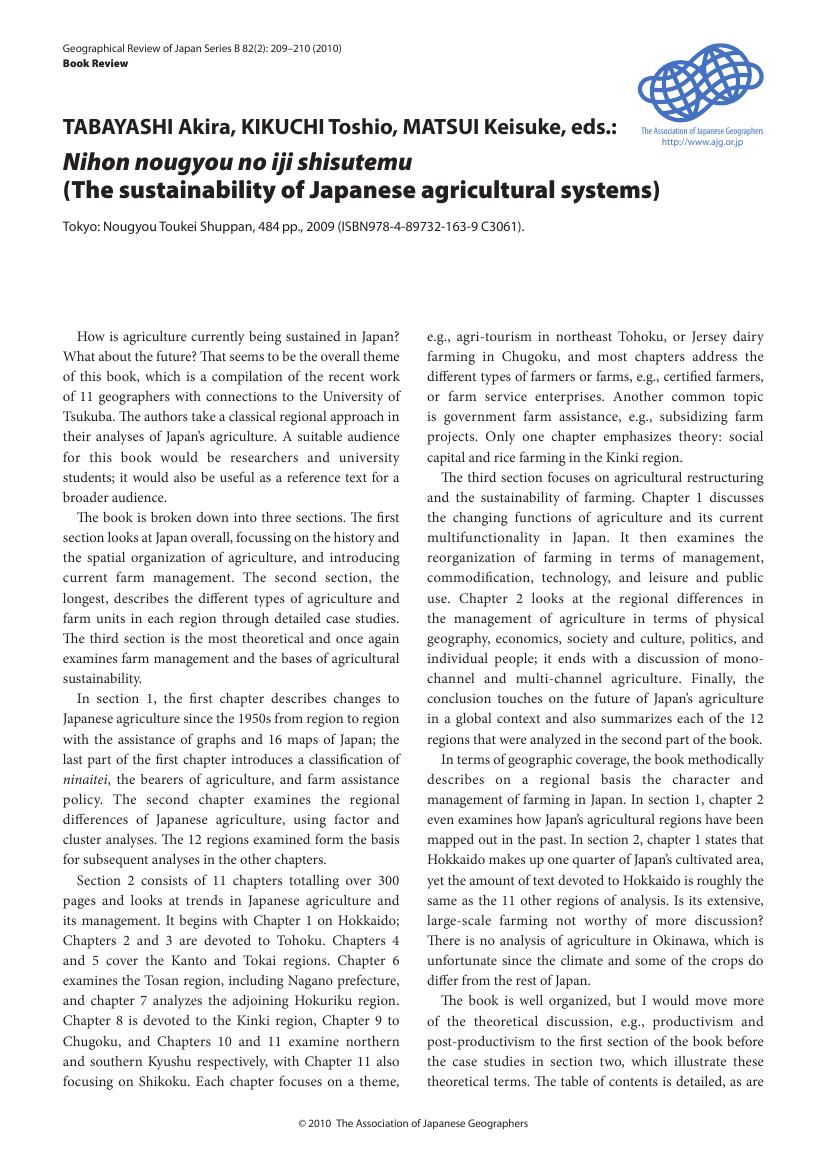
- 著者
- Tom Waldichuk
- 出版者
- The Association of Japanese Geographers
- 雑誌
- Geographical review of Japan series B (ISSN:18834396)
- 巻号頁・発行日
- vol.82, no.2, pp.209-210, 2010-03-30 (Released:2010-05-20)