1 0 0 0 OA Takeshi Amemiya, ADVANCED ECONOMETRICS Cambridge: Harvard University Press, 1985, pp. 521, $39.50

- 著者
- 森棟 公夫
- 出版者
- JAPANESE ECONOMIC ASSOCIATION
- 雑誌
- The Economic Studies Quarterly (ISSN:0557109X)
- 巻号頁・発行日
- vol.38, no.3, pp.283-285, 1987-09-30 (Released:2008-02-28)
- 参考文献数
- 2
1 0 0 0 OA THE IMPACT OF THE OPENING OF THE PORTS ON DOMESTIC JAPANESE INDUSTRY: THE CASE OF SILK AND COTTON

- 著者
- SHINYA SUGIYAMA
- 出版者
- JAPANESE ECONOMIC ASSOCIATION
- 雑誌
- The Economic Studies Quarterly (ISSN:0557109X)
- 巻号頁・発行日
- vol.38, no.4, pp.338-353, 1987-12-20 (Released:2008-02-28)
- 参考文献数
- 29
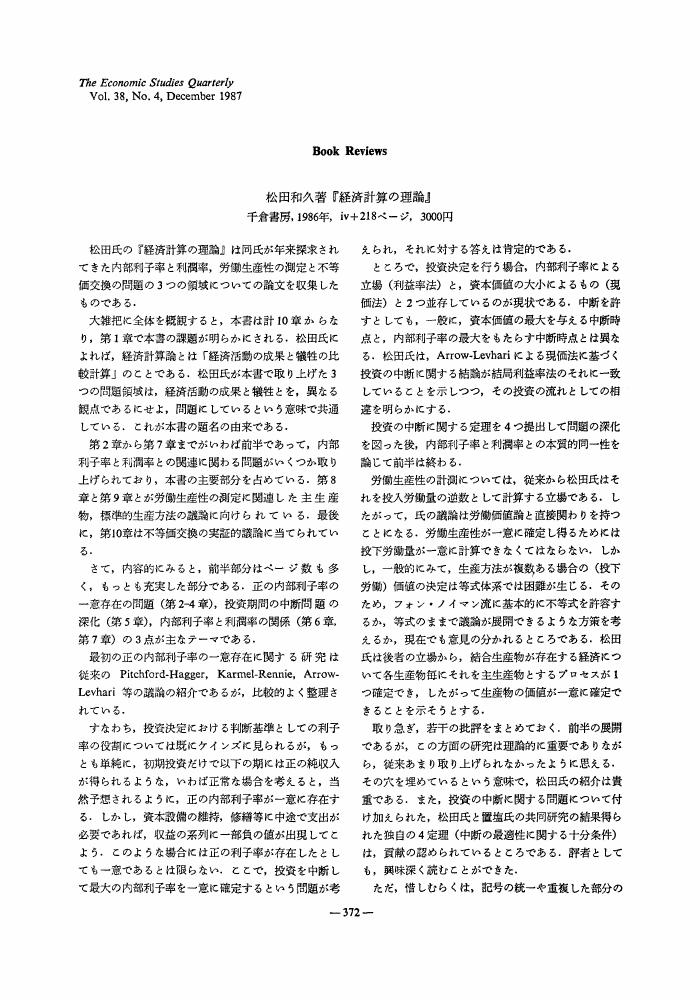
1 0 0 0 OA 松田和久著「経済計算の理論」千倉書房,1986年,iv+218ページ,3000円
- 著者
- 藤森 頼明
- 出版者
- 日本経済学会
- 雑誌
- The Economic Studies Quarterly (ISSN:0557109X)
- 巻号頁・発行日
- vol.38, no.4, pp.372-373, 1987-12-20 (Released:2008-02-28)

- 著者
- JUN TSUKAMOTO
- 出版者
- JAPANESE ECONOMIC ASSOCIATION
- 雑誌
- The Economic Studies Quarterly (ISSN:0557109X)
- 巻号頁・発行日
- vol.38, no.3, pp.258-263, 1987-09-30 (Released:2008-02-28)
- 参考文献数
- 12
1 0 0 0 OA 銀行•顧客関係と企業成長
- 著者
- 今 喜典
- 出版者
- 日本経済学会
- 雑誌
- The Economic Studies Quarterly (ISSN:0557109X)
- 巻号頁・発行日
- vol.38, no.3, pp.223-233, 1987-09-30 (Released:2008-02-28)
- 参考文献数
- 17
This paper examines the effects of the bank-customer relationship in a corporate growth model with imperfect capital market. Repeated transactions under the customer relationship in the bank loan market are mainly caused by the efficient use of the information accumulated during their past transactions when the bank evaluates the firm's credit worthiness. Advantages from this inside information, however, would be deminishing as this firm grows since the corporate growth itself reveals publicly the credit worthiness of the firm.Introducing these two factors into a corporate growth model, and formulating the bank-customer relationship as a long term contract, we determine endogenously the length of the contract, the corporate growth rate, and the interest rate under the contract. Our main conclusions are that, compared with the non-repeated transactions, (1) the loan interest rate is lower under the customer relationship, and (2) the corporate growth rate decrease (increase) under the customer relationship if the firm size is large (small) at the beginning of the contract.
1 0 0 0 OA 中間目標政策と金融構造
- 著者
- 北川 雅章
- 出版者
- 日本経済学会
- 雑誌
- The Economic Studies Quarterly (ISSN:0557109X)
- 巻号頁・発行日
- vol.38, no.3, pp.234-244, 1987-09-30 (Released:2008-02-28)
- 参考文献数
- 9
This paper puts an important strand to the discussion on the intermediate target policy for income stabilization. We explicitly introduce distinction between money supply (MS) and high-poweredmoney (HPM), a la Horiuchi (1980).MS is used as an intermediate target variable, which implies the level of fund available in the financial market is fixed. In such a case, any real disturbance affects the equilibrium condition of the financial market, because amount of loans cannot respond to the borrower's demand. If, on the other hand, HPM is used, the equilibrium condition of the financial market is independent from the real disturbance.Horiuchi proposes to use HPM as an intermediate target variable if the IS disturbance is dominant. However, we revise his conclusion, because MS rule adds another stabilizing effect through interest change due to LM shift. Our conclusion is derived by making an explicit role of lenders and borrowers in the financial market, a la Modigliani and Papademos (1980), which was not explained in Horiuchi.
1 0 0 0 OA 失業と雇用保険制度
- 著者
- 大竹 文雄
- 出版者
- 日本経済学会
- 雑誌
- The Economic Studies Quarterly (ISSN:0557109X)
- 巻号頁・発行日
- vol.38, no.3, pp.245-257, 1987-09-30 (Released:2008-02-28)
- 参考文献数
- 17
It is often asserted that the introduction of the new Employment Insurance System (EIS) in 1975 was the main cause of the notable increase in the rate of unemployment after the first oil shock in Japan. In this paper we analyze the causal relationship between the revision of the EIS and unemploy ment behavior by using gross flow data of labor force insured by the old and new insurance schemes. We find that the global effect of the revision on the unemployment rate is relatively small, as compared with the effect of sectoral shifts and the aging of the labor force.

- 著者
- MAKOTO OHTA
- 出版者
- JAPANESE ECONOMIC ASSOCIATION
- 雑誌
- The Economic Studies Quarterly (ISSN:0557109X)
- 巻号頁・発行日
- vol.38, no.3, pp.264-274, 1987-09-30 (Released:2008-02-28)
- 参考文献数
- 10

- 著者
- 辻村 和佑
- 出版者
- 日本経済学会
- 雑誌
- The Economic Studies Quarterly (ISSN:0557109X)
- 巻号頁・発行日
- vol.38, no.3, pp.280-281, 1987-09-30 (Released:2008-02-28)
1 0 0 0 OA 宮尾尊弘著「現代都市経済学」日本評論社,1985年,xiv+228ページ,2800円

- 著者
- 岸本 哲也
- 出版者
- 日本経済学会
- 雑誌
- The Economic Studies Quarterly (ISSN:0557109X)
- 巻号頁・発行日
- vol.38, no.3, pp.279-280, 1987-09-30 (Released:2008-02-28)

- 著者
- 金子 隆
- 出版者
- 日本経済学会
- 雑誌
- The Economic Studies Quarterly (ISSN:0557109X)
- 巻号頁・発行日
- vol.38, no.3, pp.276-278, 1987-09-30 (Released:2008-02-28)
1 0 0 0 OA 丸山義浩著「企業•家計複合体の理論」創文社,1984年,vi+218ページ,3500円

- 著者
- 小尾 恵一郎
- 出版者
- 日本経済学会
- 雑誌
- The Economic Studies Quarterly (ISSN:0557109X)
- 巻号頁・発行日
- vol.38, no.3, pp.275-276, 1987-09-30 (Released:2008-02-28)
1 0 0 0 OA 予想貨幣賃金率と投資決定 ケインズ投資モデルの再考
- 著者
- 鷲田 豊明 置塩 信雄
- 出版者
- 日本経済学会
- 雑誌
- The Economic Studies Quarterly (ISSN:0557109X)
- 巻号頁・発行日
- vol.38, no.3, pp.212-222, 1987-09-30 (Released:2008-02-28)
- 参考文献数
- 14
Contrary to the static theories of investment, Keynes stated in the General Theory that the reduction of expected money-wage-rates in the future would reduce the investment in quantity. This assertion, however, cannot be supported by the Neo-classical theories such as Jorgenson models or adjustment models of investment. We construct his model described in the General Theory. The main character is that the models have the capital equipment with finite operating periods. Certainly, his models support the assertion in the simplest case. Moreover, we can see that more generalized models do not necessarily support them.
1 0 0 0 OA HIGHER DIMENSIONAL ISSUES IN THE RYBCZYNSKI THEOREM WITH NONTRADED GOODS AND INTERINDUSTRY FLOWS

- 著者
- SHIGEMI YABUUCHI SUMIO KAKIMOTO
- 出版者
- JAPANESE ECONOMIC ASSOCIATION
- 雑誌
- The Economic Studies Quarterly (ISSN:0557109X)
- 巻号頁・発行日
- vol.38, no.3, pp.193-198, 1987-09-30 (Released:2008-02-28)
- 参考文献数
- 13
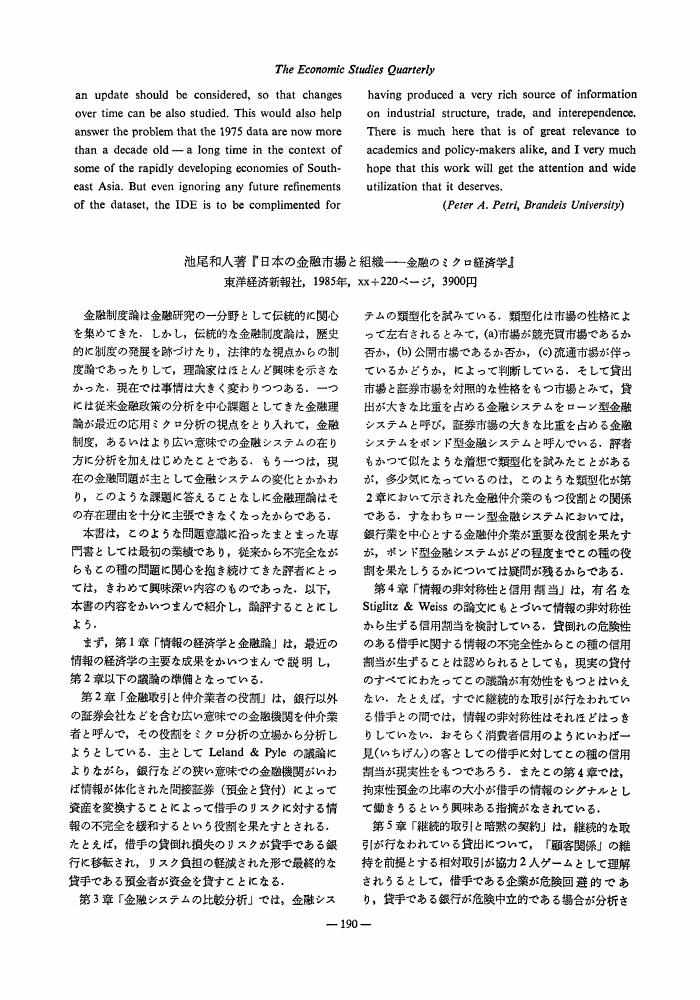
- 著者
- 貝塚 啓明
- 出版者
- 日本経済学会
- 雑誌
- The Economic Studies Quarterly (ISSN:0557109X)
- 巻号頁・発行日
- vol.38, no.2, pp.190-191, 1987-06-20 (Released:2008-02-28)

- 著者
- Peter A. Petri
- 出版者
- JAPANESE ECONOMIC ASSOCIATION
- 雑誌
- The Economic Studies Quarterly (ISSN:0557109X)
- 巻号頁・発行日
- vol.38, no.2, pp.188-190, 1987-06-20 (Released:2008-02-28)
1 0 0 0 OA ON HAUSMAN'S SPECIFICATION TEST

- 著者
- YUZO HONDA
- 出版者
- JAPANESE ECONOMIC ASSOCIATION
- 雑誌
- The Economic Studies Quarterly (ISSN:0557109X)
- 巻号頁・発行日
- vol.38, no.2, pp.172-183, 1987-06-20 (Released:2008-02-28)
- 参考文献数
- 29
1 0 0 0 OA マクロ分配理論の動学的分析 パシネッティ•パラドックスをめぐって
- 著者
- 鳥居 昭夫
- 出版者
- 日本経済学会
- 雑誌
- The Economic Studies Quarterly (ISSN:0557109X)
- 巻号頁・発行日
- vol.38, no.3, pp.199-211, 1987-09-30 (Released:2008-02-28)
- 参考文献数
- 9
Samuelson-Modigliani developed the dual theorem by applying the neoclassical growth model. We should now ask whether the dual theorem is intrinsic to the macro growth theory or it depends on the neoclassical growth model. This paper examines the dual theorem rather in the Keynesian world. Our model assumes an independent Robinsonian investment function and the KeynesWicksell adjustment process. Our main result is: if the adjustment speed of the product price is faster than that of money wage rates, then the dual theorem does not hold for any magnitude of saving propensity, while it is true otherwise.

- 著者
- KOJI OKUGUCHI FERENC SZIDAROVSZKY
- 出版者
- JAPANESE ECONOMIC ASSOCIATION
- 雑誌
- The Economic Studies Quarterly (ISSN:0557109X)
- 巻号頁・発行日
- vol.38, no.2, pp.184-187, 1987-06-20 (Released:2008-02-28)
- 参考文献数
- 6

- 著者
- SATISH K. JAIN
- 出版者
- JAPANESE ECONOMIC ASSOCIATION
- 雑誌
- The Economic Studies Quarterly (ISSN:0557109X)
- 巻号頁・発行日
- vol.38, no.2, pp.124-130, 1987-06-20 (Released:2008-02-28)
- 参考文献数
- 6