2 0 0 0 OA ロシア経済の選択
- 著者
- 西村 厚
- 出版者
- ロシア・東欧学会
- 雑誌
- ロシア・東欧研究 (ISSN:13486497)
- 巻号頁・発行日
- vol.2002, no.31, pp.3-19, 2002 (Released:2010-05-31)
- 参考文献数
- 2
Throughout these ten or twenty years, most communist countries have been trying economic transition to market economy. Now we can observe very different performances in their economic reforms. For instance, China as successful case and Russia as failed case. The way of Russian economic reform is understood to be shock therapy or big bang approach including political revolution. The Chinese approach is gradualism without political revolution.The purpose of this paper lies in analyzing the performance of transition economies through comparative study with Russia, Poland and China, aiming at finding the significant factor to influence the performance of transition economies. First, this paper focuses on the comparative study with Poland and Russia. Both countries adopted big bang approach after political revolution. However, both economies have revealed impressive contrasts in economic performance. Poland has succeeded to stabilize and develop her economy. On the other hand, Russia, going through the very long transformational recession, has not succeeded to develop her economy. Looking at macroeconomic factors, Russian current balance of payment has been sufficient, coming from oil export. On the other, Poland's one has been deficit. The contrasts in economic performance of both countries did not come from political or macroeconomic factor, but mainly came from the performance of financial reform. In the process of economic reform, Poland succeeded to build the reliable networks of commercial bank, but Russia did not succeed it. In Poland, most of national saving has been turning to investment in domestic industrial sectors through banking networks. On the other, huge saving of Russia has been running away to abroad without domestic money flow system. Even the Putin Regime, who has been trying to normalize the Russian system, has not been so eager to build the reliable banking network.China has dramatically succeeded to make economic reform under communist regime. The Chinese way of financial reform is interesting and paradoxical. Poland and Russia separated and privatized the former national banking system. The financial reform of Poland produced the nine national commercial banks, and has gradually privatized them. On the other hand, Russia separated and privatized the national banking system in the same time. The Russian financial reform produced more than two thousands small size banks that has not been trusted by Russian people. China has not been adopting such drastic separation and privatization, but sustaining the national banking system, under which China has been developing her economy. Even though the national commercial banks of China have been suffering the bad asset issue, Chinese people have been trusting the domestic banking system.
2 0 0 0 OA ソビエト国際法学界の光芒―戦後の理論上の展開を中心に

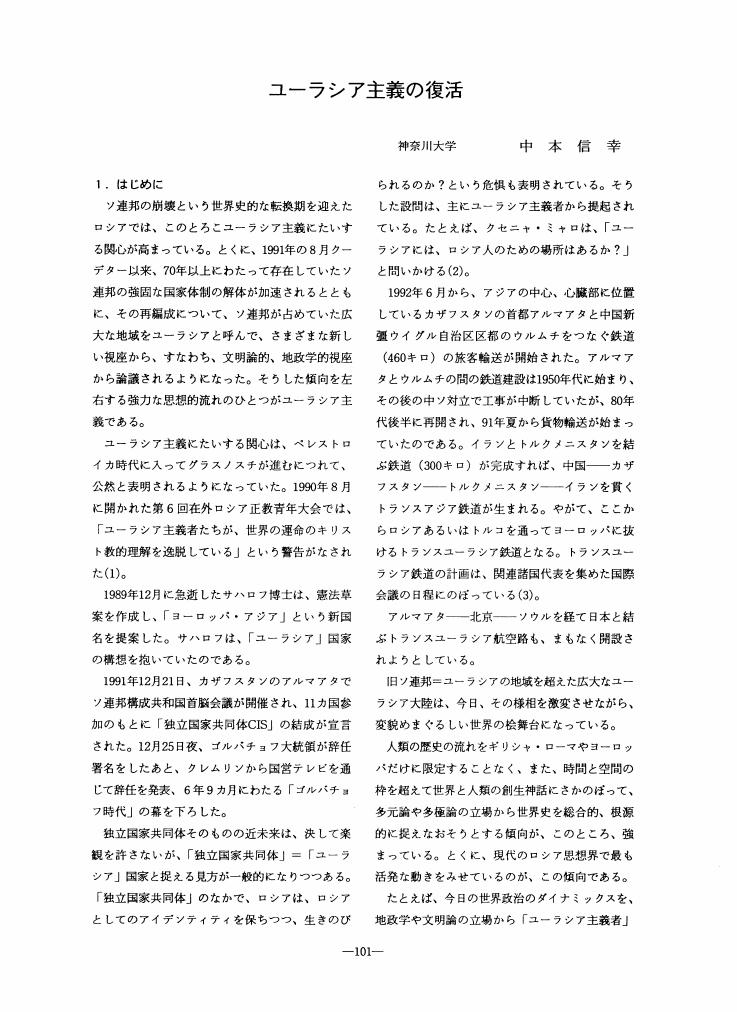
2 0 0 0 OA ユーラシア主義の復活
- 著者
- 中本 信幸
- 出版者
- ロシア・東欧学会
- 雑誌
- ソ連・東欧学会年報 (ISSN:03867226)
- 巻号頁・発行日
- vol.1992, no.21, pp.101-108, 1992 (Released:2010-05-31)
2 0 0 0 OA 旧ソ連工作機械工業の品質改善策 ―ゴルバチョフ時代 (注1) を中心にして―

- 著者
- 五十嵐 則夫
- 出版者
- ロシア・東欧学会
- 雑誌
- ソ連・東欧学会年報 (ISSN:03867226)
- 巻号頁・発行日
- vol.1992, no.21, pp.80-91, 1992 (Released:2010-05-31)
2 0 0 0 OA ドイツ統一とソ連

- 著者
- 澤 英武
- 出版者
- ロシア・東欧学会
- 雑誌
- ソ連・東欧学会年報 (ISSN:03867226)
- 巻号頁・発行日
- vol.1990, no.19, pp.27-35, 1990 (Released:2010-05-31)
- 被引用文献数
- 1
2 0 0 0 OA ロシア革命70周年とソ連の軍事政策

- 著者
- 長谷川 毅
- 出版者
- THE JAPANESE ASSOCIATION FOR RUSSIAN AND EAST EUROPEAN STUDIES
- 雑誌
- ソ連・東欧学会年報 (ISSN:03867226)
- 巻号頁・発行日
- vol.1987, no.16, pp.1-12, 1987 (Released:2010-03-16)
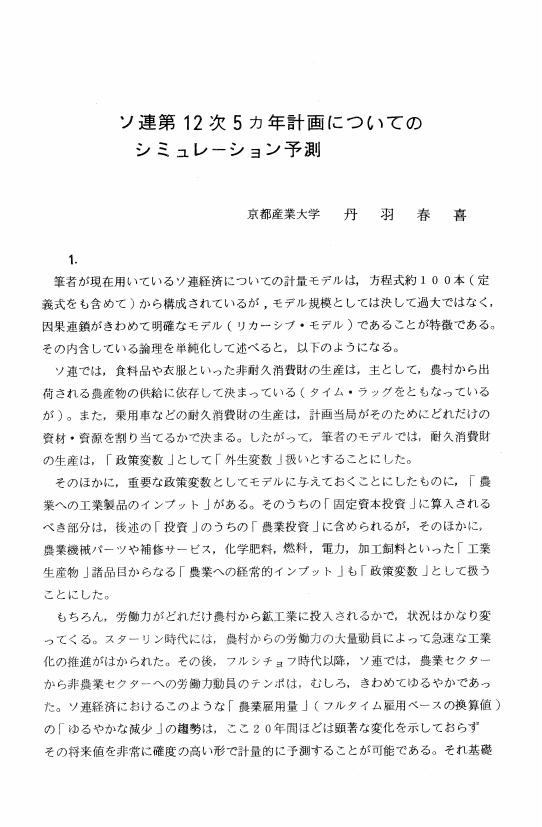
2 0 0 0 OA ソ連第12次5カ年計画についてのシミュレーション予測
- 著者
- 丹羽 春喜
- 出版者
- THE JAPANESE ASSOCIATION FOR RUSSIAN AND EAST EUROPEAN STUDIES
- 雑誌
- ソ連・東欧学会年報 (ISSN:03867226)
- 巻号頁・発行日
- vol.1986, no.15, pp.51-69, 1986 (Released:2010-03-16)
2 0 0 0 OA ソ連と朝鮮半島

- 著者
- 高瀬 浄
- 出版者
- THE JAPANESE ASSOCIATION FOR RUSSIAN AND EAST EUROPEAN STUDIES
- 雑誌
- ソ連・東欧学会年報 (ISSN:03867226)
- 巻号頁・発行日
- vol.1985, no.14, pp.14-24, 1985 (Released:2010-03-16)
2 0 0 0 OA 軍事的バランスよりみたソ連の政治的意図

- 著者
- 関野 英夫
- 出版者
- THE JAPANESE ASSOCIATION FOR RUSSIAN AND EAST EUROPEAN STUDIES
- 雑誌
- ソ連・東欧学会年報 (ISSN:03867226)
- 巻号頁・発行日
- vol.1981, no.10, pp.60-75, 1981 (Released:2010-03-16)
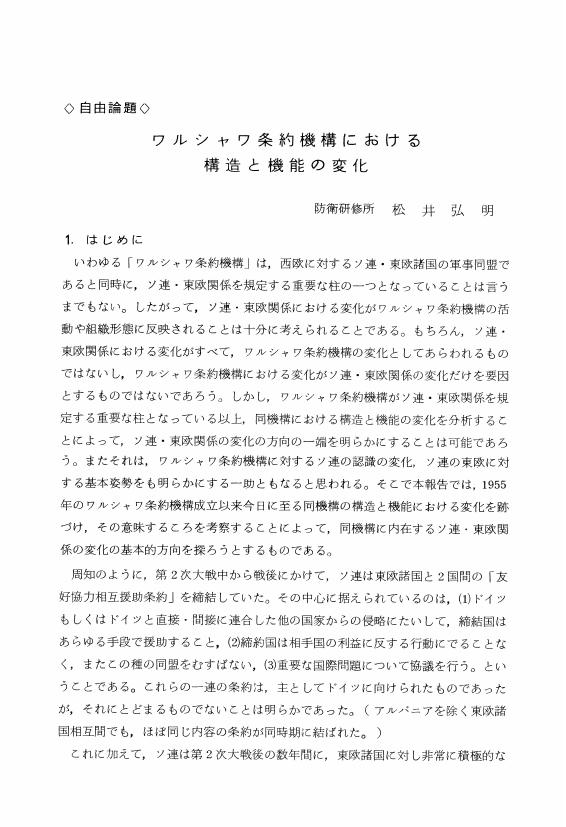
2 0 0 0 OA ワルシャワ条約機構における構造と機能の変化
- 著者
- 松井 弘明
- 出版者
- THE JAPANESE ASSOCIATION FOR RUSSIAN AND EAST EUROPEAN STUDIES
- 雑誌
- ソ連・東欧学会年報 (ISSN:03867226)
- 巻号頁・発行日
- vol.1980, no.9, pp.68-78, 1980 (Released:2010-03-16)
- 参考文献数
- 16
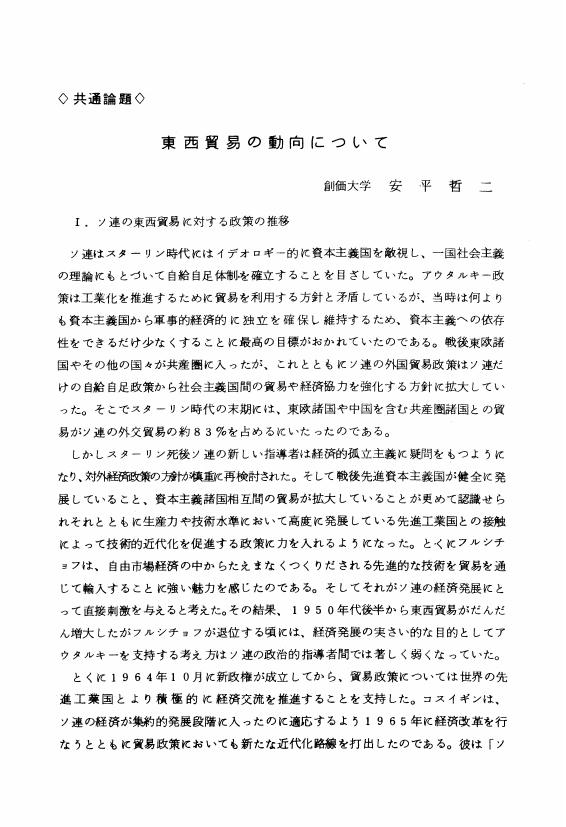
2 0 0 0 OA 東西貿易の動向について
- 著者
- 安平 哲二
- 出版者
- THE JAPANESE ASSOCIATION FOR RUSSIAN AND EAST EUROPEAN STUDIES
- 雑誌
- ソ連・東欧学会年報 (ISSN:03867226)
- 巻号頁・発行日
- vol.1978, no.7, pp.31-55, 1978 (Released:2010-03-16)
- 参考文献数
- 11
- 被引用文献数
- 6 1
2 0 0 0 OA ユーゴ型の計画と市場論

- 著者
- 沢田 于一郎
- 出版者
- ロシア・東欧学会
- 雑誌
- ソ連・東欧学会年報 (ISSN:03867226)
- 巻号頁・発行日
- vol.1973, no.2, pp.78-90, 1973 (Released:2010-03-16)
2 0 0 0 OA ソ連経済と技術進歩
- 著者
- 安平 哲二
- 出版者
- ロシア・東欧学会
- 雑誌
- ソ連・東欧学会年報 (ISSN:03867226)
- 巻号頁・発行日
- vol.1972, no.1, pp.31-48, 1972 (Released:2010-03-16)
- 参考文献数
- 9
2 0 0 0 OA ユダヤから見た新「千年」
- 著者
- 立山 良司
- 出版者
- ロシア・東欧学会
- 雑誌
- ロシア・東欧学会年報 (ISSN:21854645)
- 巻号頁・発行日
- vol.2000, no.29, pp.141-143, 2000 (Released:2010-05-31)
2 0 0 0 OA ロシアにおけるオリガルヒヤについて―その形成期における権力との癒着を中心に―
- 著者
- 中澤 孝之
- 出版者
- ロシア・東欧学会
- 雑誌
- ロシア・東欧学会年報 (ISSN:21854645)
- 巻号頁・発行日
- vol.2000, no.29, pp.12-21, 2000 (Released:2010-05-31)
- 参考文献数
- 10
This report was written with the intention which tried to clarify the realities of the oligarchies (the financial cliques)in Russia. The Russian economic oligarchy research has just started in Japan. Even in Russia, so far it seems to be insufficient. A real research is the future task. It can be said that economic oligarchy exactly symbolizes the Yeltsin age by the phenomenon which appears by the process of conversion to capitalism in Russia during about past ten years. The Russian oligarchies skillfully accumulated the capital in the first stage of Russian capitalism with economic confusion and incompleteness of the law. That is, the monopoly (oligopoly) of wealth in Russia of the present age was achieved by small number of oligarchies. The numbers of the groups were from 7 to 10 only. Privatization of government-owned properties was the splendid chance for the oligarchies. They approached the senior officials of the Yeltsin regime and build a special intimate relation with a Yeltsin family (“semiya” in Russian) to win by the public bidding for privatization. It was adhesion with the regime, by which the oligarchies have increased the property. On of the model is Berezovsky's case. The tycoon was often called even the safe keeper of the “semiya”. First of all, I look back to the time when small number of Russian financial capitalists gained power and enumerate the groups concretely. In addition, I point out their shady relationships with the regime while introducing the examples of their action behind the scene of the process of the war between banks and privatization of the government-run oil companies. Secondly, I verify when Russian words “oligarxhy” or “oligarxhiya” came to appear to the mass communication in Russia. Thirdly, I enumerate names of the oligarchies' groups and each representative's names, and classify them into some categories according to some current reports. Moreover, I elucidate the reason why they became rich after the Soviet Union was dismantled. Finally, I somewhat refer the movement of the old and new oligarchies in the Putin's regime.
2 0 0 0 OA エリツィン大統領弾劾について
- 著者
- 中澤 孝之
- 出版者
- ロシア・東欧学会
- 雑誌
- ロシア・東欧学会年報 (ISSN:21854645)
- 巻号頁・発行日
- vol.1999, no.28, pp.71-82, 1999 (Released:2010-05-31)
2 0 0 0 OA 中東欧諸国の「体制転換」―「新制度論」の視点からの分析
- 著者
- 仙石 学
- 出版者
- ロシア・東欧学会
- 雑誌
- ロシア・東欧学会年報 (ISSN:21854645)
- 巻号頁・発行日
- vol.1997, no.26, pp.10-18, 1997 (Released:2010-05-31)
- 参考文献数
- 15
2 0 0 0 OA ロシア改革の循環―利益分化と政治統合

- 著者
- 下斗米 伸夫
- 出版者
- ロシア・東欧学会
- 雑誌
- ロシア・東欧学会年報 (ISSN:21854645)
- 巻号頁・発行日
- vol.1997, no.26, pp.1-9, 1997 (Released:2010-05-31)
- 参考文献数
- 26
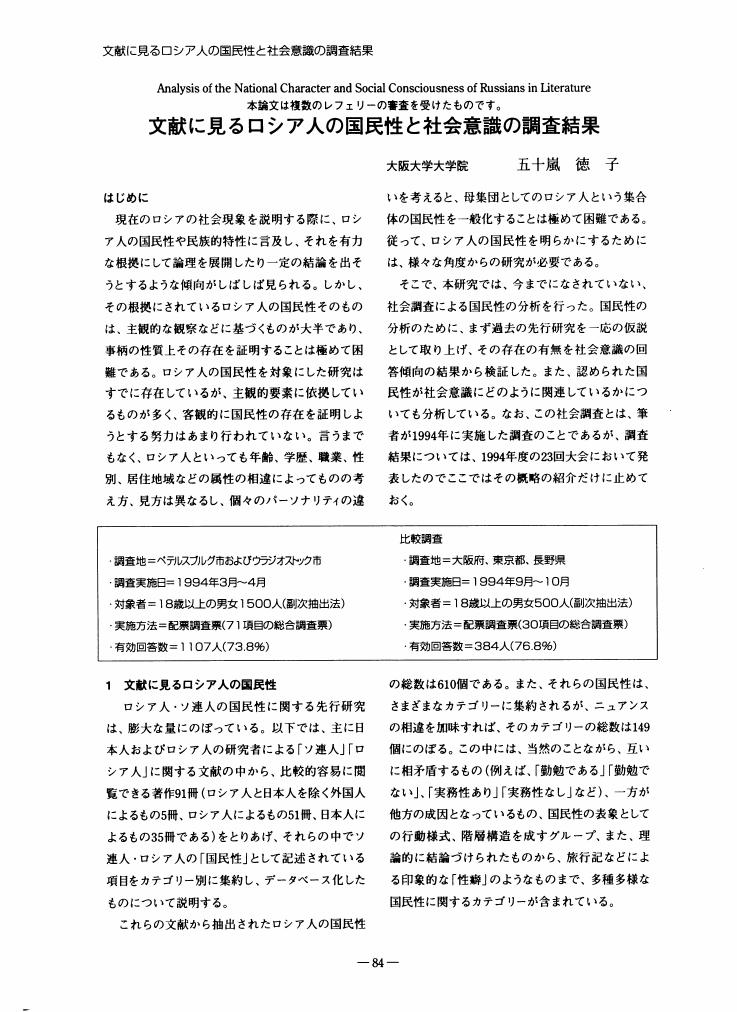
2 0 0 0 OA 文献に見るロシア人の国民性と社会意識の調査結果
- 著者
- 五十嵐 徳子
- 出版者
- ロシア・東欧学会
- 雑誌
- ロシア・東欧学会年報 (ISSN:21854645)
- 巻号頁・発行日
- vol.1996, no.25, pp.84-90, 1996 (Released:2010-05-31)
- 参考文献数
- 8
2 0 0 0 OA ポスト・ソビエト期のロシア文学

- 著者
- 浦 雅春
- 出版者
- ロシア・東欧学会
- 雑誌
- ロシア・東欧学会年報 (ISSN:21854645)
- 巻号頁・発行日
- vol.1996, no.25, pp.54-63, 1996 (Released:2010-05-31)