1 0 0 0 OA 研究討議に関する総括的報告

- 著者
- 森田 孝
- 出版者
- 教育哲学会
- 雑誌
- 教育哲学研究 (ISSN:03873153)
- 巻号頁・発行日
- vol.1980, no.41, pp.18-21, 1980-04-25 (Released:2009-09-04)
1 0 0 0 OA 現代学校への原理的提議 旧時代日本学校教育態様の講究を通して
- 著者
- 松野 憲二
- 出版者
- 教育哲学会
- 雑誌
- 教育哲学研究 (ISSN:03873153)
- 巻号頁・発行日
- vol.1980, no.41, pp.71-84, 1980-04-25 (Released:2010-01-22)
- 参考文献数
- 14
It is a well known fact that contemporary schools are facing a number of problems. Various solutions are presented and attempts at reform are made. Nevertheless the situation which is supposed to be remedied turns out more and more serious. One of the reasons for that is that the present situation is emptied to such a degree that its emptiness being formally established, is looked upon as an ordinary state of matters; another reason lies in the convictions about education which make it impossible to realise that actually schools are facing a crisis ; hence means and ways for a reform were sought in the mode of the schools of old Japan, and by matching their reality with the modern school, a principle for the regeneration of the school was sought. Thus schools can function properly standing firmly on a modern point of view.The principle here discovered leads to a theory alien to a formalistic consideration of age differences, alien to a fixed view of treating patterns and curricular theories, it is a theory of the meaning of the learning motivation, it is a theory of the relation between politics and education, in a sense an all-too obvious theory. The formation of a consciousness for which this principle is deemed absolutely necessary, was discussed with the end in view that this formation will eventually result from it.
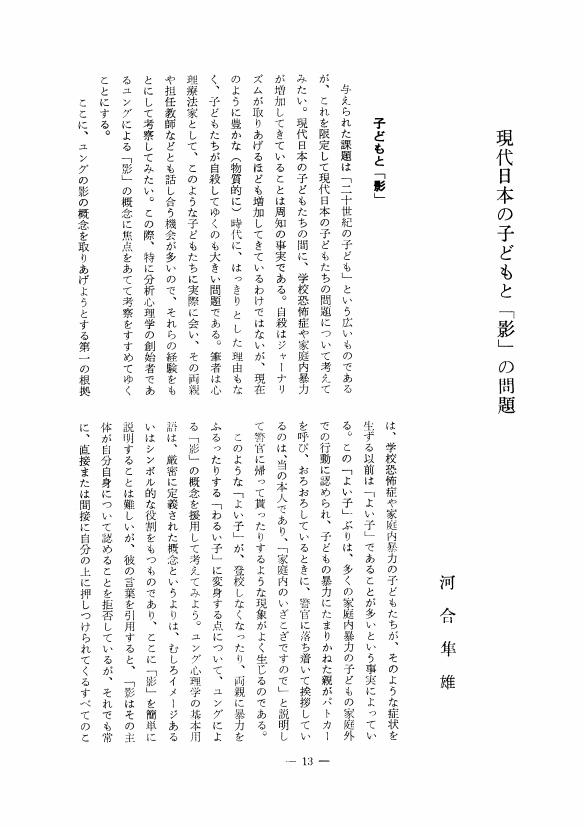
1 0 0 0 OA 現代日本の子どもと「影」の問題
- 著者
- 河合 隼雄
- 出版者
- 教育哲学会
- 雑誌
- 教育哲学研究 (ISSN:03873153)
- 巻号頁・発行日
- vol.1980, no.41, pp.13-17, 1980-04-25 (Released:2009-09-04)
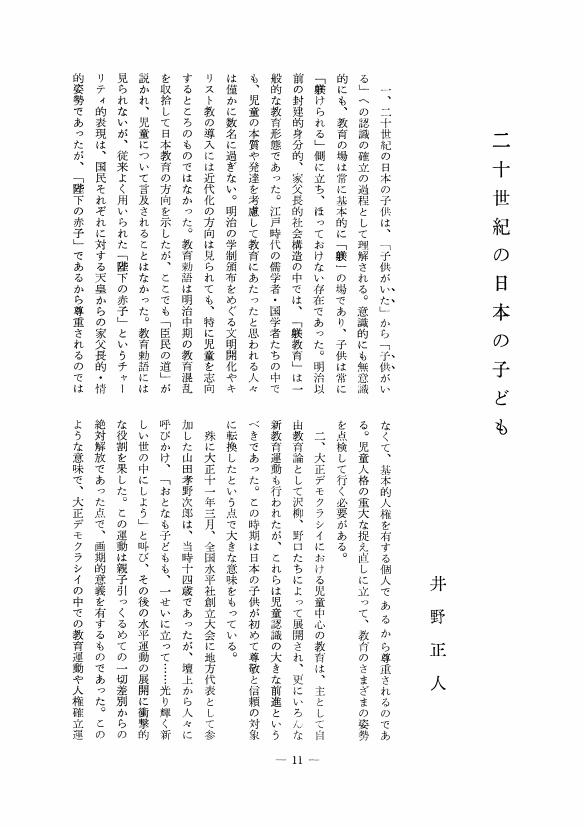
1 0 0 0 OA 二十世紀の日本の子ども
- 著者
- 井野 正人
- 出版者
- 教育哲学会
- 雑誌
- 教育哲学研究 (ISSN:03873153)
- 巻号頁・発行日
- vol.1980, no.41, pp.11-12, 1980-04-25 (Released:2009-09-04)
1 0 0 0 OA 二十世紀の子どもと「しつけ」 近代的児童観と教育にみる「助力」と「介入」の思想をふまえて

- 著者
- 市村 尚久
- 出版者
- 教育哲学会
- 雑誌
- 教育哲学研究 (ISSN:03873153)
- 巻号頁・発行日
- vol.1980, no.41, pp.6-10, 1980-04-25 (Released:2009-09-04)
1 0 0 0 OA 二十世紀と子どもの教育

- 著者
- 東 日出男
- 出版者
- 教育哲学会
- 雑誌
- 教育哲学研究 (ISSN:03873153)
- 巻号頁・発行日
- vol.1980, no.41, pp.1-5, 1980-04-25 (Released:2009-09-04)
- 著者
- 矢崎 律子
- 出版者
- 教育哲学会
- 雑誌
- 教育哲学研究 (ISSN:03873153)
- 巻号頁・発行日
- vol.1979, no.40, pp.32-49, 1979-11-30 (Released:2010-01-22)
- 参考文献数
- 53
When one examines the content of the “Declaration on Christian Education” issued by the Second Vatican Council and the Circular Letter “the Catholic School” published two years ago, one sees that the Catholic Church aims at a modernization of Catholic education. The change becomes particularly evident if these two documents are compared to the Encyclical on Christian Education by Pius XI (1929). Using the occasion of Tarnowski's recently published book “An Existential Christian Pedagogy” in which the author describes the characteristics of this change as a shift from an essentialistic tendency toward an existential trend, it is attempted here to examine this change as far as possible objectively, scientifically and pedagogically.For that purpose the content has been studied as follows : (1) The Vatican Council and its background thought;(2) a comparison of Pius XI “Encyclical on Christian Education” and the “Declaration on Education” of Vatican II;(3) source of existential thought in Catholic education;(4) existential Catholic pedagogy;(5) the problems faced by existential Catholic pedagogy.
1 0 0 0 OA 学校教育と美意識の形成 西洋画教育受容の一形態
- 著者
- 上野 浩道
- 出版者
- 教育哲学会
- 雑誌
- 教育哲学研究 (ISSN:03873153)
- 巻号頁・発行日
- vol.1979, no.40, pp.16-31, 1979-11-30 (Released:2009-09-04)
- 参考文献数
- 22
It is a characteristic of art in Japan that there are two styles of painting, Japanese and Western. In nurturing their sense of beauty, Japanese have been influenced both by their indigenous artistic culture and by the expression and way of pursuing beauty on the part of foreign arts. This is particularly true in public art education in Japan, which imported a great many ideas of western painting to enrich the Japanese way of thinking and expression.The purpose of this paper is to clarify how the ideas of western painting influenced the viewpoint and expression of N. Inamori (1892-1978), who was an ordinary school teacher, that is; a typical Japanese.N. Inamori, who was brought up in the Japanese culture, nurtured his sense of beauty within its confines. Then, in school, he received ringa (conventional training in copying pictures in the textbook), jiyuga (style of painting free from textbook restraints) education and studied Western viewpoint and expression. However, he could not understand scientific and analytical perception and expression. Later, retiring from teaching, he did Japanese painting and calligraphy as his hobby.By pursuing the process of nurturing his sense of beauty and analyzing his paintings, the following three points were clarified. (1) The technique of line drawings by ringa influenced the form of his expression for a long time. While, jiyuga education made him perceive and portray the essense of nature and life directly. It put stress on children's individual freedom, inner expression and their subjective activity. (2) Education in Western painting taught him the importance of observing objects attentively and rationally ; scientifically, analytically and mathematically. Technically, it taught himthe lams of perspective and shading, so on. But, he could not understand the Western thought behind the techniques, especially the thought that aimed at the perfected ego and the development of science. (3) He could not perceive and paint nature objectively and concretely as a third party. Because, he does not perceive the world in opposition to ego, but he finds his self in the world. The emotion, viewpoint, and expression that he had experienced in his early days was his basic and fundamental way of perception, expression and sense of beauty.
1 0 0 0 OA 第十九回国際モンテッソーリ会議に参加して AMIの五十年とモンテッソーリ教育の現代的意義

- 著者
- 原 弘美
- 出版者
- 教育哲学会
- 雑誌
- 教育哲学研究 (ISSN:03873153)
- 巻号頁・発行日
- vol.1979, no.40, pp.65-69, 1979-11-30 (Released:2009-09-04)

- 著者
- 宗和 太郎
- 出版者
- The Japanese Society for the Philosophy of Education
- 雑誌
- 教育哲学研究 (ISSN:03873153)
- 巻号頁・発行日
- vol.1979, no.40, pp.70-77, 1979-11-30 (Released:2009-09-04)
1 0 0 0 OA デュルケームの社会化の概念
- 著者
- 中村 清
- 出版者
- 教育哲学会
- 雑誌
- 教育哲学研究 (ISSN:03873153)
- 巻号頁・発行日
- vol.1979, no.40, pp.1-15, 1979-11-30 (Released:2009-09-04)
- 参考文献数
- 24
The pedagogy of Durkheim is here interpreted under the concept of socialization. This, however, has been frequently criticized as an interpretation limiting education to a function of conservative maintenance of the status quo. This paper examines the validity of such criticism.It is clear that Durkheim subjectively included in his idea of socialization the formation of a critical subject and therefore attributed to education also a function of social reform. But this critical subject is not correctly located in his sociology. It is unavoidable, therefore, that the individual is understood as subject to society. In spite of this shortcoming his view that, on the average, the individual reason does not transcend group reason is true and as long as that is admitted, his definition that education as a rule is socialization must also be admitted.
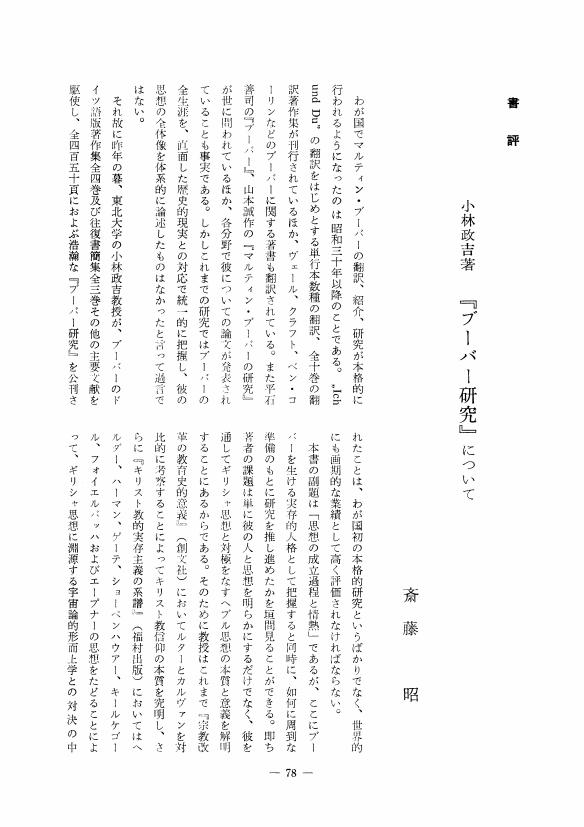
1 0 0 0 OA 小林政吉著『ブーバー研究』について
- 著者
- 斎藤 昭
- 出版者
- 教育哲学会
- 雑誌
- 教育哲学研究 (ISSN:03873153)
- 巻号頁・発行日
- vol.1979, no.39, pp.78-82, 1979 (Released:2009-09-04)
1 0 0 0 OA 動的相対主義の無基準性 特に「確定」「不確定」について
- 著者
- 池田 久美子
- 出版者
- 教育哲学会
- 雑誌
- 教育哲学研究 (ISSN:03873153)
- 巻号頁・発行日
- vol.1979, no.40, pp.50-64, 1979-11-30 (Released:2009-09-04)
Prof. Ueda says, “The dynamic A cannot be identified with an abstract generality, Ao, in the final analysis.” I admit it makes some sense to distinguish an object (A) from an abstract notion of it (Ao).But is he right when he asserts on the basis of this distinction that any actual cognition of an object is entirely uncertain and fluctuant? Is it right to deprive actual cognitions of certainty?I argue against his assertion for the following reasons.i) We should not treat “Certain” and “Uncertain” as an absolute dichotomy. Being certain to some degree necessarily implies being uncertain to some degree at the same time. The real question is to what degree a notion is certain. Many-valued thinking is necessary.ii) It is quite a nonsense to say that our actual cognitions can be uncertain altogether. To regard them uncertain, there must be some unquestionable viewpoint according to which we can measure the degree of uncertainty of the cognitions. Without such a viewpoint, we cannot regard them uncertain at all.iii) It is necessary to measure the degree of certainty of actual cognitions. What matters for this measurement is to analyze the content of individual cognitions. But in his book, Prof. Ueda ignores the content of cognitions in particular cases, so he fails to recognize how indispensable are the criteria to distinguish “Certain” from “Uncertain”.
1 0 0 0 OA 「育」意考
- 著者
- 俵木 浩太郎
- 出版者
- 教育哲学会
- 雑誌
- 教育哲学研究 (ISSN:03873153)
- 巻号頁・発行日
- vol.1979, no.39, pp.17-30, 1979 (Released:2009-09-04)
This paper follows after The Meaning of “kyo”, (Studies in the Philosophy of Education No. 38, 1978), intending to clarify the meaning of kyo-iku, a lexical equivalent word to education.Through examining all 24 cases of iku in the Four Classical Chinese Books and the Five Chinese Classics, the author finds that only one case means “bringing up” a child by parents. Majority of the cases doesn't give rise to the meaning, around which present usages are centering. Later, Xu Shen (58 A. D.-147 A.D.), a compiler of a dictionary for Chinese characters, explained iku as “bringing children up to make them do good”.The author concludes that since then iku in this sense has become influencial, and that in the present usage of kyo-iku this sense still exists. Furthermore, it is pointed out that Xu combined the iku with kyo holding an intention to mean bringing up children good by teaching. Thus, one can find that an embryonic form of the concept of kyo-iku in its modern usage had been born. On the contrary, the author is dubious about a widely held opinion that the usage of kyo-iku in the sense of “education” was originated by Mencius some four centuries before Xu.
1 0 0 0 OA 教育諸科学の発達-フランス-
- 著者
- グユイ アヴァンツィーニ
- 出版者
- 教育哲学会
- 雑誌
- 教育哲学研究 (ISSN:03873153)
- 巻号頁・発行日
- vol.1979, no.39, pp.62-77, 1979 (Released:2009-09-04)
- 参考文献数
- 54
教育実践は大人と子どものあいだの関係や大人の子どもに与える影響と不可避的に結びついている普遍的かつ必然的現象である。教育実践についての考察であるペダゴジーは、それゆえいろいろな仕方においてとくに教師の体験する諸問題や失敗を通して早くから成立した。これに対して教育現象に関する科学的研究がみられるようになったのはずっと後になってからであり、それはごく最近のことにすぎない。しかしながらその発達は≪教育諸科学≫ les sciences de l'éducationの世界的な登場としてあらわれている。以下に、フランスではどのような情況からこの科学が勃興したのか、そしてこの科学の主要目的は何であるかについて明らかにしよう。
1 0 0 0 OA 現代教育と青少年の問題行為 社会病理としての有害環境

- 著者
- 西 勇
- 出版者
- 教育哲学会
- 雑誌
- 教育哲学研究 (ISSN:03873153)
- 巻号頁・発行日
- vol.1979, no.39, pp.5-8, 1979 (Released:2009-09-04)
1 0 0 0 OA ヘルバルトの「自由教育学」 今日の「解放教育学」に対比して

- 著者
- ワルター アスムス
- 出版者
- 教育哲学会
- 雑誌
- 教育哲学研究 (ISSN:03873153)
- 巻号頁・発行日
- vol.1979, no.39, pp.48-61, 1979 (Released:2009-09-04)
- 参考文献数
- 20
1 0 0 0 OA 教育者ソクラテスの成立過程 自然学の徒から教育者への転換は如何にして可能であったか
- 著者
- 北畠 知量
- 出版者
- 教育哲学会
- 雑誌
- 教育哲学研究 (ISSN:03873153)
- 巻号頁・発行日
- vol.1979, no.39, pp.31-47, 1979 (Released:2009-09-04)
- 参考文献数
- 31
The purpose of this paper is to clarify the process of becoming an Educater Socrates, who was a student of Nature.Socrates criticized the theory of Anaxagoras. This suggests that in his study of Nature, Socrates holds a new idea which contains problems of man, and also overcomes the situation of sophism.But on the way, knowing the Delphic oracle, he stopped the study of Nature and devoted himself to the interpretation of this oracle. Then he began the dialogue. He applied to the dialogue “the ignorant consciousness about the genuine cause and reason” of which he awared in his study of Nature. Confirming the human ignorance by this way, he began the human-testing. But he was confronted with the dilemma, in which he had to bear the “Sophia”, while he had to stop even this bearing and to rescue the “Polis” by awakening the people of “Polis”.This dilemma makes Socrates a maieutic Educater.
1 0 0 0 OA 現代教育と青少年の問題行為 文明論風に

- 著者
- 堀内 守
- 出版者
- 教育哲学会
- 雑誌
- 教育哲学研究 (ISSN:03873153)
- 巻号頁・発行日
- vol.1979, no.39, pp.9-12, 1979 (Released:2009-09-04)
1 0 0 0 OA 現代教育と青少年の問題行為

- 著者
- 村井 実
- 出版者
- 教育哲学会
- 雑誌
- 教育哲学研究 (ISSN:03873153)
- 巻号頁・発行日
- vol.1979, no.39, pp.13-16, 1979 (Released:2009-09-04)