
- 著者
- 松山 圭子
- 出版者
- 日本医学哲学・倫理学会
- 雑誌
- 医学哲学 医学倫理 (ISSN:02896427)
- 巻号頁・発行日
- vol.27, pp.112-116, 2009-10-01 (Released:2018-02-01)
2 0 0 0 OA HPVワクチンの臨床利用をめぐる倫理問題 : 予防接種義務化とワクチン政策に関する一考察
- 著者
- 福田 八寿絵
- 出版者
- 日本医学哲学・倫理学会
- 雑誌
- 医学哲学 医学倫理 (ISSN:02896427)
- 巻号頁・発行日
- vol.27, pp.52-59, 2009-10-01 (Released:2018-02-01)
Human papillomavirus (HPV) causes cervical cancer, and efforts to develop vaccines against this virus have been proceeding. In June 2006, the U.S. FDA approved a vaccine that prevents HPV. There is now a political controversy over how to use this HPV vaccine in the clinical setting. Because of the high prevalence of cervical cancer in Japan, this vaccine has been eagerly awaited. This paper examines the experience in the U.S. and discusses how this vaccine might be used in Japan where it has not yet been approved and considers how the cost should be borne as well as the ethical problems involved in selecting individuals to receive preventive vaccination.
2 0 0 0 OA ハンセン病療養所の課題 : 新良田教室卒業生への聞き取り調査を手がかりに
- 著者
- 上野 哲
- 出版者
- 日本医学哲学・倫理学会
- 雑誌
- 医学哲学 医学倫理 (ISSN:02896427)
- 巻号頁・発行日
- vol.22, pp.1-6, 2004-10-18 (Released:2018-02-01)
The purpose of this paper is to contribute to making a better life in leprosariums by providing viewpoints to change leprosariums as isolation hospitals into communities of living. Although it is very hard for many residents who are advanced age and without any relatives to go off of leprosariums, the court found the isolation policy for recoverists of leprosy illegality in May 2001. Leprosariums are obliged to change, for example, homes for the aged. What I do not try to do here is to impeach someone. I make proposals, however, based on the interview to the Niirada branch school of Oku senior high school students in the Nagashima-aiseien leprosarium. The subjects of the interview meet the following two requirements: firstly they have been expected a remarkable activity out of leprosariums from their boyhood; and, secondly, they live in leprosariums again at present after the living out of leprosariums. As a consequence of the analysis, I propose attaching importance to the high regard for resident's self respect under the isolation policy and the understanding of the human relations in leprosariums, in addition to the request for substantial medical service, to better the present condition of leprosariums.
2 0 0 0 OA 病いの利他性に関する一考察 : 犠牲者非難イデオロギー対代理苦イデオロギー
- 著者
- 村岡 潔
- 出版者
- 日本医学哲学・倫理学会
- 雑誌
- 医学哲学 医学倫理 (ISSN:02896427)
- 巻号頁・発行日
- vol.19, pp.166-178, 2001-10-20 (Released:2018-02-01)
We usually take it for granted that an event that some people fall ill has no connection with another event that the others can keep healthy, because we generally judge the matter from an atomistic or individualistic daily life standpoint. Many people believe that the main cause of illness is their bad lifestyle such as drinking, smoking or working too much so that the sick only have themselves to blame. This popular idea is called "victim-blaming ideology." However, from a macroscopic mass standpoint, we can find that healthy people are dependent upon the sick. That is, for people to be healthy there must be people who are sick instead of the healthy. This paper is an introduction to this paradoxical idea. First, I reconsidered the social function of the medical diagnosis of an illness and found it is to divide all the members of a society into two groups : one that is ill and the other that is not (that is., healthy). This means that the healthy cannot be healthy without the sick unfortunately being sick instead. This substitution is a kind of altruism. "Ri-tagyo", a Buddhist encouragement of altruism also supports this idea. Secondly, some epidemiological statistics also support this altruistic relationship. Finally, we concluded that sick people are neither useless nor a nuisance, but they play a great role in society because of their being-ill altruism. Healthy people, therefore, must show extreme kindness to those who are sick. This act of kindness may be an ethical origin of clinical medicine.
2 0 0 0 OA 人間の生における「尊厳」概念の再考
- 著者
- 安藤 泰至
- 出版者
- 日本医学哲学・倫理学会
- 雑誌
- 医学哲学 医学倫理 (ISSN:02896427)
- 巻号頁・発行日
- vol.19, pp.16-30, 2001-10-20 (Released:2018-02-01)
In the argument of bioethics, more often in the public argument than in the academic one, the concept of "Dignity" has been used as a protector of a human's irreplaceable value. For example, "Dignity of Life", "Human Dignity", " Dignity of Individual", and "Death with Dignity". But in many cases, the various terms of "Dignity" are ambiguous and at times oppose one another. One main reason for this is that the word "Life" has various meanings. In Japanese, at least four words, "seimei", "seikatsu", "jinsei", and "inochi" (each has rather different implications) are equivalents to the word "life". In this paper, I have reflected on the concept of "Dignity" in Human Life in some topics of bioethics, classifying the meaning of "Life" in each case. The concept of "Dignity" has a rather ambivalent character. On the one hand, it works as a protector of a human's irreplaceble life in various dimensions, such as fundamental "seimei", individual personal "jinsei", or the interrelational "inochi". But on the other hand, it can be exclusive priciple that devalue certain forms of human life as unworthy of human dignity and so cut off the possibility of encounter and self-awareness of "inochi-beings" in advance. Today, we cannot be too cautious of the danger when the exclusive principle of the concept of "Dignity" prevails and suppresses the quest for Dignity itself.
2 0 0 0 OA 自発的積極的安楽死と自己決定権 : 死は選択できるか
- 著者
- 尾崎 恭一
- 出版者
- 日本医学哲学・倫理学会
- 雑誌
- 医学哲学 医学倫理 (ISSN:02896427)
- 巻号頁・発行日
- vol.14, pp.81-94, 1996-10-01 (Released:2018-02-01)
Not a few people in Japan are killed in active euthanasia. However, most cases are hidden, as active euthanasia is prohibited in any situation. Consequently some people are killed by immoral ways, for example involuntarily or cruelly, though they could survive with handicaps, or though they could die calmly in voluntary active euthanasia. Voluntary active euthanasia should be permitted legally, and the Involuntary one should be prohibited strictly. Why is Voluntary active euthanasia prohibited? Because people think that no one has the right of death and believe in the theory of the slippery slope. But everyone has the right of self-determination. Does this right imply that? And cannot we put the brake on unlimited killing performed under active euthanasia? In order to answer these questions, I first investigated how the right of self-determination is justified by two theories which differ from each other:social contract theory and utilitarianism. This call give an impartial solution for them. The solution is that each person has the right to decide all one's own affairs and even commit suicide if the right is not misused and makes no one unhappy. Secondly I studied the meaning of death for the dying person, especially with regard to its positive meaning, i.e. the completion of his life. It is important what he does as the last act in his life when he suffers terribly from fatal wounds or diseases. Is it morally good that doctors prolong the severe pain of the patient as long as possible? It is bad that they rob him of self-determination and his happiness. He doesn't only have the right to die,but also should exercise the right in oder to get rid of his fatal pains. Thirdly I think through the new legal systems which permit the right to die and prevent patients from misusing it. Judging from the above, these systems must be based on the principles of self-determination and state of necessity. In the case of voluntary active euthanasia, to help one commit suicide can be legally justified. However, to kill one based on the one's serious request cannot justified, but only irresponsible for the murder.
2 0 0 0 OA 医療倫理へのカント人格概念の適用の問題
- 著者
- 服部 健司
- 出版者
- 日本医学哲学・倫理学会
- 雑誌
- 医学哲学 医学倫理 (ISSN:02896427)
- 巻号頁・発行日
- vol.12, pp.28-35, 1994-10-01 (Released:2018-02-01)
Kant's concept of Person, connected with the concept of dignity, is one of the most influential in medical ethics. No one call the dignity of person into question. A person should not be treated merely as a means, rather as an end at any time. In founding bioethics, Prof. Engelhardt, Jr. brings this concept up in dual strains: the person in the strict sense, whose definition is purely ethical and the same as Kant's; the person in a broad sense, a compromise between the person in the strict sense and the merely biological human. His purpose to extend the concept in its use is, on the one hand, to impute some rights to humans who have not enough intellectual faculties and need moral protection, which has merit in overcoming the extreme argument made by M. Tooley; on the other hand, to release primary persons from obligations to some humans who cannot play any social roles. Were there undue burdens, rights of subordinate persons may be legitimately ignored. Freedom of the will of real persons should be prior to protection of secondary persons. Thus, not only nonperson humans but, occasionally, assumed persons may be treated merely as means. Problems are as follows. 1. who determines the order of priority among assumed persons, or when these would be degraded to nonpersons? 2. may one who does not possess inner worth be designated as a person? 3. must a merely arbitrary, subjective desire of primary persons be still respected even at the expense of secondary persons or others? Indeed, in Kant's writings we come across the radical, well-known dichotomy : Person and Sache. Apparently Formula II of the categorical imperative does not forbid persons to treat irrational beings merely as means. Yet there seems to be no better way than by regarding so: when Kant uses the concept Person, it matters little to which the nonperson human belongs, rather how we ourselves as moral agents should act in the name of Person. A extensional use of Person to judge not quite rational beings, subjectum patients, objectively (gegenstandlich) would seem to be looked upon as a misuse or abuse. The concept Person urges upon us self-consciousness as rational subjects and to make every endeavor to be what we must be through actual acts, because we are animal rationabile, not yet animal rationale.
2 0 0 0 OA 聖ベネディクトゥスの『戒律』 : 中世キリスト教社会の健康指針

- 著者
- 矢内 義顕
- 出版者
- 日本医学哲学・倫理学会
- 雑誌
- 医学哲学 医学倫理 (ISSN:02896427)
- 巻号頁・発行日
- vol.3, pp.16-29, 1985-07-05 (Released:2018-02-01)
2 0 0 0 OA 「自然な実在論」について
- 著者
- 横山 (中村) 幹子
- 出版者
- 科学基礎論学会
- 雑誌
- 科学基礎論研究 (ISSN:00227668)
- 巻号頁・発行日
- vol.23, no.2, pp.91-96, 1996-03-31 (Released:2010-01-20)
- 参考文献数
- 14
日常生活では, 自分が見ているものと他人が見ているものが違うものであると考えることはあまりない。たとえば, チョークの場合を考えてみよう.自分の目の前にあり, それを手で持ち上げ, それを使って黒板の上に文字を書くことができるチョークについて,「このチョークは, 私にはあるように思われるけれども, 他の人にとっても同様にあるとは限らないんだ」と言う人はそんなにはいないだろう。しかし, 哲学的と言われる話になると, そのような考えを論じることは, 非常に一般的なものになる。ここでは, そのような相対主義から逃れることができるのかを考えたい。その際, 以下のような順序で考察する。まず, どのような理由で, 相対主義的な考え方がでてくるのかを考える。それから, 相対主義がでてくる状況を認めたうえで, そのような立場をとらないことができるのかを考える。そして, その際, パトナムが「デユーイ・レクチャー」のなかで提出した「自然な実在論」という考えがその候補になりうるのではないかということについて考察する。(1)なぜなら, 彼はそのなかで, 知覚作用は外的な対象と心との間の中間領域を含んでいるという考えがどのようにしてわれわれの心が外的な世界と関係するかという問題を引き起こし, それによって形而上学的な実在論や観念論や相対主義などのいろいろと問題の多い考えが生じるとし, そのような誤りを犯さない道として「自然な実在論」という考えを提出しているからである。
2 0 0 0 OA 形式論理から哲学的論理学へ ヤスパースによる「超越」的思考の意義

- 著者
- 今本 修司
- 出版者
- 科学基礎論学会
- 雑誌
- 科学基礎論研究 (ISSN:00227668)
- 巻号頁・発行日
- vol.23, no.2, pp.73-78, 1996-03-31 (Released:2009-07-23)
- 参考文献数
- 16
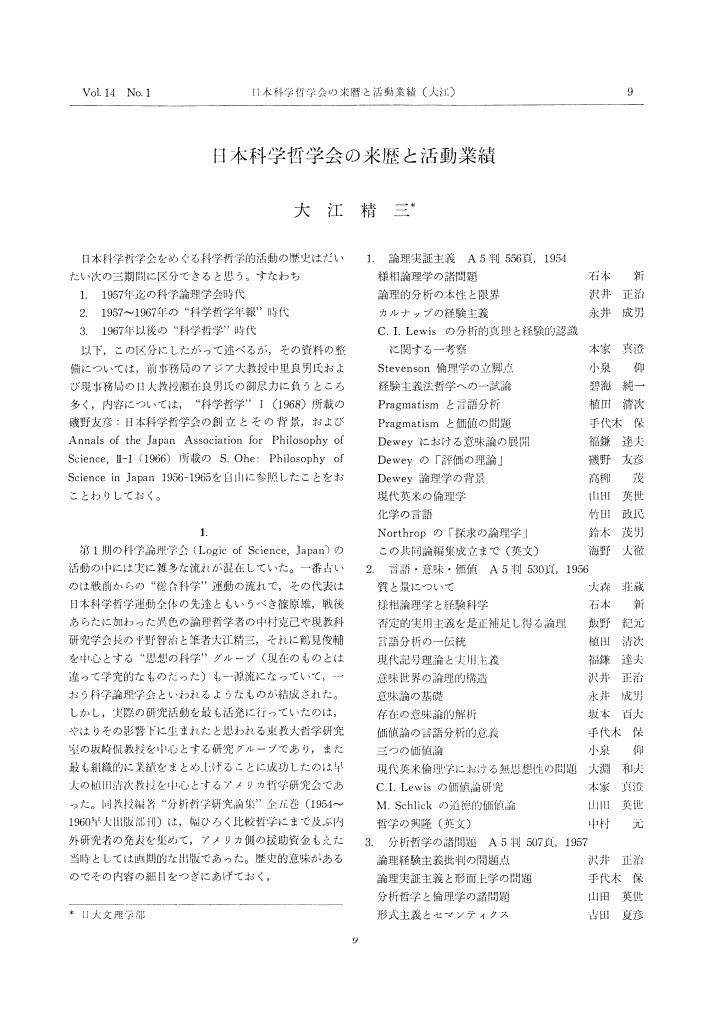
2 0 0 0 OA 日本科学哲学会の来歴と活動業績
- 著者
- 大江 精三
- 出版者
- 科学基礎論学会
- 雑誌
- 科学基礎論研究 (ISSN:00227668)
- 巻号頁・発行日
- vol.13, no.2, pp.9-13, 1977-04-25 (Released:2009-09-04)
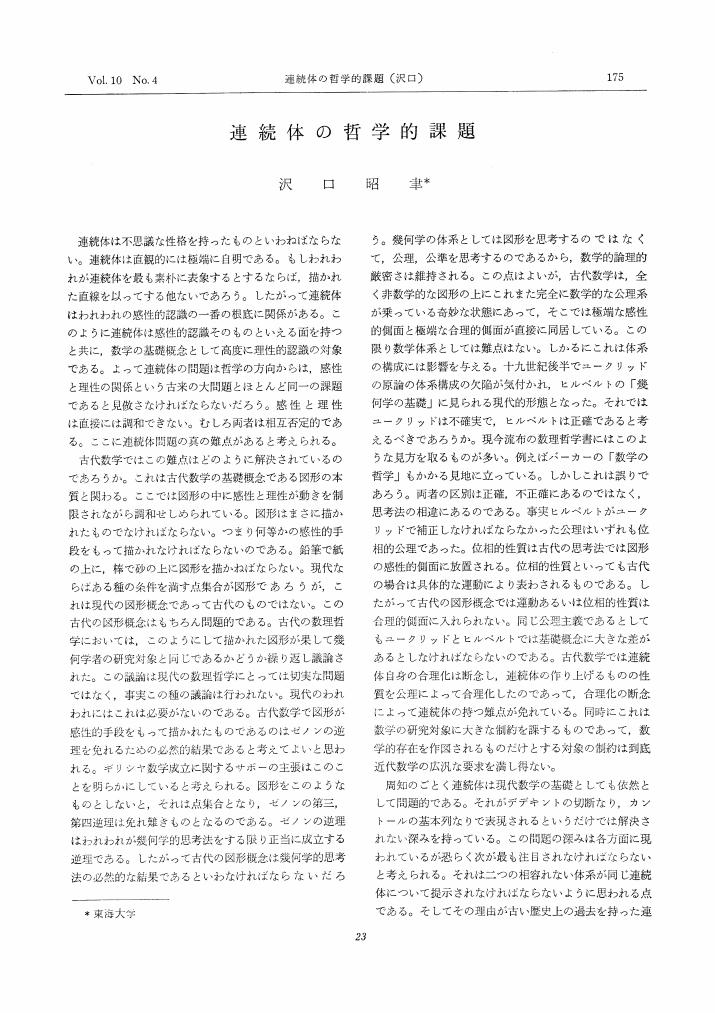
2 0 0 0 OA 連続体の哲学的課題
- 著者
- 沢口 昭聿
- 出版者
- 科学基礎論学会
- 雑誌
- 科学基礎論研究 (ISSN:00227668)
- 巻号頁・発行日
- vol.10, no.4, pp.175-178, 1972-03-30 (Released:2009-09-04)
2 0 0 0 OA ドイツ観念論における精神概念と自由 ―イェシュケ氏へ問う―

- 著者
- 権左 武志
- 出版者
- 日本ヘーゲル学会
- 雑誌
- ヘーゲル哲学研究 (ISSN:13423703)
- 巻号頁・発行日
- vol.2006, no.12, pp.26-30, 2006-12-15 (Released:2010-07-27)
- 参考文献数
- 4
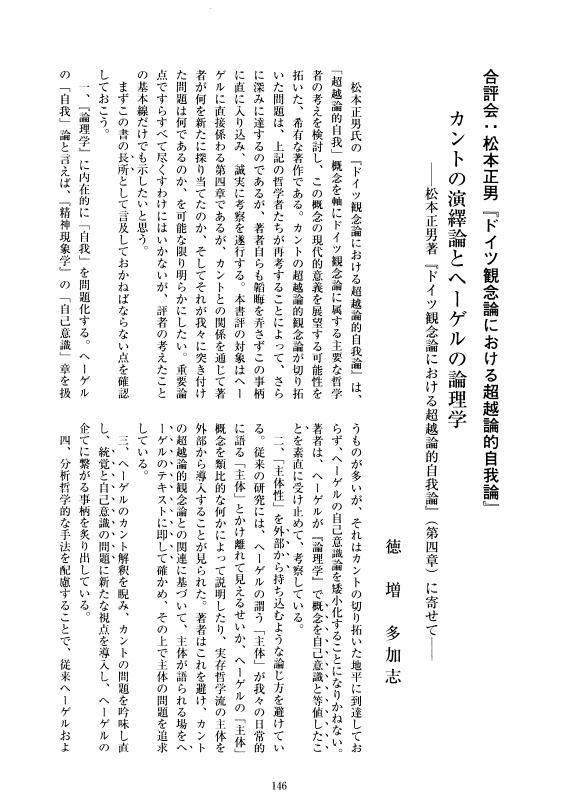
2 0 0 0 OA 合評会: 松本正男『ドイツ観念論における超越論的自我論』
- 出版者
- 日本ヘーゲル学会
- 雑誌
- ヘーゲル哲学研究 (ISSN:13423703)
- 巻号頁・発行日
- vol.2004, no.10, pp.146-153, 2004-12-24 (Released:2010-07-27)

- 著者
- ヤメ クリストフ フェルケル フランク
- 出版者
- 日本ヘーゲル学会
- 雑誌
- ヘーゲル哲学研究 (ISSN:13423703)
- 巻号頁・発行日
- vol.2006, no.12, pp.168-182, 2006-12-15 (Released:2011-01-31)
- 参考文献数
- 37
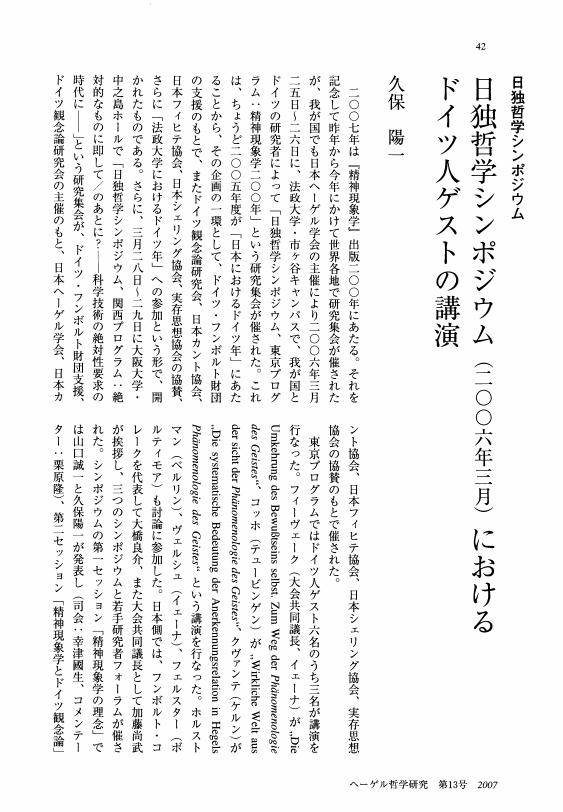
2 0 0 0 OA 日独哲学シンポジウム (二〇〇六年三月) におけるドイツ人ゲストの講演
2 0 0 0 OA 『ヘーゲル体系における意識と理念と実在性』

- 著者
- 海老澤 善一
- 出版者
- Japanische Hegel-Gesellschaft
- 雑誌
- ヘーゲル哲学研究 (ISSN:13423703)
- 巻号頁・発行日
- vol.2008, no.14, pp.167-174, 2008-12-15 (Released:2011-12-19)
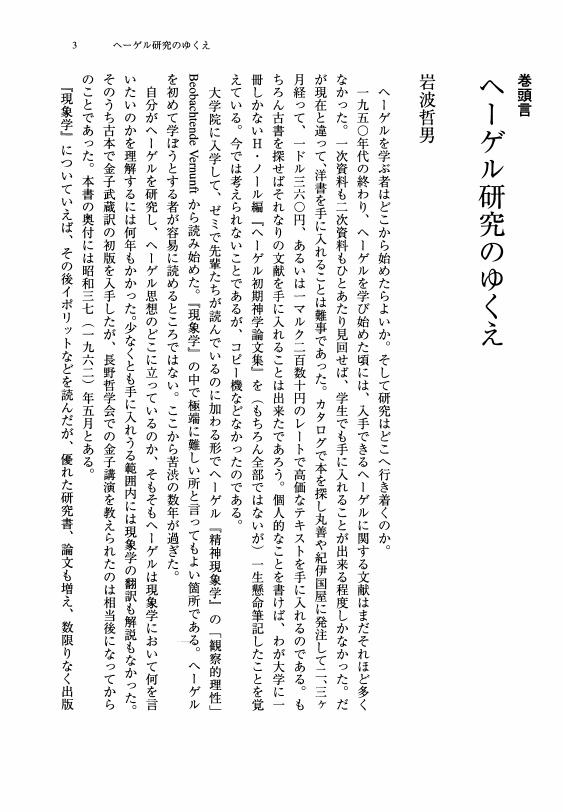
2 0 0 0 OA ヘーゲル研究のゆくえ
- 著者
- 岩波 哲男
- 出版者
- 日本ヘーゲル学会
- 雑誌
- ヘーゲル哲学研究 (ISSN:13423703)
- 巻号頁・発行日
- vol.2008, no.14, pp.3-7, 2008-12-15 (Released:2011-12-19)
2 0 0 0 OA シンポジウム討論状況報告 ―ヘーゲル・ヌースの響き―

2 0 0 0 OA 懐疑と狂気そして絶望 ―行為する理性は錯乱に陥る―

- 著者
- 小屋敷 琢己
- 出版者
- 日本ヘーゲル学会
- 雑誌
- ヘーゲル哲学研究 (ISSN:13423703)
- 巻号頁・発行日
- vol.2006, no.12, pp.110-123, 2006-12-15 (Released:2010-07-27)
- 参考文献数
- 27