1 0 0 0 OA 19世紀末から20世紀初頭アメリカにおける経済学史研究の特徴
- 著者
- 髙 哲男
- 出版者
- 経済学史学会
- 雑誌
- 経済学史研究 (ISSN:18803164)
- 巻号頁・発行日
- vol.55, no.1, pp.75-85, 2013 (Released:2019-08-23)
The rapid economic growth from the late 19th century in America was achieved with policies representing ʻAmerican Exceptionalism.ʼ It jus-tified the protection of infant industries to make America independent from the old and feudalistic European Powers. The main econom-ic policies consisted of the internal laissez-fair and the external protectionism. American eco-nomic thought was obliged to change from the traditional field of moral philosophy to explain-ing practical economic policies when modern scientific technologies created the emergency of labor management conflict in factories employ-ing high industrial productivity and a mass of unskilled labors. The outbreak of the so-called social problem promoted the establishment of economic depart-ment in universities, educating new business men for managing new large industries and oth-er public services. The universities required the training of faculty members to teach graduate courses. In the graduate courses of economics, main textbooks sifted from J. S. Millʼs Principles to A. Marshallʼs Economics and the writings of German Historical School. Since graduate stu-dents wanted to learn practical economics, seek-ing appropriate policies for solving social prob-lems, studentʼs research works into fundamental theories and thoughts of economics slighted. This situation began to change in the 1920ʼs, when economists and graduate students began to seek new methods to achieve a theoretically uni-fied system of economics appropriate for the American economy. The making of American economics, therefore, indispensably accompa-nied with the study of the economic thoughts in order to ascertain its origins and significances in the historical studies, and not a few outstanding works were written at that time. JEL classification numbers: B 1, B 13, B 15.
1 0 0 0 OA Uchida Yoshihiko:
- 著者
- 鈴木 信雄
- 出版者
- The Japanease Society for the History of Economic Thought
- 雑誌
- 経済学史研究 (ISSN:18803164)
- 巻号頁・発行日
- vol.55, no.1, pp.1-17, 2013 (Released:2019-08-23)
Abstract: It is very difficult to summarize the thought of Uchida Yoshihiko (1913-1989), one of the representative intellectuals of postwar Japan, but, we could describe the pursuit of Uchida as a search for a way to foster independent and self-reliant individuals of Japanese citizenship and to realize a fair and flexible society in Japan. He started his pursuit by resisting the authoritarianism prevalent in academic circles and the main left-wing groups of Japanese society. He made strenuous efforts to find signs of Homo economicus in modern Japanese society and enthusiastically advocated the ac-ademic and educational need of cultivating the spirit of developing and fostering democratic system, while believing in the civilizing influence of capital: “Everything old and outdated will be thoroughly recast and rebuilt according to the requirement of capital,” he argued, believing this to be an inevitable result of the advancement of economic law and the development of productivity. We can see key ideas underlying his lifelong works in his contribution to Daigaku Shinbun (University Papers) of November 1945, “Newspapers and Democracy”: “The nature of decision forming of a democratic society . . . should be seen in such a society where the people themselves obtain and activate huge, multiple social perspectives by exchanging and carefully examining the ideas expressed by the people of various positions who responsibly see and think for themselves.” Thus, his aim was to actualize an antiauthoritarian and enlightened idea of our society. JEL classification numbers: B 12, B 14, B 41.

- 著者
- 伊藤 宣広
- 出版者
- 経済学史学会
- 雑誌
- 経済学史研究 (ISSN:18803164)
- 巻号頁・発行日
- vol.54, no.2, pp.86-87, 2013 (Released:2019-10-31)

- 著者
- 上條 勇
- 出版者
- 経済学史学会
- 雑誌
- 経済学史研究 (ISSN:18803164)
- 巻号頁・発行日
- vol.54, no.2, pp.102-103, 2013 (Released:2019-10-31)

- 著者
- 神野 照敏
- 出版者
- 経済学史学会
- 雑誌
- 経済学史研究 (ISSN:18803164)
- 巻号頁・発行日
- vol.54, no.2, pp.100-101, 2013 (Released:2019-10-31)

- 著者
- 竹本 洋
- 出版者
- 経済学史学会
- 雑誌
- 経済学史研究 (ISSN:18803164)
- 巻号頁・発行日
- vol.54, no.2, pp.88-89, 2013 (Released:2019-10-31)

- 著者
- 森 直人
- 出版者
- 経済学史学会
- 雑誌
- 経済学史研究 (ISSN:18803164)
- 巻号頁・発行日
- vol.54, no.2, pp.90-91, 2013 (Released:2019-10-31)

- 著者
- 服部 茂幸
- 出版者
- 経済学史学会
- 雑誌
- 経済学史研究 (ISSN:18803164)
- 巻号頁・発行日
- vol.54, no.2, pp.92-93, 2013 (Released:2019-10-31)

- 著者
- 森下 宏美
- 出版者
- 経済学史学会
- 雑誌
- 経済学史研究 (ISSN:18803164)
- 巻号頁・発行日
- vol.54, no.2, pp.94-95, 2013 (Released:2019-10-31)

- 著者
- 斉藤 悦則
- 出版者
- 経済学史学会
- 雑誌
- 経済学史研究 (ISSN:18803164)
- 巻号頁・発行日
- vol.54, no.2, pp.96-97, 2013 (Released:2019-10-31)
1 0 0 0 OA 服部正治・竹本洋編著『回想 小林昇』日本経済評論社, 2011年, iv+383頁

- 著者
- 高 哲男
- 出版者
- 経済学史学会
- 雑誌
- 経済学史研究 (ISSN:18803164)
- 巻号頁・発行日
- vol.54, no.2, pp.98-99, 2013 (Released:2019-10-31)
1 0 0 0 OA ホブスン帝国主義論における社会進化論的思考
- 著者
- 尾崎 邦博
- 出版者
- 経済学史学会
- 雑誌
- 経済学史研究 (ISSN:18803164)
- 巻号頁・発行日
- vol.54, no.2, pp.29-44, 2013 (Released:2019-08-22)
John Atkinson Hobson, the leading theorist of the New Liberalism, is known as a sharp critic of imperialism. As is well known, the formative period of his social and political thought coin-cided with the heyday of social evolution theory. The purpose of this paper is to ascertain to what extent his theory of imperialism was under the influence of that theory. In his search for a remedy for the diseases of modern industrial societies, which were under the dominion of machine production and the law of diminishing returns, he proposed to substitute qualitative for quantitative methods of consump-tion. Thus, he adopted a qualitative view of social progress, insisting that by improving the charac-ter of consumption, the law of diminishing re-turns could be defeated, whereas the biological defenders of imperialism, such as Benjamin Kidd and Karl Pearson, maintained a quantitative view of progress, assuming that social effi-ciency and racial success were to be measured in square miles of territory within the empire. While claiming that the struggle for exist-ence within a society should be suspended for such a society to be able to compete successfully with another society, Pearson argued that the primitive struggle for physical existence was the best method for securing progress for the society of nations, which could be called humanity. In refuting Pearsonʼs view of progress, Hob-son asked why such a view, which claimed to put down the struggle for life among individuals and enlarge the area of social internal peace un-til it covered a whole nation, should not claim to extend its mode of progress to the complete so-ciety of the human race. JEL classification numbers: B 14, B 15.
1 0 0 0 OA L. T. ホブハウスにおけるニューリベラリズムの社会改革思想 中間団体論と分配論の連関
- 著者
- 寺尾 範野
- 出版者
- 経済学史学会
- 雑誌
- 経済学史研究 (ISSN:18803164)
- 巻号頁・発行日
- vol.54, no.2, pp.45-61, 2013 (Released:2019-08-22)
- 被引用文献数
- 1 1
This paper examines British new liberal thinker L.T. Hobhouseʼs (1864―1929) views on social reform with a particular focus on the connection between his early economic thought on volun-tary organizations and his later ethical theory of distributive justice, and demonstrates that these aspects of his thought were theoretically com-plementary, together composing Hobhouseʼs life-long pursuit of the moralization of capital-ism. In the 1890s, Hobhouse already shared with contemporaneous new liberals several moralistic concerns over the issue of social reform. They all (1) thought of the development of morality as the fundamental aim of social reform and (2) emphasized the stateʼs duty to provide individu-als with the legal conditions necessary for moral development. Early in his career, Hobhouse fo-cused on the first point, identifying trade unions and co-operative societies as effective agencies for instilling in workers the values of fellowship and mutual aid. Hobhouse developed his ideas on state inter-ference after the 1910s, particularly from the perspective of distributive justice. Individuals were considered to have reciprocal rights and duties in relation to others and the state: they were seen as having the right to demand legal, material and social conditions sufficient for de-veloping their moral personalities and the duty to undertake their own social functions. A just distribution ensured by the state was seen as be-ing one that was capable of maintaining the per-formance of such functions. Hobhouse saw the roles of intermediate or-ganizations and the state as complementary, thus developing new liberal thought on social reform from a pluralistic-cum-moralistic perspective. To what extent this “ethical welfare pluralism” was common at the turn of the century would be a question worth examining in the historical study of the British welfare state. JEL classification numbers: B 19, B 31, I 31.
- 著者
- 佐藤 滋正
- 出版者
- The Japanease Society for the History of Economic Thought
- 雑誌
- 経済学史研究 (ISSN:18803164)
- 巻号頁・発行日
- vol.54, no.2, pp.62-71, 2013 (Released:2019-08-22)
Abstract: This paper is an outline of studies on the political economist David Ricardo in Japan after World War II. Japanese studies on Ricardo have followed the Japanese tradi-tional learning style of thoroughly reading the original texts, and recent research has broadened to include Ricardoʼs contemporaries. Additionally, and particularly since the foundation of the Ricardo Society in Japan in 2000, researchers have endeavored to send their information to other countries. In the first section of this paper, I survey the articles about Ricardo, and in the second section, I trace the historical progress of Japanese studies. I divide their approximately 70 years of Japanese research into three periods: the postwar period to the 1960s, the 1970s to the 1980s, and the 1990s to today. The final section contains perspectives on Japanese studies on Ricardo. JEL classification numbers: A 12, B 12, B 31.

- 著者
- 伊藤 誠一郎
- 出版者
- The Japanease Society for the History of Economic Thought
- 雑誌
- 経済学史研究 (ISSN:18803164)
- 巻号頁・発行日
- vol.54, no.2, pp.74-76, 2013 (Released:2019-10-31)

- 著者
- 石井 信之
- 出版者
- 経済学史学会
- 雑誌
- 経済学史研究 (ISSN:18803164)
- 巻号頁・発行日
- vol.54, no.2, pp.77-78, 2013 (Released:2019-10-31)

- 著者
- 木村 雄一
- 出版者
- 経済学史学会
- 雑誌
- 経済学史研究 (ISSN:18803164)
- 巻号頁・発行日
- vol.54, no.2, pp.81-82, 2013 (Released:2019-10-31)

- 著者
- 若森 みどり
- 出版者
- 経済学史学会
- 雑誌
- 経済学史研究 (ISSN:18803164)
- 巻号頁・発行日
- vol.54, no.2, pp.83-85, 2013 (Released:2019-10-31)

- 著者
- 橋本 努
- 出版者
- The Japanease Society for the History of Economic Thought
- 雑誌
- 経済学史研究 (ISSN:18803164)
- 巻号頁・発行日
- vol.54, no.2, pp.72-73, 2013 (Released:2019-10-31)
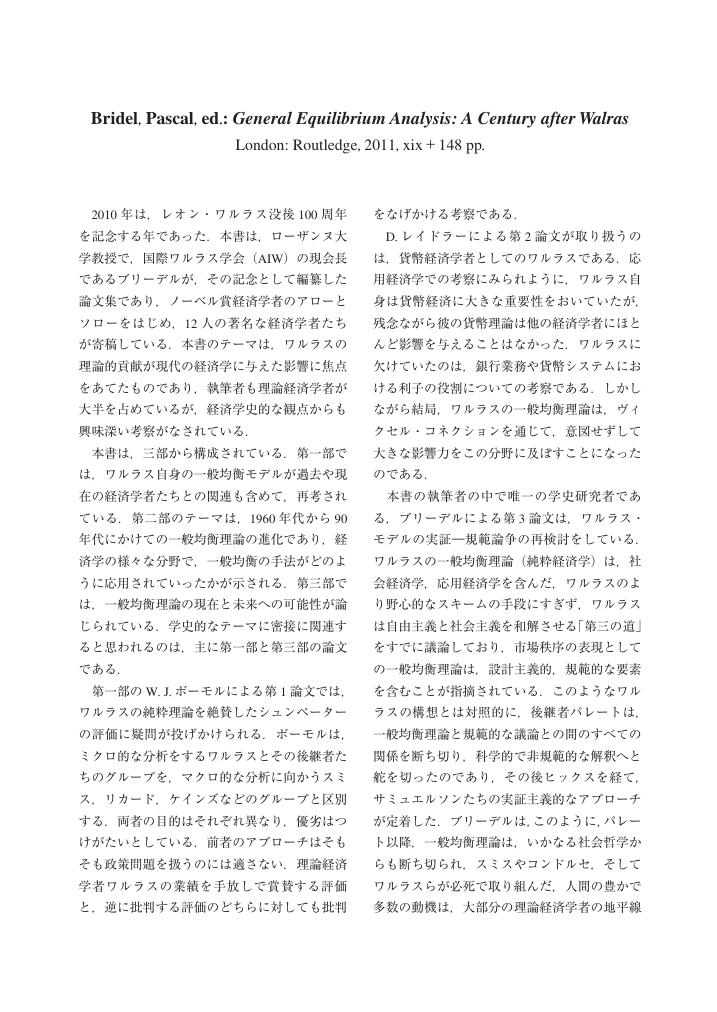
- 著者
- 御崎 加代子
- 出版者
- 経済学史学会
- 雑誌
- 経済学史研究 (ISSN:18803164)
- 巻号頁・発行日
- vol.54, no.2, pp.79-80, 2013 (Released:2019-10-31)