1 0 0 0 OA スーパーコンピュータ利用環境の現状と展望

- 著者
- 構造工学委員会 非線形解析小委員会
- 出版者
- Japan Society of Civil Engineers
- 雑誌
- 土木学会論文集 (ISSN:02897806)
- 巻号頁・発行日
- vol.1990, no.421, pp.43-52, 1990-09-20 (Released:2010-08-24)
- 参考文献数
- 24
- 被引用文献数
- 1
1 0 0 0 OA 合成樹脂塗料と石油化学

- 著者
- 田中 芳雄
- 出版者
- 一般社団法人 色材協会
- 雑誌
- 色材協会誌 (ISSN:0010180X)
- 巻号頁・発行日
- vol.30, no.9, pp.483-489, 1957-12-30 (Released:2012-11-20)
- 著者
- Masaki TORIMURA Shinya KURATA Kazutaka YAMADA Toyokazu YOKOMAKU Yoichi KAMAGATA Takahiro KANAGAWA Ryuichiro KURANE
- 出版者
- (社)日本分析化学会
- 雑誌
- Analytical Sciences (ISSN:09106340)
- 巻号頁・発行日
- vol.17, no.1, pp.155-160, 2001 (Released:2005-04-20)
- 参考文献数
- 48
- 被引用文献数
- 166 304
Fluorescently labeled oligonucleotide probes have been widely used in biotechnology, and fluorescence quenching by the interaction between the dyes and a nucleobase has been pointed out. This quenching causes big problem in analytical methods, but is useful in some other cases. Therefore, it is necessary to estimate the fluorescence quenching intensity under various conditions. We focused on the redox properties of some commercially available fluorescent dyes, and investigated dye-nucleotide interactions between a free dye and a nucleotide in aqueous solution by electrochemical and spectroscopic techniques. Our results suggested that the quenching was accompanied by photoinduced electron transfer between a thermodynamically quenchable excited dye and a specific base. Several kinds of fluorescent dyes labeled to the 5′-end of oligonucleotide C10T6 were prepared, and their quenching ratios compared upon hybridization with the complementary oligonucleotide A6G10. The quenching was completely reversible and their efficiencies depended on the attached fluorophore types. The fluorescence of 5-FAM, BODIPY FL or TAMRA-modified probe was strongly quenched by hybridization.
1 0 0 0 OA 気候変動防止対策技術

- 著者
- 外岡 豊
- 出版者
- 環境技術学会
- 雑誌
- 環境技術 (ISSN:03889459)
- 巻号頁・発行日
- vol.29, no.2, pp.84-87, 2000-02-20 (Released:2010-03-18)
- 参考文献数
- 16
1 0 0 0 OA 諏訪蘇山翁傳之

- 著者
- 小幡 茂
- 出版者
- 公益社団法人 日本セラミックス協会
- 雑誌
- 大日本窯業協會雑誌 (ISSN:03669998)
- 巻号頁・発行日
- vol.30, no.364, pp.619-625, 1922-12-20 (Released:2010-04-30)
1 0 0 0 OA 正誤訂正

- 出版者
- 公益社団法人 日本化学会
- 雑誌
- 工業化学雑誌 (ISSN:00232734)
- 巻号頁・発行日
- vol.31, no.8, pp.705c-705c, 1928 (Released:2011-09-02)
1 0 0 0 OA サイリスタを用いたボルト弾性域締結回路

- 著者
- 浮田 勇 大嶋 健司 灰川 昭三
- 出版者
- パワーエレクトロニクス学会
- 雑誌
- パワー・エレクトロニクス研究会講演論文集 (ISSN:03877043)
- 巻号頁・発行日
- vol.2, pp.87-92, 1976 (Released:2010-07-01)
- 参考文献数
- 6
1 0 0 0 OA 2011年映像情報メディア学会年次大会

- 著者
- 高村 誠之
- 出版者
- 一般社団法人 映像情報メディア学会
- 雑誌
- 映像情報メディア学会誌 (ISSN:13426907)
- 巻号頁・発行日
- vol.65, no.12, pp.1733-1736, 2011 (Released:2013-12-01)
1 0 0 0 OA 3次元加速度と心拍数による日常生活時のエネルギー消費量の推定
- 著者
- 大森 桂 古泉 佳代 鈴木 智恵美 金子 佳代子
- 出版者
- 一般社団法人 日本家政学会
- 雑誌
- 日本家政学会誌 (ISSN:09135227)
- 巻号頁・発行日
- vol.59, no.4, pp.221-229, 2008 (Released:2010-07-29)
- 参考文献数
- 26
- 被引用文献数
- 1
Enhancing the physical activity level has become a significant issue for the Japanese to prevent lifestyle-related diseases. For developing a simple and valid method to assess daily energy expenditure, we measured the energy expended by several physical activities in 13 young Japanese adults using the portable expiration gas metabolic monitor. Each subject wore a heart rate monitor on the chest and three-dimensional accelerometers on the wrist, waist and ankle. The energy expenditure was correlated with the heart rate and with the acceleration at the wrist, waist and ankle. Energy expenditure showed higher correlation coefficients with the acceleration at the waist and ankle than at the wrist. A multiple regression analysis showed that the energy expenditure could be estimated from the accelerations at the wrist and waist, the heart rate, gender, height and weight. The results indicate that measuring both the body acceleration and heart rate was important for developing a simple and valid method to assess daily energy expenditure.
1 0 0 0 OA t-ブトキシカルボニル-L-アスパラギン (BocASN)の結晶形状に及ぼす溶媒の影響

- 著者
- 平野 優 五十嵐 幸一 大嶋 寛
- 出版者
- 公益社団法人 化学工学会
- 雑誌
- 化学工学会 研究発表講演要旨集 化学工学会第39回秋季大会
- 巻号頁・発行日
- pp.228, 2007 (Released:2008-03-17)
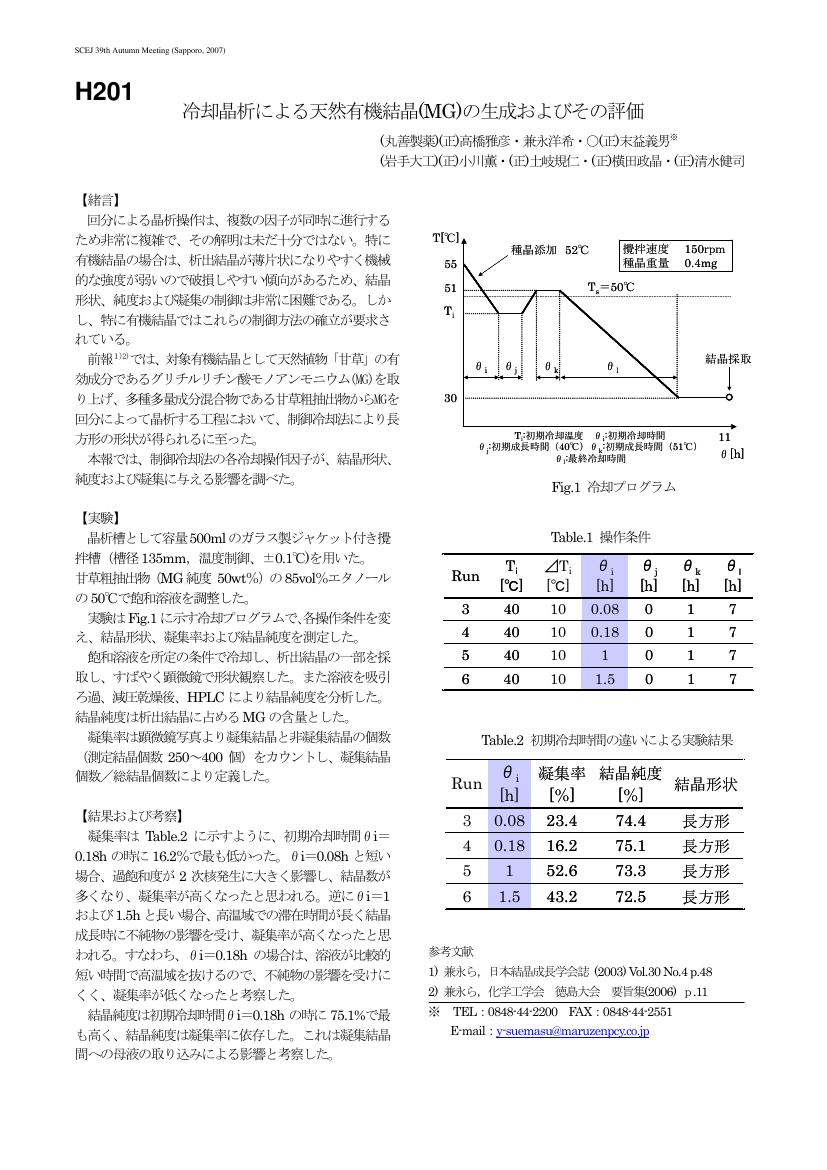
1 0 0 0 OA 冷却晶析による天然有機結晶(MG)の生成およびその評価
- 著者
- 小川 薫 土岐 規仁 横田 政晶 清水 健司 高橋 雅彦 兼永 洋希 末益 義男
- 出版者
- 公益社団法人 化学工学会
- 雑誌
- 化学工学会 研究発表講演要旨集 化学工学会第39回秋季大会
- 巻号頁・発行日
- pp.223, 2007 (Released:2008-03-17)
1 0 0 0 OA アミノ酸系冷却晶析における超音波照射による一次核化の挙動

- 著者
- 黒谷 正博 海老原 聡美 平沢 泉
- 出版者
- 公益社団法人 化学工学会
- 雑誌
- 化学工学会 研究発表講演要旨集 化学工学会第39回秋季大会
- 巻号頁・発行日
- pp.221, 2007 (Released:2008-03-17)
1 0 0 0 OA 核発生および結晶成長への超音波効果-未飽和領域での検討-

- 著者
- 後藤 雄一 加藤 尚武 平沢 泉
- 出版者
- 公益社団法人 化学工学会
- 雑誌
- 化学工学会 研究発表講演要旨集 化学工学会第39回秋季大会
- 巻号頁・発行日
- pp.220, 2007 (Released:2008-03-17)
1 0 0 0 OA 有機化合物の過冷却溶液に対する超音波照射が一次核化に及ぼす影響

- 著者
- 小寺 孝憲 黒谷 正博 平沢 泉
- 出版者
- 公益社団法人 化学工学会
- 雑誌
- 化学工学会 研究発表講演要旨集 化学工学会第39回秋季大会
- 巻号頁・発行日
- pp.219, 2007 (Released:2008-03-17)
1 0 0 0 OA L-アラニンの核発生挙動

- 著者
- 竹内 千尋 五十嵐 幸一 大嶋 寛
- 出版者
- 公益社団法人 化学工学会
- 雑誌
- 化学工学会 研究発表講演要旨集 化学工学会第39回秋季大会
- 巻号頁・発行日
- pp.217, 2007 (Released:2008-03-17)
1 0 0 0 OA 種晶無添加系回分冷却晶析の未飽和操作を利用した粒径分布の改善

- 著者
- 今成 実季 江川 絢音 滝山 博志
- 出版者
- 公益社団法人 化学工学会
- 雑誌
- 化学工学会 研究発表講演要旨集 化学工学会第39回秋季大会
- 巻号頁・発行日
- pp.218, 2007 (Released:2008-03-17)
1 0 0 0 OA アミノ酸添加による炭酸カルシウム結晶のモルフォロジー制御

- 著者
- 中川 究也 北川 輝幸 北村 光孝
- 出版者
- 公益社団法人 化学工学会
- 雑誌
- 化学工学会 研究発表講演要旨集 化学工学会第39回秋季大会
- 巻号頁・発行日
- pp.216, 2007 (Released:2008-03-17)
1 0 0 0 OA 官能基置換によるBPT誘導体結晶の析出挙動ならびに結晶構造への影響

- 著者
- 原 崇行 足立 浩介 北村 光孝
- 出版者
- 公益社団法人 化学工学会
- 雑誌
- 化学工学会 研究発表講演要旨集 化学工学会第39回秋季大会
- 巻号頁・発行日
- pp.210, 2007 (Released:2008-03-17)
1 0 0 0 OA トリアシルグリセロールの結晶化に及ぼす圧力の影響

- 著者
- 山本 英二 石本 裕一 安部 伸宏 松井 岐美 村田 哲章 高橋 俊介
- 出版者
- 公益社団法人 化学工学会
- 雑誌
- 化学工学会 研究発表講演要旨集 化学工学会第39回秋季大会
- 巻号頁・発行日
- pp.202, 2007 (Released:2008-03-17)
1 0 0 0 OA 分岐鎖アミノ酸の晶析時における類似構造アミノ酸の相互間取り込み機構

- 著者
- 亀井 利道 長谷川 和宏 冨家 一郎 永井 秀忠 横田 政晶 清水 健司 土岐 規仁
- 出版者
- 公益社団法人 化学工学会
- 雑誌
- 化学工学会 研究発表講演要旨集 化学工学会第39回秋季大会
- 巻号頁・発行日
- pp.225-226, 2007 (Released:2008-03-17)