1 0 0 0 OA 虚構を通じて実在へ――無限小の本性をめぐるライプニッツの数理哲学
- 著者
- 池田 真治
- 出版者
- 日本ライプニッツ協会
- 雑誌
- ライプニッツ研究 (ISSN:21857288)
- 巻号頁・発行日
- vol.5, pp.81-99, 2018-11-14 (Released:2023-11-14)
1 0 0 0 OA 『百科全書』の哲学史関連諸項目に見るディドロのライプニッツ主義
- 著者
- フォヴェルグ クレール
- 出版者
- 日本ライプニッツ協会
- 雑誌
- ライプニッツ研究 (ISSN:21857288)
- 巻号頁・発行日
- vol.1, pp.99-114, 2010-12-15 (Released:2023-11-14)
1 0 0 0 OA フロイトの精神分析から考察されるヴィトゲンシュタインの治療的哲学
- 著者
- 林 晃紀
- 出版者
- The Philosophy of Science Society, Japan
- 雑誌
- 科学哲学 (ISSN:02893428)
- 巻号頁・発行日
- vol.56, no.1, pp.1-1, 2023-11-15 (Released:2023-11-15)
- 参考文献数
- 17
The later Wittgenstein's philosophy is often characterized as therapeutic. According to the idea of therapeutic philosophy, Wittgenstein never intends to propound a theory of philosophy; rather he attempts to show us that philosophical problems are merely pseudo-problems generated by philosophical confusions. The aim of this paper is to clarify what Wittgenstein's therapeutic philosophy is. In order to do so, I shall investigate the methodological similarities between Wittgenstein and Freud. I attempt to show that the analysis of Freud's method of psychoanalysis gives us various insights on what Wittgenstein's therapeutic philosophy is.
1 0 0 0 OA 証言的正義の徳から変容的な徳へ
- 著者
- 佐藤 邦政
- 出版者
- The Philosophy of Science Society, Japan
- 雑誌
- 科学哲学 (ISSN:02893428)
- 巻号頁・発行日
- vol.56, no.1, pp.37, 2023-11-15 (Released:2023-11-15)
- 参考文献数
- 34
This paper proposes a transformative virtue that counteracts testimonial injustice by responding to two critiques of the virtue of testimonial justice. First, I demonstrate that self-reflection can function in more varied ways than the direct detection of oneʼs own prejudices, as previously assumed in the literature. Hence, self-reflection can holistically be effective in neutralizing the influence of oneʼs prejudices on oneʼs beliefs. Second, I propose a virtue that encourages epistemic agents to be epistemically acute enough to experience dissonance between perceiving a particular testifier (who is talking in person) as trustworthy and having biased beliefs about the testifierʼs trustworthiness: transformative virtue. Third, I argue that the development of a proper indirect contact theory with relevant epistemic practices can offer epistemic environments that facilitate peopleʼs critical imagination to cultivate a transformative virtue, considering the risk of victimized epistemic agentsʼ vulnerability.
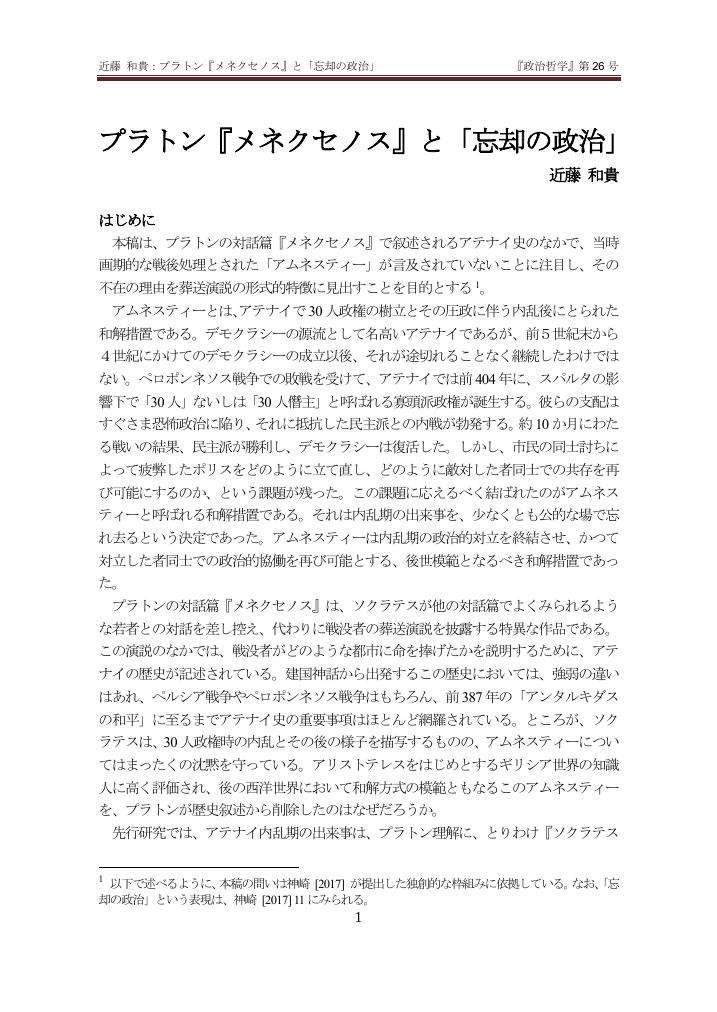
1 0 0 0 OA プラトン『メネクセノス』と「忘却の政治」
- 著者
- 近藤 和貴
- 出版者
- 政治哲学研究会
- 雑誌
- 政治哲学 (ISSN:24324337)
- 巻号頁・発行日
- vol.26, pp.1-18, 2019 (Released:2019-11-01)
- 参考文献数
- 28
1 0 0 0 OA 救出と反復 ベンヤミンとハイデガーの歴史についての思考
- 著者
- 柿木 伸之
- 出版者
- 日本哲学会
- 雑誌
- 哲学 (ISSN:03873358)
- 巻号頁・発行日
- vol.1999, no.50, pp.263-273, 1999-05-01 (Released:2010-01-20)
二つの世界大戦の狭間で、歴史に関する二つの哲学的な理論がほぼ踵を接して構想されていた。人間存在の歴史性を論じたハイデガーの『存在と時間』 (一九二七年) が公刊されたのと同じ頃、ベンヤミンは、未完に終わった『パサージュ論』のための最初の草稿 (一九二七-二九年) を書き始めているのである。この草稿のなかには、歴史哲学についてのいくつかの覚え書きが含まれている。この歴史哲学が後に、彼の絶筆となった『歴史の概念について』に結晶することになるのである。ベンヤミンは、自らの歴史哲学に関する理論的考察を、パリのパサージュから「十九世紀の根源史」 (Urgeschichte) を引き出すべき著作の序論をなすものと考えていたようである。ゲルショム・ショーレムに宛てた書簡 (一九三〇年一月二〇日) において、彼は構想中の『パサージュ論』について、「認識論に関する序論なしですませることはできないだろう」と述べている。「今回それはとくに歴史の認識論に関するものでなくてはなるまい。」『パサージュ論』は、この「歴史の認識論」を提示する序論をもたなければならないというのである。ベンヤミンはさらに同じ書簡で、「歴史の認識論」の形成にあたって、ハイデガーとの対決が不可避であることを示唆している。「そこで私は途上にハイデガーを見いだすことだろう。そして私は、私たち二人のきわめて異なった歴史の見方の衝突から、何か火花が飛び散るのを期待している。」 -(V 1094) 二人の対決-このテクストという舞台の上で繰り広げられることのなかった対決が火花を散らすものであるのは、二人が対立しあう思考を同じ焦点に集中させているときであろう。ここで私は、まず彼らの思考が集中する一点を探り当て、そしてそこでせめぎあうベンヤミンとハイデガーの歴史についての思考のコントラストを描き出してみたい。それを通じて、ハイデガーが『存在と時間』の時期に語る歴史理解の構造としての「歴史性」とともに、ベンヤミンの歴史哲学の一端を浮き彫りにすることができればと思う。
1 0 0 0 OA 体育の学習内容としての身体観:「表現運動・ダンス」領域の学習を考えるために
- 著者
- 寺山 由美
- 出版者
- 日本体育・スポーツ哲学会
- 雑誌
- 体育・スポーツ哲学研究 (ISSN:09155104)
- 巻号頁・発行日
- vol.42, no.2, pp.49-63, 2020 (Released:2021-08-11)
- 参考文献数
- 78
The purpose of this study is to clarify the validity of taking a physical view as a learning content of physical education. To exist as a subject, it will be necessary to clarify the educational significance that is not just a movement but a formal lesson. For that purpose, it is necessary to consider how to guide the learner's body in physical education. In order for learners to grasp their bodies that cannot be separated for their lifetime, it is considered necessary to focus on the development of a view of the body as the learning content that physical education plays.The view of the body can be said to be the way of seeing the body and the way of understanding the body. In other words, for <me>, asking what is the body is the training of the view of the body. Developing a view of the body involves asking what is the body for <me> and at the same time asking what is <I>. The development of a view of the body becomes possible through exercise practice, and the process in which the learner continues to seek his or her own view of the body is important. For <me>, fostering a view of the body asking "what is the body" can be a universal educational content of physical education that does not change with the times and regions as a reasonable educational significance.In addition, the study in this study is considered as the ground for thinking about learning in the "expression activity and dance" area. That is, if the body view can be the learning content in physical education, it is possible to propose a learning content in a “expression activity and dance” area different from before.
1 0 0 0 OA 自己は環境に適応すべきか 前期デューイ「進化と倫理」における非進化論的前提をめぐって
- 著者
- 柴田 悠
- 出版者
- 日本哲学会
- 雑誌
- 哲学 (ISSN:03873358)
- 巻号頁・発行日
- vol.2008, no.59, pp.179-193,L17, 2008-04-01 (Released:2010-07-01)
The aim of this paper is to answer the following two questions: (Q1) How valid is the widely believed proposition that each agent (i. e. an individual or a social group functioning as an agent) should adapt to its environment? and, (Q2) If this proposition needs revision, in what way should we revise it? In order to answer Q1, we trace the historical lineage of thinking about evolution-ethics from Galton through Darwin, Spencer, and Huxley to early Dewey. This survey reveals that the widely believed proposition appeared first in that lineage in the early Dewey's ‘Evolution and Ethics’ (1898), and that it depends on the following two un-evolutionary premises: first, that if X is an agent, what is desired by X is ethically good to X (P1: a familiar form of ethical naturalism), and second, that the responsibility for X's adaptation (or adjustment) to X's environment should be attributed only to X (P2: the principle of self-responsibility).Whether P1 is valid or not is too large a question to address in this paper, so we will suppose for the sake of argument that P1 is acceptable. However, it is possible to argue, both from evolution itself and from P1, that P2 is not tenable, and that a premise more appropriate than P2 is that whether the responsibility for X's adaptation to X's environment should be attributed to X alone, or to both X and X's social environment (i. e. other agents concerned with X), should depend on whether X prefers to take the whole responsibility or to share it with the social environment (P3: the principle of the agent's choice of responsibility scope).Thus we can say, in response to Q1, that the widely believed proposition is not valid (at least as we have it from the early Dewey) because it depends on P2. And we can say, in response to Q2, that a more appropriate version of it will be based on evolution, P1 (perhaps), and P3 (probably)-though within the confines of the present paper, P1 and P3 obviously remain conjectural.
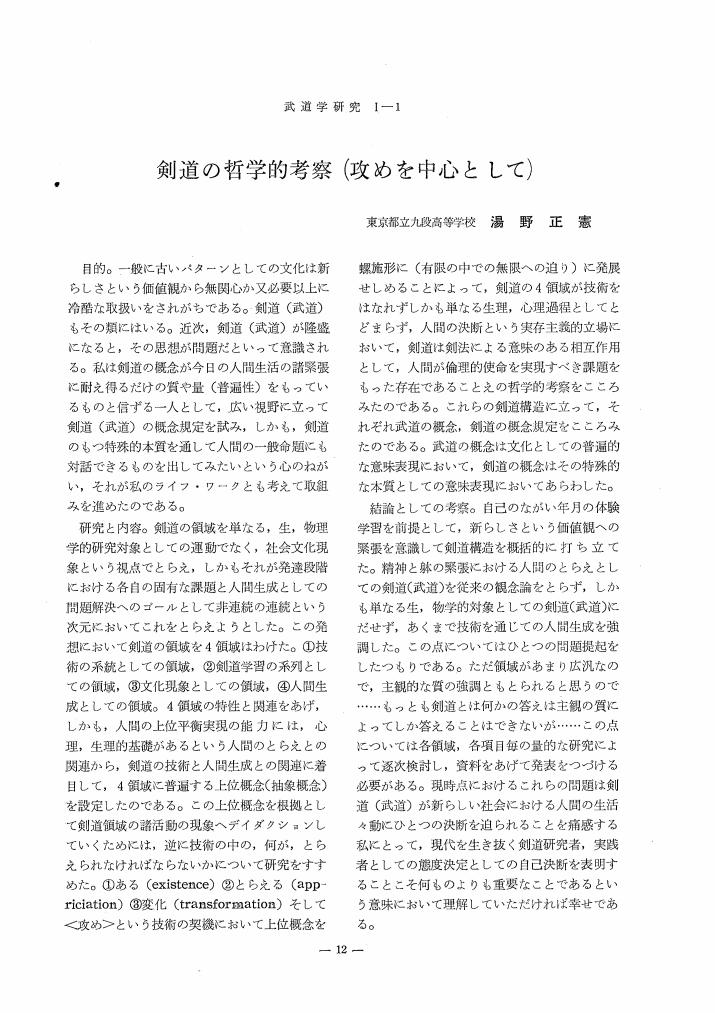
1 0 0 0 OA 剣道の哲学的考察(攻めを中心として)
- 著者
- 湯野 正憲
- 出版者
- 日本武道学会
- 雑誌
- 武道学研究 (ISSN:02879700)
- 巻号頁・発行日
- vol.1, no.1, pp.12, 1968-12-25 (Released:2012-11-27)
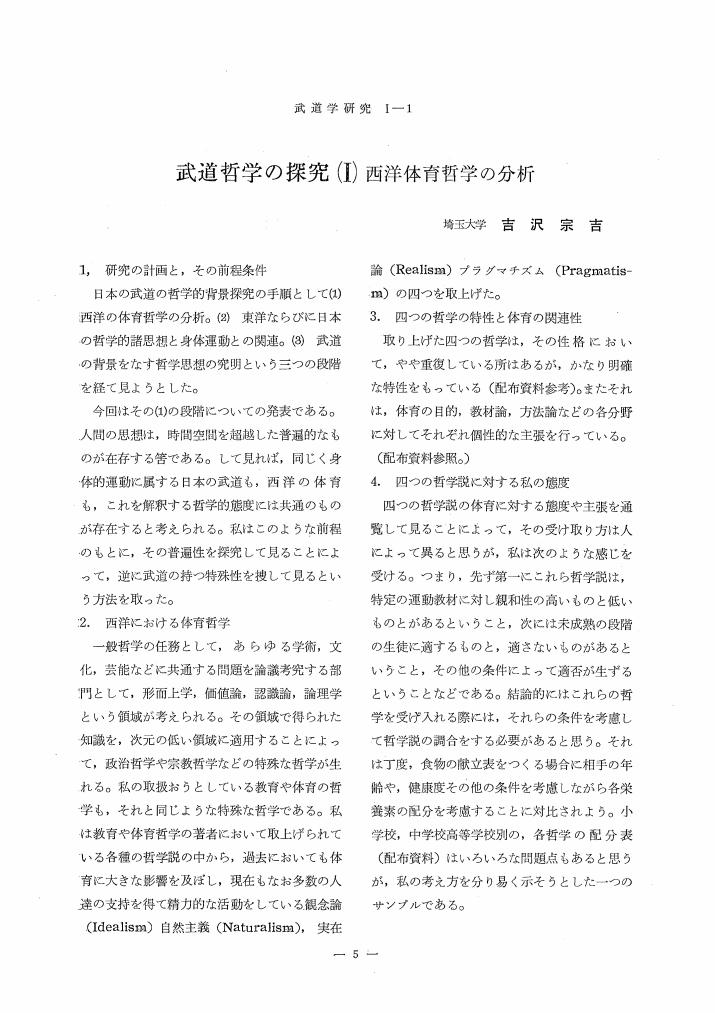
1 0 0 0 OA 武道哲学の探究(I)西洋体育哲学の分析
- 著者
- 吉沢 宗吉
- 出版者
- 日本武道学会
- 雑誌
- 武道学研究 (ISSN:02879700)
- 巻号頁・発行日
- vol.1, no.1, pp.5, 1968-12-25 (Released:2012-11-27)
1 0 0 0 OA 宙吊りの視点だけに自己は宿るか?身体的自己意識研究の新潮流をつくる身体不在錯覚
身体と自己の関係に関する研究は哲学的探求のみならず、神経疾患や精神疾患に伴う身体感覚変容の病理解明や療法応用のためにも発展が望まれる領域である。最近では身体的自己意識研究が加速しており、特に代替物を自身の身体だと感じさせる錯覚実験が主に行われている。しかし、従来の実験はその手続き上の制約により、錯覚の生起過程を検証できず、錯覚強度も弱いという問題がある。本研究ではこの問題に対するひとつの解決策を提案するために、宙吊りの視点だけに自己を感じる『身体不在』体験を生み出す新規実験系を開発し、身体不在のまま体験者が歩行することで生じる感覚を心理・生理・行動の側面から検証・分析する。
1 0 0 0 OA 日本の哲学と社会学
- 著者
- 丸山 徳次
- 出版者
- 関西社会学会
- 雑誌
- フォーラム現代社会学 (ISSN:13474057)
- 巻号頁・発行日
- vol.4, pp.26-34, 2005-05-28 (Released:2017-09-22)
日本の大学における社会学のありようについての社会学者による反省は、哲学者による哲学についての反省と極めて類似している。第一に「暗い」とか「かたい」とかいったイメージや世間的評価に悩む点で類似している。第二に、理論や方法論の紹介や研究が、現実社会の問題の究明よりも尊重される、ということに対する学問の現状批判の点で類似している。第三に、学問構造が類似している。社会学は、近代における社会諸科学の成立と連動しながらも「最後の社会科学」と言われるが、それはまた、哲学から自立していった「最後の科学」でもある「越境する知」としての社会学の不安定さは、ハードなパラダイム科学となり得ない学の宿命であると同時に、絶えざる自己反省を必然とする哲学的性格にもよる。こうして、大学教育のあり方への反省は、学およびその対象(近代社会)の生成についての歴史的反省と結びつく必要があるし、それを教育に生かす必要がある。また、当の学問の意義自体を反省すると同時に、新しい制度化を考えることにつながらねばならない。そこで一つのヒントを与えているのは、応用倫理学の新たな胎動である。応用倫理学は、科学技術の高度の発達がもたらす社会問題に応答するものである。こうした時代と社会の「切実な問題」の解決には、多様な専門家が参集する「問題共同体」が形成される必要がある。社会学がそこで期待されるのは、社会調査の能力であって、哲学的自己反省の能力ではない。
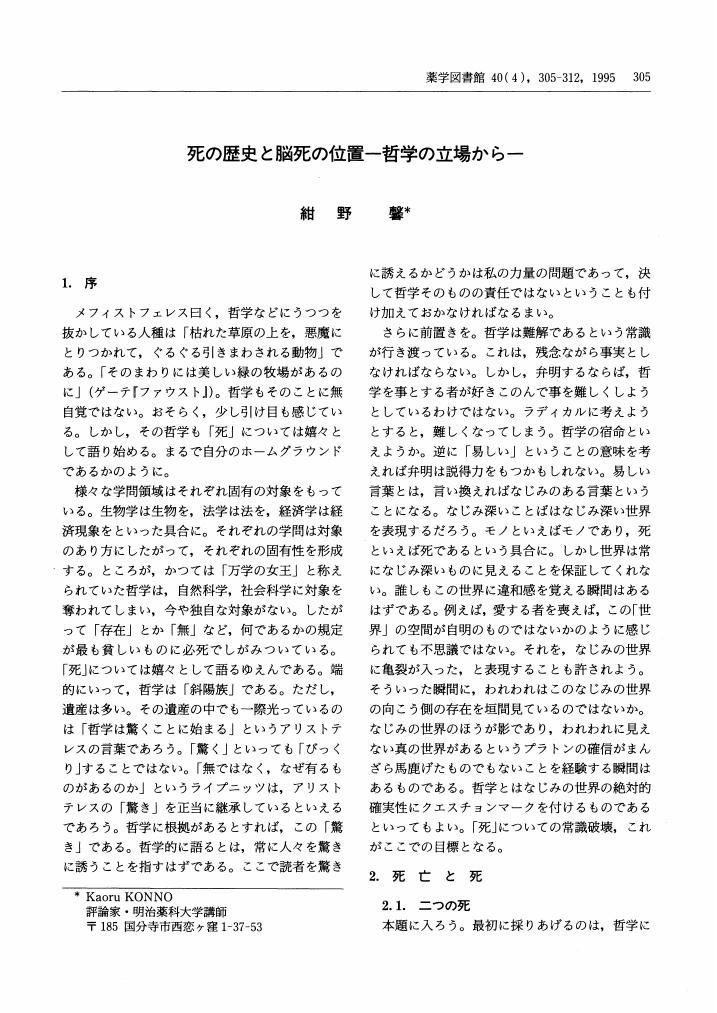
1 0 0 0 OA 死の歴史と脳死の位置―哲学の立場から―
- 著者
- 紺野 馨
- 出版者
- 日本薬学図書館協議会
- 雑誌
- 薬学図書館 (ISSN:03862062)
- 巻号頁・発行日
- vol.40, no.4, pp.305-312, 1995-10-31 (Released:2011-09-21)
- 参考文献数
- 13
1 0 0 0 解釈主義の心の哲学 : 合理性の観点から
1 0 0 0 経験論から言語哲学へ
- 著者
- 勢力尚雅 古田徹也著
- 出版者
- 放送大学教育振興会
- 巻号頁・発行日
- 2016
1 0 0 0 OA ヘラクレイトスのロゴス (覚書)
- 著者
- 加藤 裕
- 出版者
- 日本哲学会
- 雑誌
- 哲学 (ISSN:03873358)
- 巻号頁・発行日
- vol.1959, no.9, pp.1-5, 1959-03-31 (Released:2009-07-23)
- 参考文献数
- 17
周知の通りヘラクレイトスの根本思想は、「万物流転 (ηαντα ρετ) 」である.それは「万物がロゴスに従って (κατα τον λογον) 生起する」 (H. Diels: Fr. der Vorsokratiker. Fr. 1) ことである.それ故「万物流転」の思想を把握する最大の鍵は「ロゴス」にあると言うことができる.「万物」及び「流転」ということに根拠がないと言う訳ではもとよりないのであるが、言わば「万物流転」という根源体験に理性的照明を与えるものが、「ロゴス」であると言うことはできるのではあるまいか.小論は、その「ロゴス」に焦点を合せたヘラクレイトス研究の覚書である.
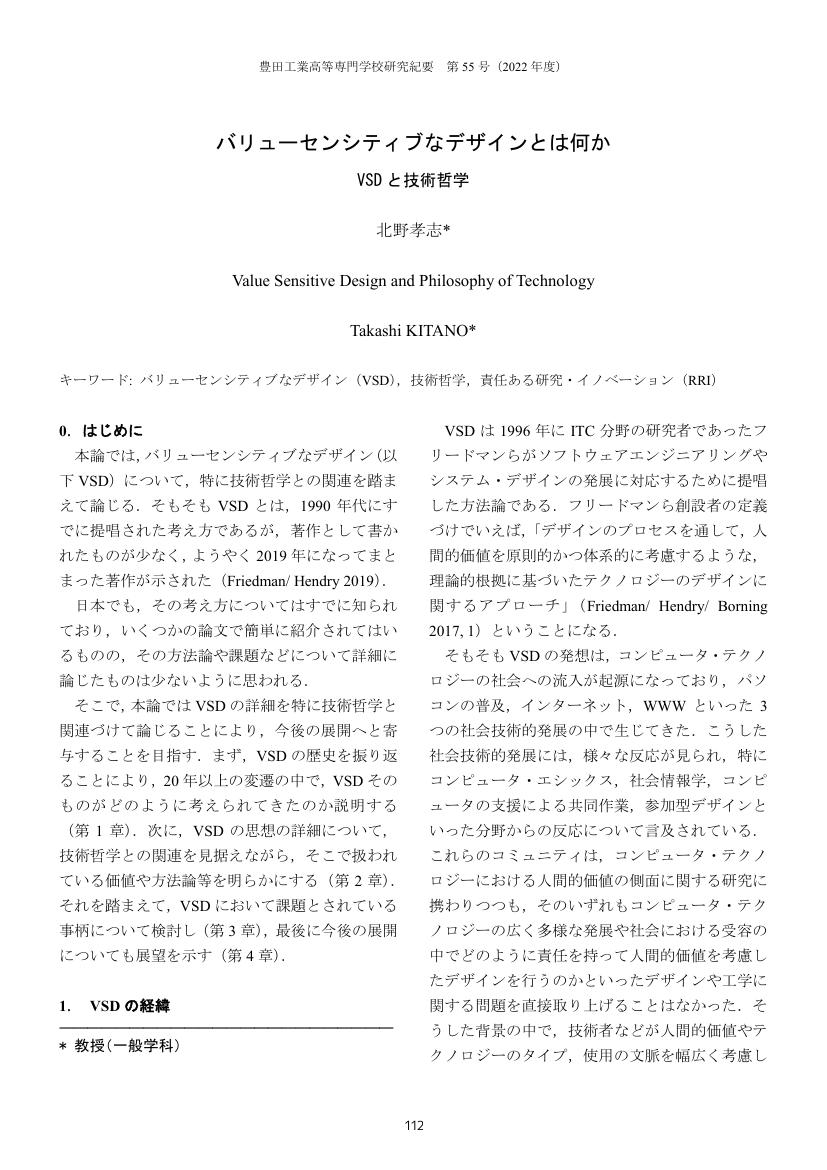
1 0 0 0 OA バリューセンシティブなデザインとは何か VSDと技術哲学
- 著者
- 北野 孝志
- 出版者
- 独立行政法人 国立高等専門学校機構豊田工業高等専門学校
- 雑誌
- 豊田工業高等専門学校研究紀要 (ISSN:02862603)
- 巻号頁・発行日
- vol.55, pp.55-6, 2023 (Released:2023-02-03)
1 0 0 0 OA 未来の人間学的考察 -VE.フランクル『夜と霧』を通して一
- 著者
- 眞次 浩司
- 出版者
- 九州医学哲学・倫理学会
- 雑誌
- 人間と医療 (ISSN:21863482)
- 巻号頁・発行日
- vol.3, pp.31-39, 2013 (Released:2022-03-07)
We ponder the future (in die Zukunft sehen). Why do we ponder the future? It is because the future is an area that is undecided, open, and uncertain. Therefore, we ponder the future. Still, the future is uncertain for us. Despite the fact that the future is uncertain, we ponder the future. This study, then, addresses whether there is any meaning for us in pondering the uncertain future. Specifically, the question is this: "what meaning is there for us to ponder the future?" In order to investigate this question, the paper examines passages from Man s Search for Meaning (Ein Psychologe erlebt das Konzentrationslager) by V. E. Frankl from the perspective of philosophical anthropology, shedding light on what it means for us to ponder the future. The study shows that when we ponder the future, we form a situation that emerges from our daily life. Moreover, it is characterised by subtle and unremarkable expectation which is emotional (Gefühl) and related to our mood (Stimmung). It refers to an open situation in which a meaning is realised and autonomous decision making by each individual is required through experiential encounters among human beings and between human beings and the world. Under certain circumstances, we no longer depend upon the system of norms which corresponds to the view of human beings that has already been confirmed. Each time we ponder the future, cach time we continue to ponder the future, we renew our expectation, hope, and prayer. The meaning of pondering the future is found in this state where we do not let go of it while we give up on it.
1 0 0 0 OA 哲学の戦い ――歴史における、世界のための――
- 著者
- 中田 光雄
- 出版者
- 日本哲学会
- 雑誌
- 哲学 (ISSN:03873358)
- 巻号頁・発行日
- vol.2009, no.60, pp.101-120_L7, 2009 (Released:2010-11-09)
Après la grandeur et les défauts de l’idée de l’histoire des philosophies chez Hegel homme moderne allemand, et aprés la raison et les déraisons du discours post-moderne de l’endisme: la fin de la philosophie, de l’histoire, de l’homme, etc., on trouve et retrouve Bergson, avec Heidegger, Derrida, mettant en question l’histoire de la philosophie, et surtout ouvrant le champ philosophique sur le réel concret: devenir-durée-différence qualitative contre l’être logique, intellectuel, intemporel, immobile, vainqueur du néant, qui n’est qu’une pseudo-idée; Sein-Lichtung-Differenz ontologique qui se donne à travers l’expérience existentiale du néant contre la métaphysique de l’étant et de la subjectivité; différence-différance grammatologique contre l’idée de l’identité de la méta-physique de la présence et du logocentrisme. Tous les trois s’arrêtent plutôt, cependant, dans une hantologie, une méditation ésotérique, une intuition mystique et d’ailleurs pessimiste. Les bons résultats des pensées d’aujourd’hui, y compris celles de Foucault, Deleuze, Badiou, stiegler devront se transposer dans un champ plus ouvert, par exemple, non pas dans l’histoire des philosophies, mais plutôt dans une praxiologie philosophique dans l’histoire réelle et vivante.