3 0 0 0 OA あの世、そして恋する身体
- 著者
- 村上 靖彦
- 出版者
- 宗教哲学会
- 雑誌
- 宗教哲学研究 (ISSN:02897105)
- 巻号頁・発行日
- vol.32, pp.55-66, 2015-03-31 (Released:2018-08-28)
En partant de l’analyse phénoménologique des entretiens effectués avec les infirmières et les sages-femmes, je voudrais dégager quelques points qui touchent ce qu’on pourrait appeler « religiosité » au milieu même de notre civilisation non-religieuse.D’abord, l’infirmière recourt implicitement mais très souvent à l’« utopie », à savoir à un temps irréalisable où le patient et la famille retrouvent l’intimité, où on peut affirmer l’être du patient et où le patient retrouve la possibilité de la jouissance.Deuxièmement, le patient, la famille et l’infirmière imaginent ensemble une corporéité vivante des morts, pour que le patient retrouve sa « vie » après la mort et que les vivants retrouvent un bon rapport avec le décédé.Enfin et troisièmement, toutes les infirmières ont présupposé une temporalité non-linéaire. Au lieu du temps qui court du passé au futur en passant le moment présent, la pratique du soin palliatif se base sur une temporalité pour ainsi dire « verticale » où le moment présent se rivalise avec la totalité de l’horizon du temps ou avec l’utopie où la vie et la mort se recouvrent.
3 0 0 0 OA 現前と不在 ミシェル・ド・セルトーの神秘主義研究
- 著者
- 鶴岡 賀雄
- 出版者
- 宗教哲学会
- 雑誌
- 宗教哲学研究 (ISSN:02897105)
- 巻号頁・発行日
- vol.19, pp.13-28, 2002 (Released:2019-03-21)
How is the term “mysticism” used today? Does this term remain scientifically or philosophically significant? Michel de Certeau’s works on the mysticism (la mystique) are provocative attempts to confront this problem. In this paper I recapitulate Certeau’s concept of mysticism, by examining (in chronological order) his important texts on the subject. Though his manner of writing and methodological procedures became progressively more sophisticated and his analyses of the historical contexts of both past mystics and contemporary scholars developed over time, I believe that his understanding of the nature of mysticism remained essentially the same from his earliest treatise to his last. For Certeau, mysticism is the “impossible investigations” of individuals who are seized by a desire to situate the ineffable encounter with the Infinite (what Christians may call God) in the historical reality of this world, through language, action and interaction. However, Certeau maintains that mystical endeavours are always doomed to fail, as the Infinite can never be completely situated in this world. Thus, driven by a desire to fill the void created by the absence of the ineffable, mystics cannot avoid going beyond conventional representations (theories, practices, institutions, experiences, etc.) of the Infinite in order to find more adequate means of expression. This conceptualization of mysticism that does not emphasize the moment of presence of the Infinite in mystical experiences but rather stresses a profound sense of its absence, provides new ways in which to interpretate the writings and actions of mystics, and new ways in which to further consider the nature of the Infinite itself.
3 0 0 0 OA 展望:黒人イスラムの世界からみたイスラム教倫理の一側面

- 著者
- 嶋田 義仁
- 出版者
- 宗教哲学会
- 雑誌
- 宗教哲学研究 (ISSN:02897105)
- 巻号頁・発行日
- vol.3, pp.87-94, 1986 (Released:2018-03-14)
3 0 0 0 OA 「人道に対する罪」処罰の今日的展開 国内立法および国内裁判に着目して

- 著者
- 岡田 泉
- 出版者
- 世界法学会
- 雑誌
- 世界法年報 (ISSN:09170421)
- 巻号頁・発行日
- vol.1996, no.15, pp.49-70, 1996-03-20 (Released:2011-02-07)
- 参考文献数
- 55
3 0 0 0 OA 世界連邦運動からみた国際連合
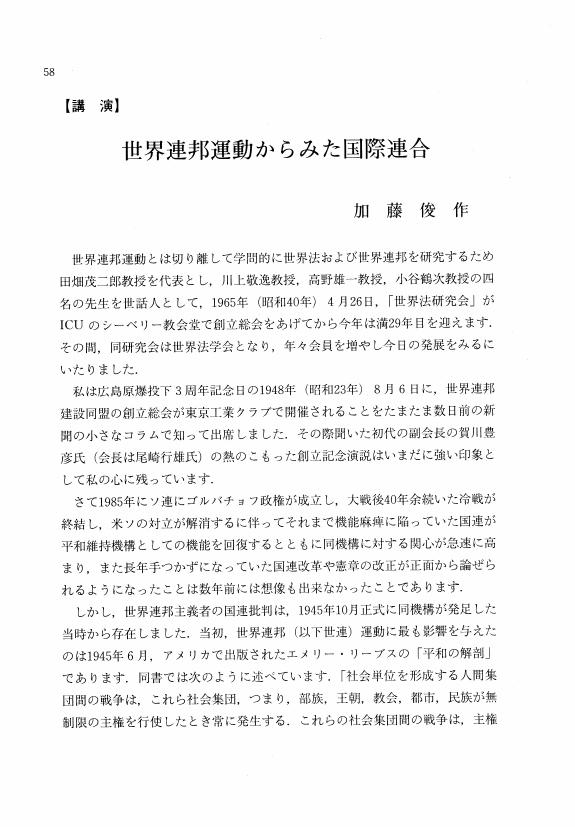
- 著者
- 加藤 俊作
- 出版者
- 世界法学会
- 雑誌
- 世界法年報 (ISSN:09170421)
- 巻号頁・発行日
- vol.1994, no.14, pp.58-66, 1994-12-20 (Released:2011-02-07)
3 0 0 0 OA 国際機構と国際社会の組織化 米国のユネスコ脱退を中心的素材として

- 著者
- 最上 敏樹
- 出版者
- 世界法学会
- 雑誌
- 世界法年報 (ISSN:09170421)
- 巻号頁・発行日
- vol.1986, no.6, pp.15-28, 1986-10-15 (Released:2011-02-07)
- 参考文献数
- 13
3 0 0 0 小特集 日独中における産業IoTの展開と科学技術体制
- 著者
- 中村真悟、杉本通百則、永島昴、藤谷麻菜、山崎文徳、兵藤友博、高橋信一、田口直樹
- 出版者
- 日本科学史学会
- 雑誌
- 科学史研究 (ISSN:21887535)
- 巻号頁・発行日
- vol.59, no.295, pp.215-221, 2020 (Released:2021-01-24)
3 0 0 0 OA ロマン主義的主体の形成とメディアとの関わりについて 活字と貨幣に媒介された主体化の様相
- 著者
- 清家 竜介
- 出版者
- 経済社会学会
- 雑誌
- 経済社会学会年報 (ISSN:09183116)
- 巻号頁・発行日
- vol.37, pp.83-93, 2015 (Released:2016-03-25)
If discussed from media theoretical perspective, the media has had a storong influence on the user. Under modern digitized media environment, new Romanticism and political Romanticism apper. In preparation for discussing the new Romanticism, this paper asks the media theory conditions to enable the Romantic movements and Romantic subjectivities in the early 19th century from the late 18th century. This subject should become an indispensable work for consideration of the new Romanticism and political Romanticism.
3 0 0 0 OA 経済社会学と「社会の理論」プロジェクト

- 著者
- 馬場 靖雄
- 出版者
- The Society of Economic Sociology
- 雑誌
- 経済社会学会年報 (ISSN:09183116)
- 巻号頁・発行日
- vol.37, pp.10-20, 2015 (Released:2016-03-25)
3 0 0 0 OA 塩野谷祐一の経済倫理学 卓越主義の構想を中心に
- 著者
- 斉藤 尚
- 出版者
- 経済学史学会
- 雑誌
- 経済学史研究 (ISSN:18803164)
- 巻号頁・発行日
- vol.61, no.1, pp.45-65, 2019 (Released:2019-10-01)
Abstract: This article aims to demonstrate Yuichi Shionoya’s theory of economic ethics by classifying his study into early, middle, and later stages and focusing on his conception of perfectionism. His theory is composed of ethics and economics. In early and later stages, Shionoya proposes his notion of ethics as one category of liberal perfectionism by demonstrating the relationship between the concepts of justice, goodness, and virtue. Part of its originality is that it is defined as being compatible with the pursuit of common good, which is the main purpose of welfare economics. Moreover, he proposes three kinds of economics: economic sociology, economic statics, and economic dynamics in the middle and later stages. He argues that a society in which liberal perfectionism prevails can be realized by the elitist method that he demonstrates in economic sociology. Thus, Shionoya attempts to construct his economic ethics as “universal social science” by integrating the ideas of political philosophy and welfare economics and showing consistency in his entire study. This article questions the consistency of Shionoya’s theory of economic ethics. The rest of this article is organized as follows. First, we classify Shionoya’s study and show that his main purpose is to construct an alternative theory by criticizing neoclassical economics. Second, we clarify his view of perfectionism by showing his ethical system. We then outline his theory of economic ethics by analyzing his economics and clarifying his method of institutional reform. Finally, we express doubt as to whether reform can lead to his concept of an ideal society. JEL classification numbers: B31, O31.
3 0 0 0 OA 石橋湛山の経済理論 古典派的側面を中心に
- 著者
- 布施 豪嗣
- 出版者
- 経済学史学会
- 雑誌
- 経済学史研究 (ISSN:18803164)
- 巻号頁・発行日
- vol.60, no.2, pp.1-19, 2019 (Released:2019-09-04)
Abstract: Although the relationship between liberalism and his political thought has been emphasized, the classical aspect of his economic theories has been underestimated. This has, in my view, several reasons: To be sure, Ishibashi was one of those who had introduced Keynesian economics and his idea of positive fiscal policy. At the same tine, Ishibashi also admitted the rigidity of the market system. But this aspect of his economics did not prevent him to be committed to the classical economic theories, based on free market. It is characteristic of Ishibashi that these aspects existed together in theory and in practice. Based on this understanding, this paper attempts to reveal his optimism about price adjustment. This, in my understanding, led to his basic optimism about inflation. Thus, the study contributes to the better understanding of Ishibashi’s economic thought in particular and also to the better understanding of the many-layered disputes in his age in general. JEL classification number: B31.
3 0 0 0 OA バーク経済思想研究の最前線 「バークとスミス」はどのように論じられてきたのか

- 著者
- 中澤 信彦
- 出版者
- 経済学史学会
- 雑誌
- 経済学史研究 (ISSN:18803164)
- 巻号頁・発行日
- vol.60, no.2, pp.102-105, 2019 (Released:2019-09-04)
3 0 0 0 OA アダム・スミス研究の動向 過去10年における内外の『国富論』研究を中心に
- 著者
- 渡辺 恵一
- 出版者
- 経済学史学会
- 雑誌
- 経済学史研究 (ISSN:18803164)
- 巻号頁・発行日
- vol.53, no.1, pp.100-118, 2011 (Released:2019-08-21)
This paper aims to review the scholarship on Adam Smithʼs The Wealth of Nations (WN) in the past decade. The publication of The Glasgow Edition of the Works and Correspondence of Adam Smith (1976―1987) led to the so-called “Adam Smith Renaissance” that has encouraged many scholars from different disciplines to con-duct interdisciplinary or multidisciplinary stud-ies on Smith. In addition to the studies on Scot-tish Enlightenment, the establishment of the In-ternational Adam Smith Society (IASS) in 1995 and the publication of the Adam Smith Review (ASR) in association with the IASS since 2004 further promoted interdisciplinary studies on Smith. Thus, the interdisciplinary wave of interest in Smithʼs moral philosophy is an outstanding feature of the latest scholarship on Smith. How-ever, as the interdisciplinary studies on Smith have advanced increasingly, there has been a definite waning of interest in his economics con-cerning WN. This phenomenon is indicated straightforwardly in Den Uyl (2008, 4) who mentions that “We can no longer say that WN is somehow the ʻessentialʼ Smith” and in Forman-Barzilai (2008, 219) who affirms that “Smithʼs political economy itself was not the centre on his thought, but rather its place in a lager project of moral philosophy.” Part I of this paper is a prologue to the man-ner in which the WN was studied in the past dec-ade. Part II discusses two excellent foreign works, Fleischackerʼs On Adam Smithʼs Wealth of Nations (2004) and Aspromourgosʼ The Sci-ence of Wealth (2009). These two books sharply contrast with each other, because the former has a philosophical approach to WN, while the latter adopts an orthodox style used by economic his-torians. Part III considers the scholarship on the WN in Japan. Inamuraʼs Reconsideration of the system of The Wealth of Nations (2003), Ta-jimaʼs Adam Smithʼs Institutional Economics (2003), and Takemotoʼs Across The Wealth of Nations (2005) will be mainly reviewed in this paper. In part III, I aim to ascertain the ortho-doxy of our scholarship on WN and its transfigu-ration in comparison with the scholarship abroad. Part IV, the epilogue, briefly surveys the origin of WN (Smithʼs political economy) in or-der to understand the nature of modern econom-ics. JEL classification number: B12, B31, A12.
3 0 0 0 OA 新型インフルエンザ流行時における一般住民の外出自粛に関する意識の検討
- 著者
- 菅原 民枝 杉浦 正和 大日 康史 谷口 清州 岡部 信彦
- 出版者
- 一般社団法人 日本感染症学会
- 雑誌
- 感染症学雑誌 (ISSN:03875911)
- 巻号頁・発行日
- vol.82, no.5, pp.427-433, 2008-09-20 (Released:2011-02-07)
- 参考文献数
- 8
- 被引用文献数
- 3
[目的]新型インフルエンザの対策計画が各国で策定されているが, 未知の感染症であるため, 感染の拡大については数理モデルを用いて検討されている. しかしながら, 数理モデルで検証するためのパラメーターがわからない. そこで本研究は第一に新型インフルエンザを想定して, 個人がどの程度の割合で外出を控える行動をするのかを明らかにし, 第二に外出を控えない行動をする要因を明らかにして, 新型インフルエンザ対策に役立てることを目的とした.[方法]調査はアンケート調査とし, 2007年4月に, 調査会社の保有する全国25万世帯が無作為抽出されているパネルから地域年齢群で層別抽出した2,615世帯とした.調査内容は, 新型インフルエンザ国内発生の場合の外出自粛の選択, 在宅勤務体制, 食料備蓄等とした. 解析は, 外出選択を目的変数とし, 多変量解析を行った.[結果]回答は1727世帯, 有効回答者数は5,381人であった. 新型インフルエンザ国内発生の場合の外出自粛の選択は, 勧告に従わず外出すると思う人が6.7%, 様子を見て外出すると思う人が47.1%, 勧告が解除されるまで自宅にとどまると思う人が46.1%であった.現在災害用に食料備蓄をしている世帯は, 3日分程度が29.9%, 1週間程度が58%, 2週間程度が1.5%, していないが628%であった. また, 今後2週間程度の食料備蓄をする予定の世帯は, 29.6%であった.多変量解析では, 30歳代, 40歳代, 男性, 高齢者の就業者, インフルエンザワクチン接種歴の無い者は, 有意に外出する選択をしていることが明らかになった.[考察]本研究により, 新型インフルエンザを想定した一般市民の外出の選択によって, 数理モデルによる外出自粛の効果が検討できるようになった. 30歳代, 40歳代の「外出する」選択確率が高く, この年齢層に大きな影響を与える要因のひとつとして, 職場の対応があると考えられた. 就業者が外出自粛を選択するような対策として, 企業の経営戦略人事管理面での対策が必要であると示唆された.
3 0 0 0 OA F. ナイトにおける経済学の倫理性と科学性
- 著者
- 藤井 賢治
- 出版者
- The Japanese Society for the History of Economic Thought
- 雑誌
- 経済学史学会年報 (ISSN:04534786)
- 巻号頁・発行日
- vol.38, no.38, pp.134-145, 2000 (Released:2010-08-05)
- 参考文献数
- 35
The Chicago School has changed since Knight's time. Though the modern Chicago School puts an emphasis solely on the positivistic aspect of economics, Knight emphasizes the ethical aspect of economics at the same time. This change corresponds to that of liberalism in Chicago.Putting evaluation of these changes aside, we try to understand why and how Knight thought ethics and economics are inseparable. We find his basic vision of a society to be consisting of problem-solvers. For a person trying to find out what he or she really wants, freedom is needed, not to get the best, but to have a chance to try. Therefore economic activities consist of two interrelated parts: seeking better values and satisfying wants. Correspondingly two kinds of freedom must clearly be distinguished. One is freedom as an end in itself, and the other is freedom as an instrument. Of course, freedom as an end in itself can only be defended on ethical grounds.Similarly, scientific activities can be understood as consisting of two parts: seeking “better truth” and getting useful results. According to Knight, defining truth is also a matter of value judgment.Thus, economics is value-loaded in two meanings. One is that the behavior of seeking better values, i. e., freedom as an end in itself, is value-loaded. The other is that truth, which economics as one branch of science explores, is value-loaded.
3 0 0 0 OA フェミニズムと経済学

- 著者
- 安川 悦子
- 出版者
- The Japanese Society for the History of Economic Thought
- 雑誌
- 経済学史学会年報 (ISSN:04534786)
- 巻号頁・発行日
- vol.35, no.35, pp.141-149, 1997 (Released:2010-08-05)
- 参考文献数
- 28
3 0 0 0 OA 音楽づくりについての圏論的考察(1 音・音楽の認識,II 音楽経験と認識)

- 著者
- 松下 行馬
- 出版者
- 日本学校音楽教育実践学会
- 雑誌
- 学校音楽教育研究 (ISSN:13429043)
- 巻号頁・発行日
- vol.19, pp.121-122, 2015-03-31 (Released:2017-04-24)
3 0 0 0 OA ケネー「経済表」再考
- 著者
- 菱山 泉
- 出版者
- The Japanese Society for the History of Economic Thought
- 雑誌
- 経済学史学会年報 (ISSN:04534786)
- 巻号頁・発行日
- vol.32, no.32, pp.1-15, 1994 (Released:2010-08-05)
Leontief's input-output analysis and Sraffa's production model are, I think, founded on Quesnay's idea in the Tableau économique that is ‘the original picture of the system of production and consumption as a circular process’.This paper is intended as an attempt to rethink Quesnay's Tableau économique—centered in the «zig-zag» and the «formule»—through the looking glass of the intersectoral approach, with adequate reference to my old paper of the Tableau (1960), and in comparison with the recent Italian article: G. Candela and V. Denicolò, Coerenza statica ed incoerenza dinamica dei «Tableau Écomonique», Giornale degli Economisti e Annali di Ecomonia, Anno XLI (Nuova Serie), 1984, pp. 605-637.Sections II, III and IV of the paper are devoted mainly to throwing light on the parallels and distinctions between the «zig-zag» and the «formule» in the static and dynamic context of the Tableau économique. Section V then explains the analytical relationship between Quesnay's Tableau économique and the Sraffian production model in which is attempted the modern formulation of the Ricardian theory of value and distribution in the framework of the Quesnay-type circular process of production with a surplus.

- 著者
- 水田 洋
- 出版者
- 経済学史学会
- 雑誌
- 経済学史学会年報 (ISSN:04534786)
- 巻号頁・発行日
- vol.24, no.24, pp.65, 1986 (Released:2010-08-05)
3 0 0 0 OA アメリカ経済思想史

- 著者
- 高 哲男
- 出版者
- The Japanese Society for the History of Economic Thought
- 雑誌
- 経済学史学会年報 (ISSN:04534786)
- 巻号頁・発行日
- vol.19, no.19, pp.9-17, 1981 (Released:2010-08-05)