1 0 0 0 古書に現れた文献蒐録紙の文献
1 0 0 0 OA 韓国仏教の本質回帰と現代的可能性

- 著者
- 藤 能成
- 出版者
- 日本印度学仏教学会
- 雑誌
- 印度學佛教學研究 (ISSN:00194344)
- 巻号頁・発行日
- vol.60, no.2, pp.754-760, 2012-03-20
1 0 0 0 OA 『統治の書』について
- 著者
- 勝藤 猛
- 出版者
- 東洋史研究會
- 雑誌
- 東洋史研究 (ISSN:03869059)
- 巻号頁・発行日
- vol.34, no.4, pp.540-562, 1976-03-31
- 著者
- 澁谷 政子
- 出版者
- 東京芸術大学
- 雑誌
- 東京藝術大学音楽学部紀要 (ISSN:09148787)
- 巻号頁・発行日
- vol.20, pp.A53-A70, 1994
It has already been recognized that Jonn Cage radically expanded the boundaries of music and had great influence upon contemporatry music. He was an extraordinary inventor, but he was not completely free of relations with the Western traditional world. This paper aims to reveal him as a man who still possessed intention, rationality and ego. By presenting a clue to the interpretations, it should be helpful to the listener of Cage's music. The first section deals with what Cage has adhered to: a fight against the traditional norms, his respect for Schoenberg's twelvetone method, his belief in the importance of electronic instruments for new music, and his faith that the advance of science will bring utopia to the global village. These adherences of Cage show that from the beginning he was never a marvelous naive man free of the actual world. The problems which he held are common to both other composers and modern people. The second section discusses the intention and the method of Cage's music. He had not a lack of intention, but rather a strong intention of unexpressing his own intention. According to this intention, Cage invented different original systems for composing music. They are, including the rhythm structure and the chance operations, very rational and effective means of realizing his purpose, that is to say, to protect the process of composing from being influenced by the composer's taste or thought. Such rationality of his method is found in the twelve-tone method and total-serialism, as well. In the third section, the particularity of Cage's solution to the universal problem about ego is brought to light. When he faced rationality in ego, he gave an answer and put it into practice as a musician: he attempted to renounce his ego, in other words, to change the nature of ego. This renouncement would be impossible in reality. In the field of the imagination, however, all is conceivable. Since he was a musician, he could imagine such a situation and try to make it come true in his music, and moreover in his life. Finally, one interpretation of Cage's music is presented. No one can live without his ego in the real world, but Cage found that in the world of sound one might remain without ego, and continued seeking in that direction. Therefore, John Cage's music can transfer the listener to a world in which one feels free of ego.
- 著者
- 木下 和重
- 出版者
- 美学会
- 雑誌
- 美学 (ISSN:05200962)
- 巻号頁・発行日
- vol.57, no.3, 2006
1 0 0 0 OA モーパッサンの『脂肪の塊』における共和主義者像 : 飲食に関する描写を通して

- 著者
- 北川 美香
- 出版者
- 日本フランス語フランス文学会
- 雑誌
- 関西フランス語フランス文学 (ISSN:1341433X)
- 巻号頁・発行日
- no.5, pp.24-33, 1999-03-31
1 0 0 0 OA 17 世紀イギリスにおけるヨーロッパ胎教論の一水脈 : トマス・トライオンの教育思想
- 著者
- 寺崎 弘昭
- 出版者
- 東京大学教育学部
- 雑誌
- 東京大学教育学部紀要 (ISSN:04957849)
- 巻号頁・発行日
- vol.34, pp.1-20, 1995-02-28
In this paper, the writer has attempted to analyze the educational thought of Thomas Tryon (1634-1703) in order to clarify an aspect of the historical stream of European thought of embryo education. Jean-Jacques Rousseau, citing Varro's discourse, said such as the following : Educit obstetrix, dit Varron; educat nutrix, instituit poedagogus, docet magister. Ainsi l'education, l'institution, l'instruction, sont trois choses aussi differentes dans leur objet que la gouvernante, le precepteur et le maitre. This shows explicitly that the term "educacion" traditionally meant the action of midwives and nurses. "Education" did not mean school-instruction but "san-iku (bringing forth and breeding up)" (Kunio Yanagida). Accordingly, in the first place, the history of education must be a history of "saniku" which clarifies the historical transformation of "education". Furthermore, the crucial and critical field of such history, though it might sound strange, is the history of embryo education, because it comprises the overlapping field both of "san" and "iku". In fact, historical materials of embryo education consist of books for midwifery and child-rearing. However, at least to Japanese, European history of embryo education discourses has not been familiar. On the other hand, we have already had many informations on Japanese history of embryo education ("taikyo"). Therefore, in Japan, exsists a tendency to think that embryo education discourses exisist in Japan rather than in Europe. But, in this paper, the writer presents one of embryo education discourses in the 17th-century England as an example for embryo education in Europe. Thomas Tryon, a Pythagorean and vegetarian, published his book A New Method of Educating Children in 1695,which was read by John Locke too. This book on education began with his discourse on embryo education, which was founded on two premises : (1) The "Impressions" that women make, whilst they are pregnant and go with the child, have a wonderful "Influence" upon their issue. (2) There is a strong and unconceivable "Sympathy" between the mother and the child. Because of these premises, he had to submit the discourse on embryo education at first, proposing six dietetic advices, physical and mental, toward mothers. Of course, his dietetic advices which were based upon his The Way to Health functioned as a manual for mothers' self-fashioning, naturally stressing on the importance of female education. In Tryon's educational thought, embryo education was an archtype and a foundation of his whole thought of education, which represented European tradition of education.
1 0 0 0 お産椅子への旅 : ものと身体 (からだ) の歴史人類学
- 著者
- 堀口 健一 松田 朗海 高橋 敏能 萱場 猛夫 角田 憲一 安藤 豊 後藤 正和
- 出版者
- 山形大学
- 雑誌
- 山形大學紀要. 農學 (ISSN:05134676)
- 巻号頁・発行日
- vol.15, no.3, pp.111-117, 2008-02-15
Summary : The objectives of this study were to investigate the fermentation quality characteristics of Chineria-Mama whole crop rice silage and to examine the effect of addition of fermented juice of silage extract (FJSE) and fermented juice of epiphytic lactic acid bacteria (FJLB) on the fermentation quality. Rice plant (Oryza sativa L. line, Chineria-Mama) was cultivated by using conventional methods and was harvested on September 8 (Sept-cutting) and October 6 (Oct-cutting), 2006. The rice plants were cut with a cutter blower into 1-3 cm pieces and were crammed into plastic pouches without (control) or with 1 % of FJSE (FJSE treatment) or FJLB (FJLB treatment) in the fresh matter. All silages were maintained indoors and opened after 1 month. FJSE and FJLB were prepared according to the following method. 100 g of the cut fresh Chineria-Mama silage and Chineria-Mama rice plant were macerated with 500 mL of water and 10 g granulated sugar was added. The mixture was incubated anaerobically at room temperature for 2 days, and then filtered through quadruple layers of cheesecloth. The filtrate was collected in a plastic bucket and blended with 10 g granulated sugar. There was no remarkable difference in crude protein, ether extracts and neutral detergent fiber content between the Sept-cutting rice plant and the Oct-cutting rice plant. The non fibrous carbohydrates content of Chineria-Mama rice plant was 33.1% Sept-cutting and 33.6% Oct-cutting in the dry matter. The pH values for silage of control, FJSE treatment and FJLB treatment were the range of 3.6-3.8. Moisture contents for all silages of Sept-cutting were higher than those of Oct-cutting (P<0.01). The lactic acid contents in the fresh matter of all silages were more than 1 %, and that of FJSE treatment silage was lowest (P<0.05) at Sept-cutting and Oct-cutting. Propionic acid was observed only in FLSE treatment silage (P<0.01). Butyric acid contents were low in the silage of control, FJSE treatment and FJLB treatment. There was no large difference in volatile basic nitrogen content among three treatment silages. The present results suggest that the fermentation quality of Chineria-Mama whole crop rice silage is good, and the addition of FJSE and FJLB prepared in this experiment can not improve on the lactic fermentation of silage. Key Words : Chineria-Mama, fermented juice of epiphytic lactic acid bacteria, fermented juice of silage extract, fermentation quality, whole crop rice silage キーワード:イネ「チネリア・ママ」,サイレージ抽出培養液,原材料由来乳酸菌培養液,発酵品質,イネホールクロップサイレージ
1 0 0 0 OA A Potential Therapeutic Application of SET/I2PP2A Inhibitor OP449 for Canine T-Cell Lymphoma
- 著者
- Nobuyuki FUJIWARA Hideyoshi KAWASAKI Ryotaro YABE Dale J. CHRISTENSEN Michael P. VITEK Takuya MIZUNO Koichi SATO Takashi OHAMA
- 出版者
- 公益社団法人 日本獣医学会
- 雑誌
- Journal of Veterinary Medical Science (ISSN:09167250)
- 巻号頁・発行日
- pp.12-0366, (Released:2012-11-05)
- 被引用文献数
- 9 18
Lymphoma is one of the most common malignant tumors in canine. Chemotherapy results in a high rate of remission; however, relapse and clinical drug resistance are usually seen within a year. Protein phosphatase 2A (PP2A) acts as a tumor suppressor and plays a critical role in mammalian cell transformation. Increased protein levels of SET, endogenous PP2A inhibitor, have been reported to correlate with poor prognosis in human leukemia. Here, we test the potential therapeutic role for a SET antagonist in canine lymphoma. We observed SET protein levels increased in multiple canine lymphoma cell lines compared with primary peripheral blood cells. A novel SET antagonist OP449 increased PP2A activity and effectively killed SET high-expressing canine lymphoma cells, but not SET low-expressing cells. Caspase-3 activation and enhanced Annexin V positive staining were observed after OP449 treatment, suggesting apoptotic cell death by OP449. Consistent with this, pan-caspase inhibitor Z-VAD-FMK blocked OP449 induced cell death. These data demonstrated the potential therapeutic application of SET antagonists for canine lymphoma.
1 0 0 0 OA <巻頭言>社会福祉の今日的課題
- 著者
- 神野 直彦 Naohiko Jinno
- 雑誌
- 人間福祉学研究 = Japanese Journal of Human Welfare Studies (ISSN:18832741)
- 巻号頁・発行日
- vol.2, no.1, pp.3-5, 2009-11-25
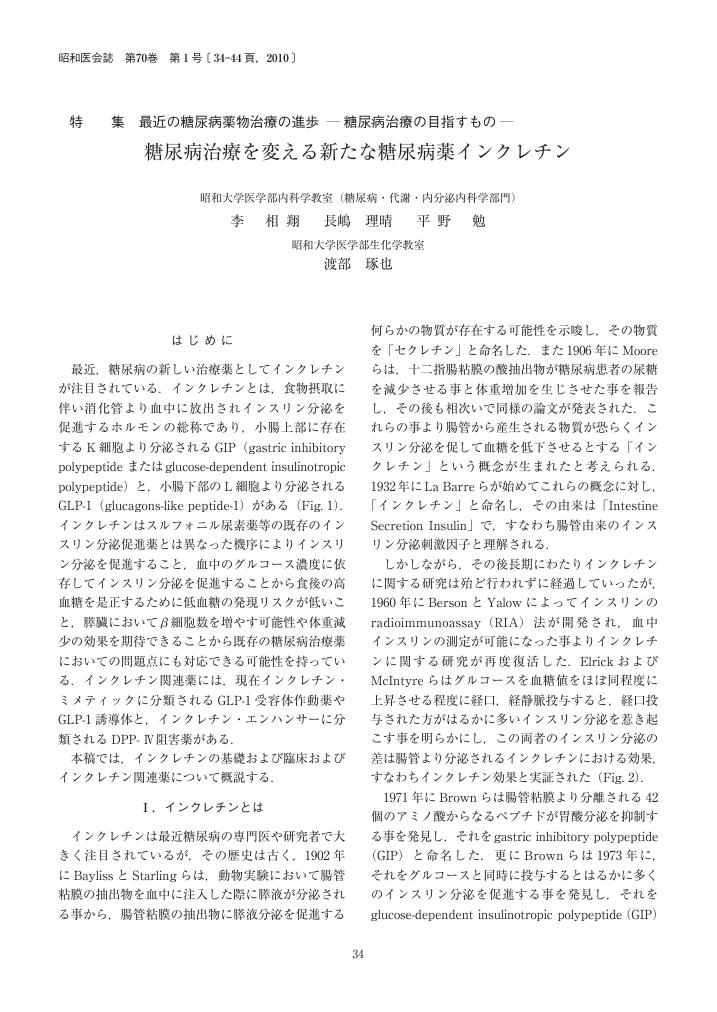
1 0 0 0 OA 糖尿病治療を変える新たな糖尿病薬インクレチン
1 0 0 0 OA 野球の打撃時における視覚探索方略
- 著者
- 竹内 高行 猪俣 公宏
- 出版者
- 日本スポーツ心理学会
- 雑誌
- スポーツ心理学研究 (ISSN:03887014)
- 巻号頁・発行日
- vol.39, no.1, pp.47-59, 2012 (Released:2012-04-27)
- 参考文献数
- 22
- 被引用文献数
- 1 1
The purpose of the present study was to examine visual search strategies employed by batters during a pitcher's pre-release motion. Eye movement, response time, and response accuracy were measured and analyzed while subjects were asked to observe images of pitches thrown by a pitcher edited using spatial occlusion techniques and to press a pushbutton switch when they decided to swing the bat. The results showed that the batters gazed at the pitcher's pitching wrist, elbow, and arm during the final period. When the pitcher's pitching arm was selectively occluded, the response time was significantly delayed compared with when the pitcher's other body parts were occluded. The findings suggest the importance of strategies for acquiring visual cues for batting by watching a pitcher's pitching arm during the final period. When the pitching wrist and wrist plus elbow were selectively presented during the final period, the response time was significantly delayed compared with when the pitcher's pitching wrist plus elbow plus arm, upper body, and lower body were shown. These results indicate that experts set their visual pivot on the pitcher's elbow and predict cues of the pitching arm from the whole pitcher's motion.
1 0 0 0 OA 小森谷山地集落における山域利用と生業形態 : 両神村小森煤川集落を中心として
- 著者
- 原田 洋一郎
- 出版者
- 筑波大学歴史・人類学系歴史地理学研究室
- 雑誌
- 歴史地理学調査報告 (ISSN:09152504)
- 巻号頁・発行日
- no.6, pp.43-56, 1994-03
1 0 0 0 OA 外秩父大野村における信仰の展開
- 著者
- 三木 一彦
- 出版者
- 筑波大学歴史・人類学系歴史地理学研究室
- 雑誌
- 歴史地理学調査報告 (ISSN:09152504)
- 巻号頁・発行日
- no.7, pp.103-116, 1996-03
1 0 0 0 埼玉県秩父市贄川猪狩神社の狼信仰に関する一考察
- 著者
- 西村 敏也
- 出版者
- 東京成徳大学
- 雑誌
- 研究紀要 (ISSN:13403702)
- 巻号頁・発行日
- vol.18, pp.162-153, 2011
1 0 0 0 OA 秩父山間集落の存立基盤とその変質 : 両神村薄を事例として
- 著者
- 六本木 健志 中嶋 則夫 新井 敦史
- 出版者
- 筑波大学歴史・人類学系歴史地理学研究室
- 雑誌
- 歴史地理学調査報告 (ISSN:09152504)
- 巻号頁・発行日
- no.5, pp.53-81, 1991-02