1 0 0 0 OA フェスティバルホール 継承と進化

- 著者
- 小野 茂樹 津村 昌伸
- 出版者
- 一般社団法人 電気設備学会
- 雑誌
- 電気設備学会誌 (ISSN:09100350)
- 巻号頁・発行日
- vol.33, no.12, pp.917-920, 2013-12-10 (Released:2014-09-08)
- 著者
- Ippei KAWASAKI Kuniaki NAGAI Yoshihisa MASUMITSU Kanae SAGAWA Satoshi KONDO
- 出版者
- Japanese Society for Study of Occupation
- 雑誌
- 作業科学研究 (ISSN:18824234)
- 巻号頁・発行日
- vol.16, no.1, pp.55-65, 2022-12-31 (Released:2023-02-01)
- 参考文献数
- 18
Abstract: Background: Due to the COVID-19, many people are forced to restraint from their activities. People who are restricted in their activities can be said to be in a state of occupational deprivation, but it is thought that they might be taking action to keep themselves healthy even in such a blocked situation. The purpose of this study is to determine the differences in coping behaviors between elderly and young in dealing with occupational deprivation, and to show the potential for new health promotion, especially for elderly based on the results. Methods: To explore the state of occupational deprivation among the elderly and the young and their coping behaviors, a questionnaire survey of 89 elderly and 264 young generation was conducted. In the questionnaire, basic attributes of the respondents, self-rated health, things they had stopped doing or reduced the number of times they did, and things they had started doing or increased the number of times due to the COVID-19 were asked. We analyzed the feature of coping behavior under occupational deprivation by the elderly and the young. Results: The coping behaviors were categorized into the following four groups: "loss or decrease of existing occupations," "enhancement of existing occupations," "continuation and maintenance of existing occupations," and "introduction of new occupations". There were no significant differences in self-rated health among the four groups, but there was a trend toward lower self-rated health when comparing "loss or decrease of existing occupations" and the other groups. The elderly tended to engage in outward-looking occupations such as creating social connections online, while the young tended to engage in inward-looking occupations such as familiar household chores and hobby. Conclusion: People had different coping behaviors that tended to vary by generation against occupational deprivation. Using online is already familiar among the elderly, and it is necessary to recognize for those potential they have and develop health promotion activities using ICT technology and other means.
1 0 0 0 OA 皿型高力ボルトを用いた摩擦接合継手のボルト形状及び継手特性に関する解析的検討
- 著者
- 田畑 晶子 金治 英貞 黒野 佳秀 山口 隆司
- 出版者
- 一般社団法人 日本鋼構造協会
- 雑誌
- 鋼構造論文集 (ISSN:18809928)
- 巻号頁・発行日
- vol.20, no.79, pp.79_19-79_28, 2013-09-27 (Released:2014-12-20)
- 参考文献数
- 10
The authors focused on the high strength bolted friction grip joints with countersunk head bolts which can finish the surface of the connection plate flat smoothly and prevent from functional depression due to corrosion. In this study, we carried out FE analysis varying the angle of countersunk head in order to evaluate the contact pressure of double shear connected friction joints with countersunk heads. Also, we have investigated the influence on load transferring mechanism by using countersunk head bolt for frictional joints. It has concluded that the most desirable angle of the countersunk head is 90 degrees. CD series's slip strength is about only 4% lower than that with normal head bolts.
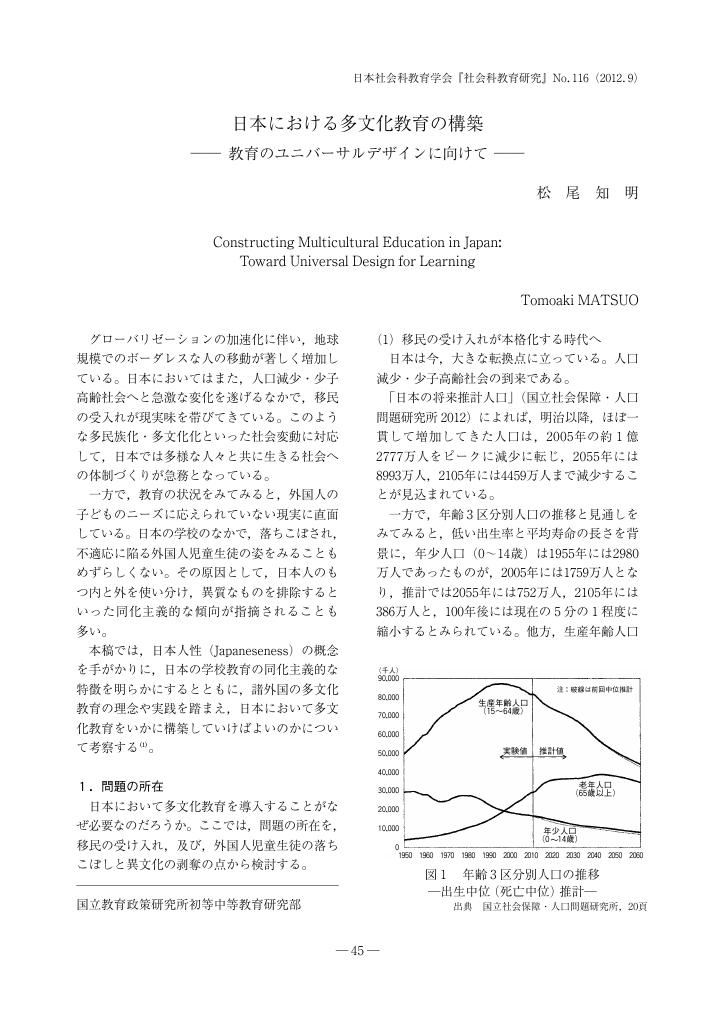
1 0 0 0 OA 日本における多文化教育の構築 教育のユニバーサルデザインに向けて
- 著者
- 松尾 知明
- 出版者
- 日本社会科教育学会
- 雑誌
- 社会科教育研究 (ISSN:09158154)
- 巻号頁・発行日
- vol.2012, no.116, pp.45-56, 2012 (Released:2016-12-01)
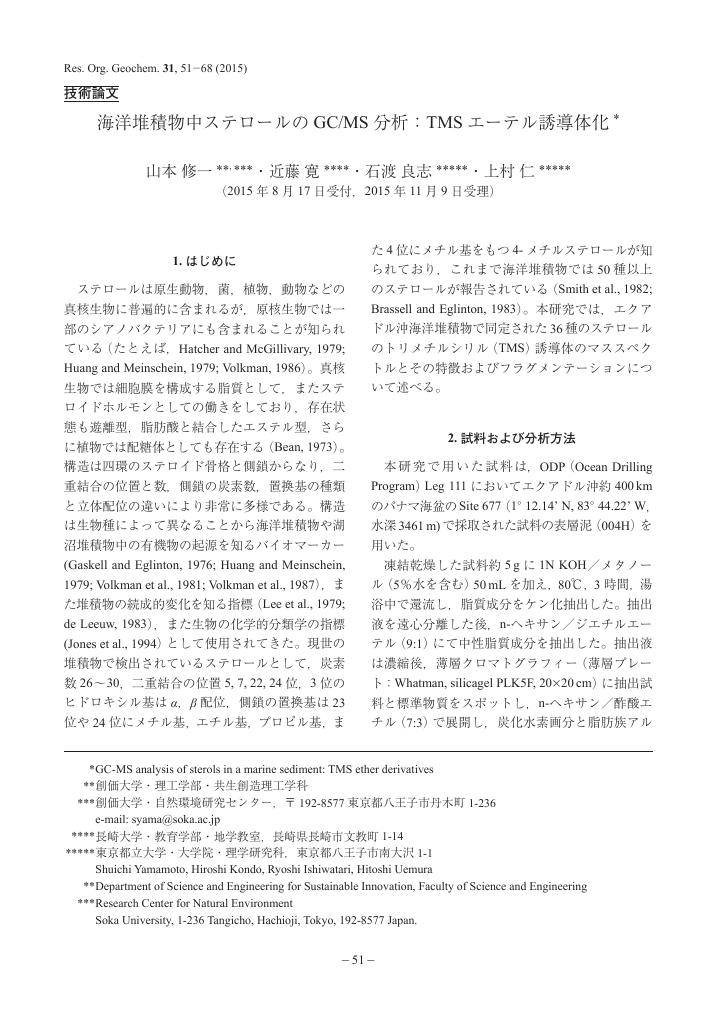
1 0 0 0 OA 海洋堆積物中ステロールのGC/MS 分析:TMS エーテル誘導体化
- 著者
- 山本 修一 近藤 寛 石渡 良志 上村 仁
- 出版者
- 日本有機地球化学会
- 雑誌
- Researches in Organic Geochemistry (ISSN:13449915)
- 巻号頁・発行日
- vol.31, no.2, pp.51-68, 2015-12-30 (Released:2016-11-07)
- 参考文献数
- 27
- 被引用文献数
- 1
1 0 0 0 OA 肺血栓塞栓症による心停止後3時間の蘇生により回復した1症例
- 著者
- 野村 哲也 西良 雅夫 中筋 加恵 澤井 克彦 吉川 範子 立川 茂樹 安宅 啓二
- 出版者
- The Japanese Society of Intensive Care Medicine
- 雑誌
- 日本集中治療医学会雑誌 (ISSN:13407988)
- 巻号頁・発行日
- vol.11, no.3, pp.223-226, 2004-07-01 (Released:2009-03-27)
- 参考文献数
- 10
急性の肺血栓塞栓症を来し心停止となったが,3時間の心肺蘇生法の後に心拍が再開し,ほとんど神経学的欠損なしに回復した症例を経験した。症例は57歳,女性。左股関節再置換術を受けるため,深夜の長距離バスを利用して翌朝に来院,直後に心停止となった。乗車中ほとんど動いていなかった。3時間の胸骨圧迫による心肺蘇生法の後,心拍が再開し意識が回復した。肺動脈近位部の血栓が心臓マッサージにより破砕され,心拍が再開した可能性が考えられた。長時間の心肺蘇生法を行ったが出血所見を認めなかった。肺動脈の血栓を破砕吸引し,血栓溶解療法を行った。その後肺水腫となり,循環も不安定であったが,徐々に改善し人工呼吸器からも離脱できた。上肢にわずかに振戦を認めたのみで独歩退院できた。心肺蘇生法をいつまで行うかについては明確な基準はないが,長時間の心肺蘇生法にもかかわらず神経学的後遺症をほとんど認めなかった症例を経験した。
1 0 0 0 OA ムクドリの調査 第2報 蕃殖(2)
- 著者
- 黒田 長久
- 出版者
- Yamashina Institute for Ornitology
- 雑誌
- 山階鳥類研究所研究報告 (ISSN:00440183)
- 巻号頁・発行日
- vol.1, no.10, pp.413-426, 1957-06-25 (Released:2008-11-10)
- 被引用文献数
- 1 1
This is the summary for the breeding biology of the Grey Starling so far reported in Nos. 9 and 10. In the article in No. 10 the data obtained in 1957 are cited when necessary, but the details will be published elsewhere.The general results are: 1) Commenced from early February, the preparatory period lasted almost a month and half during which the birds acted by pairs staying at nest-site and going out for feeding (within about 800m.). But, the winter flocking was maintained out on the feeding grounds until early April. From March they gradually abandoned the winter roost to sleep at the bamboo thicket of their colony (the spring roost) (but where this is not available the winter roost is maintained). During the egg-laying period, they seemed to roost at each nest-site separately for a short time, but during the incubation and feeding periods one of the pair (possibly the male) or both birds (after chicks are fairy grown) went to the roost, and the fledged young are guided to it by the parents and other adult birds. 2) As shown in the Tables 3, 4 and Figs. 4, 5, it is to be noticed that the first broods are successful by the coincidence of the highest food abundance and availability (of mole-crickets dug out by ploughing) with the chicks' fledging period, but for the second chicks the available foods are mainly small larvae and miscellaneous (Fig. 4) and thus, the parents could not bring enough quantity of food in later broods (cf. Fig. 6 for mal-nutrition of such chicks compared with those of the first brood). This point should be studied in future in the early ploughing districts (and the results of 1957 obtained in different food situation, such as in city zone, will be given in another paper). 3) In the colony, the nest-site territories were noticed (Fig. 7), and the pairs of bad sites or those which failed to get nest-hole spent much time for quarrel or seeking good sites. Such a psychological state prolonged the egg-laying almost 20 days in some cases, and thus, the latest clutches were laid over a month later than the earliest. Good-site nesters were therefore early layers and are possibly old birds, but often suffured competition with others. After flying of the first brood chicks, some nest-boxes were at once utilized by Tree Sparrow (Table 6) and were occasionally reoccupied by the starlings (Table 8a). 4) The nesting for second brood was made after completely taking out wet dirty material of the first brood nest (Table 6.) This was observed on the 2nd and 4th days after leaving of the first brood chicks, and new nests were completed after about 4-8 days, the eggs having been laid on the 5-16th days (Table 8a). 5) Before and during the nesting period there were found some eggs dropped on the ground, crashed on the roof or laid on the bare floor of the nest-boxes, or also under roosting place. This is considered as a case of disorder between the bird's psychological condition and breeding cycle. 6) In the nesting period, the both sexes always act together, and the nest material (chiefly dead bamboo leaves, pine needles and some feathers of domestic fowl) are gathered within the colony, even under nesting trees. 7) Almost all the nest-boxes were quickly occupied by putting in a few material (Gibb's "spurious nest", and may be an expression of the male's nest-owning appetite' (Kortlandt, '55)) which are sometimes taken out or reput, but the nesting advanced very slowly, the period of 24-42 days being roughly divided into three stages as shown in Table 7, and the nest is usually suddenly completed by the 'final stage' in about 4 days. They work hardest in the early morning and only at leisure in the afternoon. Their daily routine is the chain of "stay at nest-site" (nesting or mere inspection and rest) and "off for feeding", the peaks of the latter phase being in the morning and especially in the evening (Table 9 and Fig. 8).

- 出版者
- 日本基礎心理学会
- 雑誌
- 基礎心理学研究 (ISSN:02877651)
- 巻号頁・発行日
- vol.40, no.2, pp.259-274, 2022-03-31 (Released:2022-06-17)
1 0 0 0 IR 南部と前田
- 著者
- 千葉 一大
- 雑誌
- 青山史学 (ISSN:03898407)
- 巻号頁・発行日
- no.35, pp.37-58, 2017
1 0 0 0 OA 所得税の人的控除に関する研究
- 著者
- 田口 方美
- 出版者
- 関西大学経済学会
- 雑誌
- 関西大学経済論集 (ISSN:04497554)
- 巻号頁・発行日
- vol.72, no.3, pp.119-141, 2022-12
本稿の目的は、所得税制の所得控除の中で、人的控除に焦点を当てて、その現状と所得税負担への効果を考察し、今後の所得税制の方向性を探る一助とすることである。人的控除による世帯人員への配慮の考察では、OECD等で用いられている世帯所得の概念を用いる。具体的には、世帯人員の増加に伴う規模の経済を考慮した等価所得(Equivalent income)の概念を用いて、日本の人的控除を世帯人員への考慮という観点から評価する。扶養(世帯)人員に対する人的控除の効果の検証では、第1に人的控除の適用数が減少傾向であること、第2に給与収入ベースでの分析によると、扶養人員が多い給与所得者ほど高い再分配効果を示す負担構造に直面しているという結果になった。そして、第3に等価所得を用いた分析によって扶養人員による負担調整の効果をまとめると以下のようになる。等価所得は、世帯人員の増加による生計費についての規模の経済を考慮して求めるもので、人的控除は所得水準とは無関係に定額で設定されているものであり、所得水準が大きくなるほど所得に対する割合は小さくなる。等価所得を用いた考察から、現行の人的控除制度は、低収入層では扶養人員に対する規模の経済を小さく評価し、高収入層では規模の経済を大きく評価、つまり世帯人員が増えても生計費は増加しないという前提の税負担構造となっていることが示された。
1 0 0 0 OA 海外だより ~ニュージーランドから~

- 著者
- 竹内 信人
- 出版者
- 一般社団法人 日本生物物理学会
- 雑誌
- 生物物理 (ISSN:05824052)
- 巻号頁・発行日
- vol.62, no.6, pp.374-375, 2022 (Released:2023-01-25)
- 参考文献数
- 2
1 0 0 0 OA 病原細菌のIV型分泌系
- 著者
- 永井 宏樹
- 出版者
- 日本細菌学会
- 雑誌
- 日本細菌学雑誌 (ISSN:00214930)
- 巻号頁・発行日
- vol.65, no.4, pp.379-386, 2010 (Released:2010-12-25)
- 参考文献数
- 59
病原細菌がヒトを初めとする宿主に病気を引き起こすためには,細菌から宿主細胞へ輸送される病原因子群と,そのための輸送システムが中心的な役割を果たす。そのような輸送システムのうち,毒素分泌・エフェクター輸送の両方に関わるIV型分泌系の研究は,近年飛躍的な進展を遂げている。本稿では,IV型分泌研究の最前線を紹介させていただきたい。
1 0 0 0 OA 終わらない宥和政策 -1939年イギリス外交を中心に-
- 著者
- 遠藤 紳一郎
- 出版者
- 早稲田大学総合研究機構
- 雑誌
- プロジェクト研究 (ISSN:18809553)
- 巻号頁・発行日
- vol.14, pp.1-14, 2020-03
1 0 0 0 OA 自由民主党の党首選出手続きルールと派閥権力

- 著者
- 田中 善一郎
- 出版者
- JAPANESE POLITICAL SCIENCE ASSOCIATION
- 雑誌
- 年報政治学 (ISSN:05494192)
- 巻号頁・発行日
- vol.36, pp.1-33, 1986-03-28 (Released:2009-12-21)
1 0 0 0 OA キャリアデザイン談話室(14) プランド・ハップンスタンス理論のすすめ

- 著者
- 石谷 隆一郎
- 出版者
- 一般社団法人 日本生物物理学会
- 雑誌
- 生物物理 (ISSN:05824052)
- 巻号頁・発行日
- vol.62, no.6, pp.367-369, 2022 (Released:2023-01-25)
- 参考文献数
- 6
1 0 0 0 OA ものづくりの最前線 ―ゼネコンの使命と魅力―
- 著者
- 清水 穂高 冨森 淳
- 出版者
- 公益社団法人 農業農村工学会
- 雑誌
- 農業農村工学会誌 (ISSN:18822770)
- 巻号頁・発行日
- vol.85, no.8, pp.733-734,a2, 2017 (Released:2021-01-14)
農業農村工学(農業土木)を専攻されている大学生,または大学進学を控えて学部学科を検討中の高校生の皆さんに,ゼネコンの仕事の概要と魅力を紹介するとともに,建設業を取り巻く環境の変化に対し求められるイノベーションについて述べる。一般的な製造業との決定的な違いは「単品受注生産」という特性であり,1つとして同じものはない構造物を,数々の創意工夫と技術力で造り上げるのがこの仕事の面白さである。建設マーケットの変化,人口減少社会の到来,働き方改革など,外部環境の変化に柔軟に対応しながら,10年,20年先を見据えた新たな一手を打つ必要がある。培った知識や経験に新しい発想や新技術を加えて価値を創造し,ものづくりの最前線で社会に貢献する建設業を知っていただきたい。
1 0 0 0 OA 鉄筋コンクリートの歴史・エネルギー施設 (ガス)

- 著者
- 頼 千元
- 出版者
- Japan Society of Civil Engineers
- 雑誌
- 土木学会論文集 (ISSN:02897806)
- 巻号頁・発行日
- vol.1991, no.433, pp.19-25, 1991-08-20 (Released:2010-08-24)
- 被引用文献数
- 1
1 0 0 0 OA 最近のエネルギー貯槽関連事故報告

- 著者
- 吉田 聖一
- 出版者
- 一般社団法人 日本高圧力技術協会
- 雑誌
- 圧力技術 (ISSN:03870154)
- 巻号頁・発行日
- vol.49, no.5, pp.232-240, 2011-09-25 (Released:2012-09-25)
- 参考文献数
- 6
- 被引用文献数
- 13
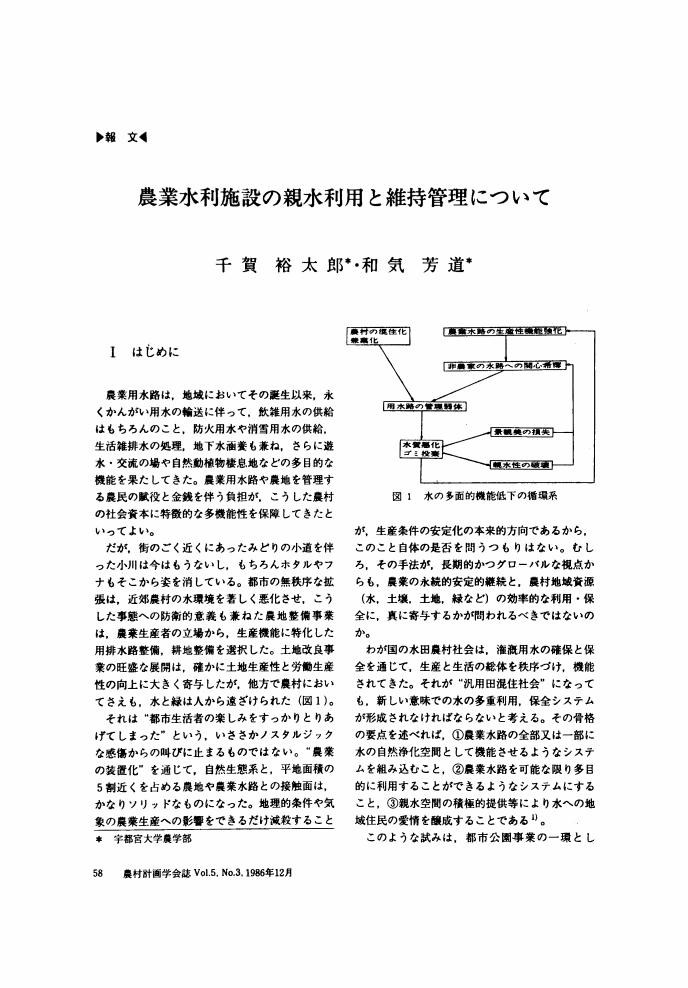
1 0 0 0 OA 農業水利施設の親水利用と維持管理について
- 著者
- 千賀 裕太郎 和気 芳道
- 出版者
- THE ASSOCIATION OF RURAL PLANNING
- 雑誌
- 農村計画学会誌 (ISSN:09129731)
- 巻号頁・発行日
- vol.5, no.3, pp.58-68,75, 1986-12-30 (Released:2011-04-13)
- 参考文献数
- 6

- 著者
- 椎名 乾平
- 出版者
- 心理学評論刊行会
- 雑誌
- 心理学評論 (ISSN:03861058)
- 巻号頁・発行日
- vol.32, no.4, pp.370-386, 1989 (Released:2019-07-24)