3 0 0 0 OA バセドウ病に対する甲状腺亜全摘出術の成績
- 著者
- 山本 浩孝 児嶋 剛 岡上 雄介 大槻 周也 長谷部 孝毅 柚木 稜平 堀 龍介
- 出版者
- 公益財団法人 天理よろづ相談所 医学研究所
- 雑誌
- 天理医学紀要 (ISSN:13441817)
- 巻号頁・発行日
- vol.24, no.1, pp.37-43, 2021-12-25 (Released:2021-07-01)
- 参考文献数
- 26
背景:バセドウ病に対する甲状腺亜全摘出術は,バセドウ病の再発のリスクはあるものの,甲状腺機能の正常化が期待でき,その場合は術後抗甲状腺製剤,LT4製剤などの薬物の内服なしで寛解を持続させることができる.近年,再発を確実に回避することを意図して甲状腺全摘出術や甲状腺準全摘出術が推奨されているが,全摘出術は術後甲状腺機能低下が必発であり,LT4製剤を内服しなければならない.当科でのバセドウ病に対する甲状腺亜全摘出術は,2002年よりその術式を甲状腺両葉の亜全摘出術(以下両側亜全摘術)から甲状腺片葉切除と他葉の亜全摘出術であるHartley-Dunhill法 (以下Dunhill法) に変更した.Dunhill法では甲状腺片葉しか残っていないため, バセドウ病が再発し再手術が必要となった場合でも,片側のみの手術のため両側反回神経麻痺などの合併症リスクを低減することが可能である.今回,当科で施行した甲状腺亜全摘術の成績を報告する.方法:1997年から2019年までの22年間に甲状腺亜全摘出術を行い,術後6か月以上経過観察が可能であった128例について術後甲状腺機能を評価した.結果:51例に両側亜全摘術,77例にDunhill法を施行した.Dunhill法は両側亜全摘術よりも手術時間が短く,出血量が少なかった.両手術間で合併症や再発率に有意差は認めなかった.術後,最終観察時の甲状腺機能は,機能亢進17例,寛解27例,機能低下84例であった.甲状腺の残置量で再発率に有意差は認めなかった.再発した17例のうち3例に再手術を行ったが,術後に有意な合併症なく,現時点まで再々発なく経過している.結論:当科の過去22年間の甲状腺亜全摘出術の成績を報告した.甲状腺亜全摘出術は甲状腺機能を寛解できる可能性があるものの再発を完全に防止することは難しい.バセドウ病の手術としては甲状腺全摘出術が第一選択であるが,患者背景を鑑みて寛解を目指す甲状腺亜全摘出術を行うこともあり,その場合,初回手術をDunhill法とすることで,再発した際でも再手術を安全に行うことが可能である.
3 0 0 0 OA 食品の味わいと味覚・嗅覚

- 著者
- 小早川 達 後藤 なおみ
- 出版者
- 一般社団法人 日本調理科学会
- 雑誌
- 日本調理科学会誌 (ISSN:13411535)
- 巻号頁・発行日
- vol.48, no.3, pp.175-179, 2015 (Released:2015-07-06)
- 参考文献数
- 17
- 被引用文献数
- 1
3 0 0 0 OA 脳内低酸素とあくび反応

- 著者
- 北 一郎 有田 秀穂
- 出版者
- 日本比較生理生化学会
- 雑誌
- 比較生理生化学 (ISSN:09163786)
- 巻号頁・発行日
- vol.18, no.2, pp.96-101, 2001-08-31 (Released:2011-03-14)
- 参考文献数
- 42
- 著者
- YULIHASTIN Erma HADI Tri Wahyu ABDILLAH Muhammad Rais FAUZIAH Irineu Rakhmah NINGSIH Nining Sari
- 出版者
- Meteorological Society of Japan
- 雑誌
- 気象集誌. 第2輯 (ISSN:00261165)
- 巻号頁・発行日
- pp.2022-005, (Released:2021-10-04)
- 被引用文献数
- 7
Early morning precipitation (EMP) events occur most frequently during January and February over the northern coast of West Java and are characterized by propagating systems originating from both inland and offshore. The initial location, direction, and speed of the propagating precipitating system determine the timing of EMP. This study explores processes that characterize such propagating precipitation systems by performing composite analysis and real-case numerical simulations of selected events using the Weather and Research Forecasting (WRF) model with a cloud-permitting horizontal resolution of 3 km. In the composite analysis, EMP events are classified according to the strength of the northerly background wind (VBG), defined as the 925-hPa meridional wind averaged over an area covering western Java and the adjacent sea. We find that under both strong northerly (SN) and weak northerly (WN) wind conditions, EMP is mainly induced by a precipitation system that propagates from sea to land. For WN cases, however, precipitating systems that propagate from inland areas to the sea also play a role. The WRF simulations suggest that mechanisms akin to cold pool propagation and advection by prevailing winds are responsible for the propagating convection that induces EMP, which also explains the dependence of EMP frequency on the strength of VBG. Based on the WRF simulations, we also discuss the roles of sea breeze and gravity waves in the initiation of convection.
3 0 0 0 OA 私服と制服着用勤務における大学職員の作業効率や心理の違いならびに他者からの印象評価
- 著者
- 庄山 茂子 御領園 沙紀 加來 卯子 栃原 裕
- 出版者
- 一般社団法人 日本繊維製品消費科学会
- 雑誌
- 繊維製品消費科学 (ISSN:00372072)
- 巻号頁・発行日
- vol.60, no.11, pp.1025-1034, 2019-11-25 (Released:2019-11-25)
- 参考文献数
- 15
私服を着用して勤務する大学の女性職員24 名に制服を着用して勤務してもらい,私服着用時と制服着用時で,作業効率や仕事時の状況,職場のチームワークにどのような違いがみられるか調査 した.さらに,同大学の女子学生86 名を対象に私服着用時と制服着用時の事務職員の印象について調査し,次の結果を得た. (1)指定された3 文字を検索する検索問題では,文字検索数は制服着用時の方が私服着用時より有意に多かった. (2)仕事時の状況については,制服着用時の方が私服着用時より緊張感が有意に高く,私服着用時の方が制服着用時よりも有意に動きやすく違和感がないと評価された.チームワークに関して,私服着用時と制服着用時に有意な差はみられなかった. (3)学生による評価では,制服着用時は私服着用時より「信頼性・外見のよさ」の評価が有意に高かった.
3 0 0 0 OA 医学教育における学習者の評価(1) 総論
- 著者
- 田川 まさみ 西城 卓也
- 出版者
- 日本医学教育学会
- 雑誌
- 医学教育 (ISSN:03869644)
- 巻号頁・発行日
- vol.44, no.5, pp.345-357, 2013-10-25 (Released:2015-07-06)
- 参考文献数
- 37
- 被引用文献数
- 3
本稿では,学習者の評価の計画と実施に関する基礎的事項を概論する.●学習者中心のアウトカム基盤型教育が重要視される医学教育では,個々の学習者を支援する形成的評価とプログラム修了,資格認定における「必要な能力コンピテンシー」の評価が重要である.●測定して得られたデータを受験生の能力として一般化する過程が評価であり,一般化できることが良い評価の特性である.妥当性の高い試験を実施するために信頼性や評価の影響を含む妥当性の根拠を検証する.●目的に応じた妥当性の高い評価を実施するために,計画,運営,集計と判定,利用,改善を行う.
3 0 0 0 OA Acute Exacerbation of Idiopathic Pulmonary Fibrosis after Pandemic Influenza A (H1N1) Vaccination
- 著者
- Yukihiro Umeda Miwa Morikawa Masaki Anzai Yasuyuki Sumida Maiko Kadowaki Shingo Ameshima Takeshi Ishizaki
- 出版者
- The Japanese Society of Internal Medicine
- 雑誌
- Internal Medicine (ISSN:09182918)
- 巻号頁・発行日
- vol.49, no.21, pp.2333-2336, 2010 (Released:2010-11-01)
- 参考文献数
- 14
- 被引用文献数
- 15 34
We report a case of acute exacerbation of idiopathic pulmonary fibrosis (AE-IPF) after pandemic influenza (H1N1) vaccination. A 57-year-old man, who had been diagnosed with IPF in September 2008, was admitted to our hospital in December 2009 because of aggravation of dyspnea and fever two days after H1N1 vaccination. Chest computed tomography showed diffuse bilateral ground-glass opacities superimposed on preceding reticular opacities. We diagnosed AE-IPF. Corticosteroid and cyclophosphamide were effective. Although the efficacy of influenza vaccination in patients with chronic lung diseases is well established, physicians should keep in mind that influenza vaccination has the potential to cause AE-IPF.
3 0 0 0 OA 金洛年著『日本帝国主義下の朝鮮経済』

- 著者
- 岩本 卓也
- 出版者
- 一般財団法人 アジア政経学会
- 雑誌
- アジア研究 (ISSN:00449237)
- 巻号頁・発行日
- vol.50, no.4, pp.98-102, 2004 (Released:2014-09-15)
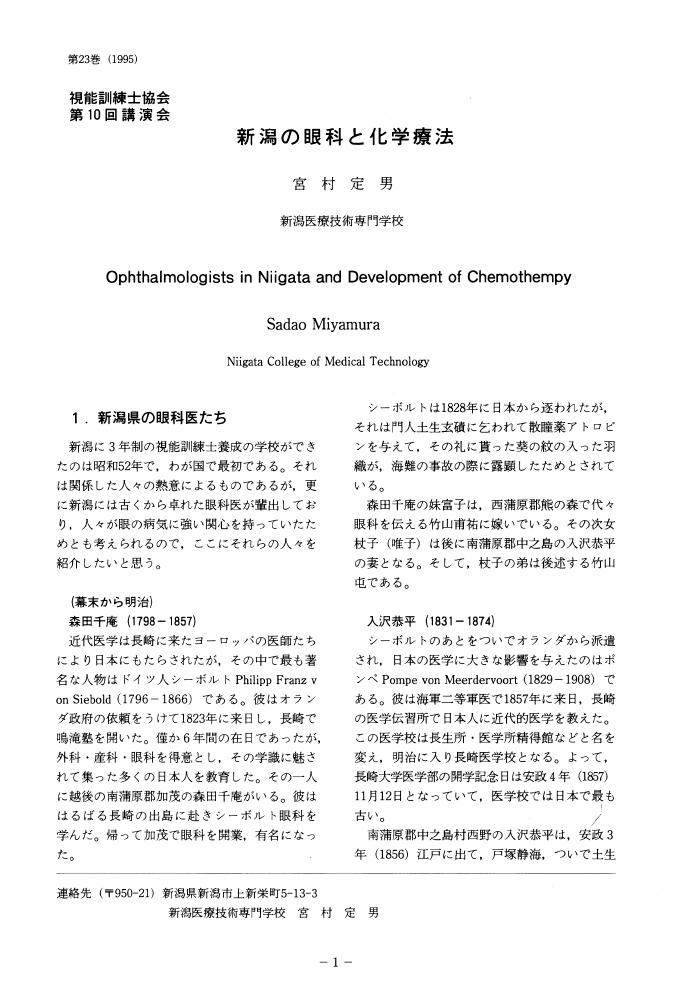
3 0 0 0 OA 新潟の眼科と化学療法
- 著者
- 宮村 定男
- 出版者
- JAPANESE ASSOCIATION OF CERTIFIED ORTHOPTISTS
- 雑誌
- 日本視能訓練士協会誌 (ISSN:03875172)
- 巻号頁・発行日
- vol.23, pp.1-9, 1995-08-31 (Released:2009-10-29)
- 参考文献数
- 4
3 0 0 0 OA 小牧実繁の「日本地政学」とその思想的確立―個人史的側面に注目して―
- 著者
- 柴田 陽一
- 出版者
- 一般社団法人 人文地理学会
- 雑誌
- 人文地理 (ISSN:00187216)
- 巻号頁・発行日
- vol.58, no.1, pp.1-19, 2006 (Released:2018-01-06)
- 参考文献数
- 143
- 被引用文献数
- 2 5
The purpose of this paper is to examine the ideological establishment of the geopolitics of Saneshige Komaki (1898-1990), who was a Professor of Geography at Kyoto Imperial University, and a well-known advocate of “Japanese Geopolitics” during World War 2, and accordingly a remarkable figure in the history of Japanese geography. Approaching this subject biobibliographically, I focus on the personal background of Komaki. Using his own bibliography, and through an analysis of his written works, I trace the development of his thought. To begin with, I demonstrate the ideological background of Komaki’s geopolitics. Komaki had a great antipathy toward Western imperialism. In addition, immigration issues closely related to racial discrimination were his great concern. He held the view that geography in those days had lost its social relevance, and that the nature and culture of each land should be maintained under an indigenous order. Next, I examine the ideological composition of Komaki’s geopolitics. His geopolitics began before the outbreak of the Sino-Japanese War in July 1937. He asserted that “Japanese Geopolitics” was indigenous and one which attaches importance to the autonomy of Japan, after he had criticized the history of Western exploration, conventional geography, and Geopolitik. His geopolitics tried to clarify what was destroyed by Western colonization and had an historico-geographical and irrational character. Lastly, I point out some of the positive and negative aspects of his geopolitics. The social relevance of geography, his criticism of Western colonialism and the issue of positionality in research can be seen the light of Japan at that time. On the other hand, the lack of an attitude to relativize Japan and the subjective/intuitive judgement in the reasoning process were negative aspects. However, the positive and negative are not clearly divided. “Japanese Geopolitics” has suggested important issues in connection with the political nature and the social relevance of geography and geographical knowledge, although it served to justify the aggressive wars of the Japanese Empire.
3 0 0 0 OA 2021 DAPCON産業賞 受賞者発表会講評
- 著者
- 高野 明彦
- 出版者
- デジタルアーカイブ学会
- 雑誌
- デジタルアーカイブ学会誌 (ISSN:24329762)
- 巻号頁・発行日
- vol.6, no.1, pp.61-64, 2022-02-01 (Released:2022-03-22)
- 参考文献数
- 10
3 0 0 0 OA 誰のための予防理学療法なのか
- 著者
- 島田 裕之
- 出版者
- 一般社団法人 日本予防理学療法学会
- 雑誌
- 日本予防理学療法学会雑誌 (ISSN:24369950)
- 巻号頁・発行日
- vol.1, pp.1, 2022 (Released:2022-03-22)
3 0 0 0 OA ハティニ虐殺とベラルーシにおける戦争の記憶

- 著者
- 越野 剛
- 出版者
- 地域研究コンソーシアム
- 雑誌
- 地域研究 (ISSN:24337358)
- 巻号頁・発行日
- vol.14, no.2, pp.75-91, 2014 (Released:2021-11-30)
- 参考文献数
- 16
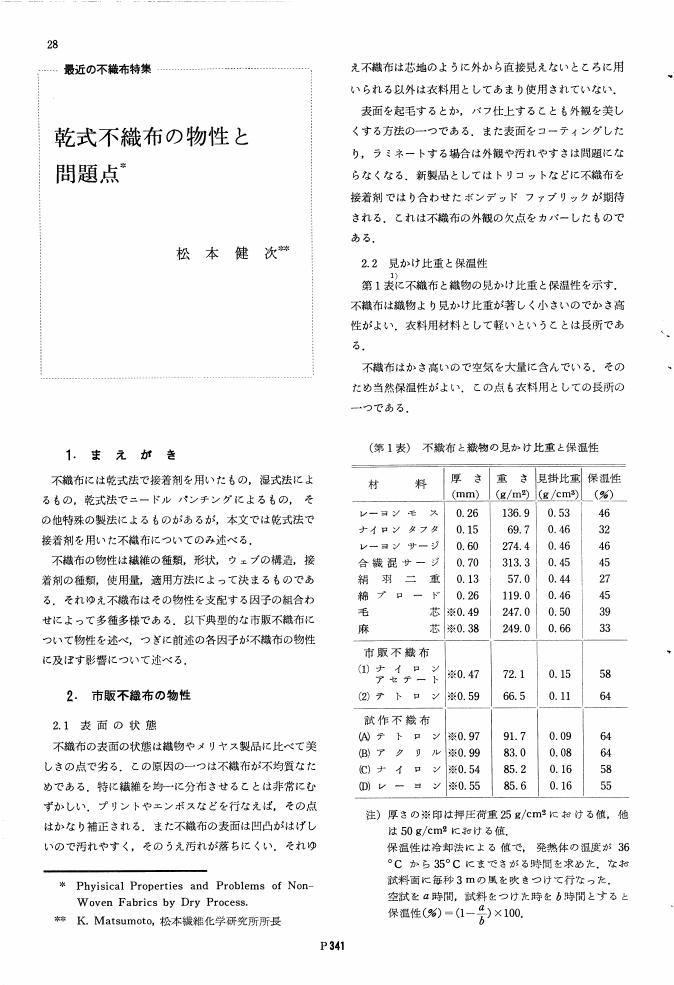
3 0 0 0 OA 乾式不織布の物性と問題点
- 著者
- 松本 健次
- 出版者
- 社団法人 日本繊維機械学会
- 雑誌
- 繊維工学 (ISSN:18838731)
- 巻号頁・発行日
- vol.19, no.5, pp.P341-P347, 1966-05-20 (Released:2010-09-27)
- 参考文献数
- 14
3 0 0 0 OA 地名・場所・場所イメージ
- 著者
- 内田 順文
- 出版者
- The Human Geographical Society of Japan
- 雑誌
- 人文地理 (ISSN:00187216)
- 巻号頁・発行日
- vol.39, no.5, pp.391-405, 1987-10-28 (Released:2009-04-28)
- 参考文献数
- 49
- 被引用文献数
- 16 5
In this paper the term place image is used in its broadest sense to mean all kinds of mental imagery related to a certain place. The recognition of a place is to relate place images with that place. The author defines the idea which arises from this recognition a place. The concept of place implies' both existing space (place) and the image for this place. Therefore every life has this concept of place.In human society, a place name existing as a sign indicates a particular place. We can recognize in this a symbolic relation between place name as significant and place as signifie. As the symbolic relation once accepted as a social norm is passed on in the social group, in mature and complicated societies, most places alreaday have place names and the society's members must learn the symbolic relations.To recognize a place indicated by a place name is to have an image for that place. Therefore a place name not only represents a place as a part of space but causes recognition of place by connecting it with a personal place image. Now places and place names are given a variety of meanings and values by the personal place image, so we can understand the relation between man and place, and explain human behaviour by decoding these meanings. We could deal with this as a problem of interpretation of places.Although each member of the social group has a personal place image for a given place and place name, there is a commonly held part in each place image. As a result of decoding the relation between place, place name and place image, we can communicate a common place image to each other by use of that place name. Such social place images intensify regulation by repeated use in the society. The author calls this process symbolization of place images. We use this social place image in communicating on a social level.In Japan, place images symbolized on a national level are seen frequently and are most important. Some examples of places influenced by such symbolization are as follows:1. Artists often make better use of existing place images in their works for communication with their audience. On the other hand, it sometimes happens that the personal place images of artists get symbolized socially through expression in their works.2. The images of places having a figurative relation to each other can be placed in a certain system and are apt to be symbolized because of the connection of images intensitied by the association.3. Place image often produces economic values, for example a rise in land prices or an increase in the number of tourists, by connecting with ideas having social values.4. Once the symbolization of a place name and place image is formed, the relation is not easily broken. Therefore when there is a gap between actural conditions and the symbolized place image, it no longer represents the true content.
3 0 0 0 OA 事実確認と真実検証ー情報・通信メディアの規制とルール(2)ー
- 著者
- 仲佐 秀雄
- 出版者
- 山梨英和学院 山梨英和大学
- 雑誌
- 山梨英和短期大学紀要 (ISSN:02862360)
- 巻号頁・発行日
- vol.29, pp.114-102, 1995-12-10 (Released:2020-07-20)
前号所載の「情報・通信メディアの規制とルール」に引き続き、その各論の一つとして、情報発信の「真実性」確保を採り上げた。この点について新聞では自律的倫理に委ねられているが、放送では「報道は事実をまげないですること」などの法規制があること。過去の誤報事例や最近のオウム報道における捜査中間情報の「確認」のありようなどを通じ、報道組織体の中の「コンプアメーション」のシステムについて検討を行った。
3 0 0 0 OA [講演 1] デジタルアーカイブ学会第6回研究大会 in 仙台第2部
- 著者
- 今村 文彦
- 出版者
- デジタルアーカイブ学会
- 雑誌
- デジタルアーカイブ学会誌 (ISSN:24329762)
- 巻号頁・発行日
- vol.6, no.1, pp.2a-3a, 2022-02-01 (Released:2022-03-22)
3 0 0 0 OA 中国における民族自治地方の設立過程と展開
- 著者
- 松村 嘉久
- 出版者
- The Human Geographical Society of Japan
- 雑誌
- 人文地理 (ISSN:00187216)
- 巻号頁・発行日
- vol.49, no.4, pp.331-352, 1997-08-28 (Released:2009-04-28)
- 参考文献数
- 62
- 被引用文献数
- 2 2
There are two main processes underlying the formation of a nation-state. First is the process of state-building, which has been related to the territorialization of state hegemony. Second is the process of nation-building, which is linked with the creation of a citizenry. In October 1949, when the Chinese Communist Party (CCP) came into power, the influence of the CCP in frontier areas occupied by minority nationalities was quite limited. Such areas formed a kind of buffer zone, where the interests of local ethnic minorities, the former Guomindang government, and various foreign powers all lay in competition. Following the establishment of the Inner Mongolian Autonomous Region in 1947 the CCP produced a state-building plan known as the Regional Autonomy System for Minority Nationalities (RAS), with the purpose of integrating frontier areas into the territory under the direct power of the CCP. The purpose of this study is to elucidate the development of the Autonomy Policy of the CCP, paying special attention to the formation of Chinese state building in the 1950s.In the second section of this study the development and present state of Nationality Autonomous Areas (NAA) is examined from a historical perspective. During the period 1947-1958 four autonomous regions, twenty-eight autonomous prefectures, and fifty-three autonomous counties were established. In the 1960s and 1970s, when the ethnic policy of the CCP had been largely rejected under the influence of the Great Leap Forward and the Great Proletarian Cultural Revolution, only the Tibet autonomous region and ten autonomous counties were established. Afterwards, the number of autonomous counties increased rapidly following enforcement of the Law on Regional Autonomy for Minority Nationalities in 1984. Evidence is brought to light, however, to suggest that several NAAs said to have been established after 1959 were set up in the 1950s. In fact, the structure of the present administrative organization in almost all Chinese minority areas, with the only exceptions of the Tuija and the Man nationalities, were formulated in the 1950s. This is considered to be the decisive period in which the CCP government created a nation-state.The third section of this paper explains how, in the first half of the 1950s, Nationality Autonomous Regions (NAR) and Nationality Democratic United Governments (NDUG) were set up as predecessors of NAAs. The CCP dispatched missions to three regions with minority groups which, in the South-West and the Middle-South, resulted in the establishment of a large number of NAR and NDUGs. In the South-West region in particular, eighty-five NARs and 163 NDUGs had been set up by the end of 1951 (with a view to their importance for national defence), although formal enactment was not carried out until August, 1952.Administrative reorganization of these districts in the second half of the 1950s is discussed in section four of this paper. The Chinese Constitution of 1954 provided for a new administrative order, with NAR and NDUGs to be replaced by NAAs comprising autonomous regions, autonomous prefectures, and autonomous counties. Three policies for reorganization, announced officially at the end of 1954, clarified the complementarity of these districts with one another and introduced certain reforms. RAS policies after 1958 are also discussed briefly in this section.The final section investigates whether or not RAS policies have been applied equally to all the main nationality minorities, using data from the 1990 Census of Minority Nationalities. The political and administrative conditions of minority nationalities are classified into six categories according to the number of autonomous areas for each minority nationality and the percentage share of total population occupied by these groups. The results indicate that minority nationalities are not always treated equally by the CCP.
3 0 0 0 OA 「世直し」とミロク信仰 : 日本における「世直し」の民俗的意味
- 著者
- 宮田 登
- 出版者
- 日本文化人類学会
- 雑誌
- 民族學研究 (ISSN:24240508)
- 巻号頁・発行日
- vol.33, no.1, pp.32-44, 1968-06-30 (Released:2018-03-27)
The purpose of this article is to analyse several types of renewal concepts of the Japanese folk. (1) In the harvest festivals on Yaeyama island, Okinawa, we can discern orgy elements. At these festivals which may be called rituals for yearly renewal, people enthusiastically enter into fertility dances for the coming new year, expressed as "the year of the Miroku", that is, the year in which the utopian world begins with the appearance of the Miroku (a visiting deity). We can find the same elements in the scenes of "the Okageodori" and "Eejanaika" which were recorded in documents of the Edo period. This is one type of renewal concept which was based on agrarian rites. (2) The rites which ward off the world full of evil spirits and welcome the new world, are found in the practices of "Torikoshisyogatsu" in various parts of Japan. These practices have functional force in facilitating the coming of the new year by repeating the new year festivals within the course of the year. In the middle of the Edo period there occurred several Miroku years and in the turbulent Middle Ages "the year of the Miroku" occurred quite frequently, especially in the Kanto district. In this district people warded off evil spirits at the Kashima shrine (Ibaragi prefecture), and hoped or believed that the fertile world of Mioku came from Kashima. In the Kashimaodori and Mirokuodori dances which are still held as divine services, these ideas are expressed ritually. This is another type of renewal concept, by which evil spirits are warded off and the world is purified and cleansed. (3) In Japan renewal through fanatic eschatological concepts did not exist. But the lower classes thought that earthquakes or floods signified renewal because in such disasters people could expect assistance from the authorities People thought that the causes of earthquakes were as follows: the occasion on which the Kashima deity ordinarily presses down upon the sheatfish with a secret stone (Kanameishi), thus causing the earthquake (i. e, reform), sometimes, however, the sheatfish appears as a servant of the gods who revolts against the god of Kashima, changing the earth's axis and bringing catastrophe upon the world.
3 0 0 0 OA 第1回研究者訪問 東亜大学 崔吉城教授

- 著者
- 崔 吉城 上水流 久彦
- 出版者
- 日本文化人類学会
- 雑誌
- 文化人類学 (ISSN:13490648)
- 巻号頁・発行日
- vol.81, no.1, pp.108-115, 2016 (Released:2017-10-16)